



Security Vulnerabilities  security advisory zero-day
security advisory zero-day CISA added CVE-2026-11645 to its Known Exploited Vulnerabilities catalog after Google confirmed active exploitation of the flaw. The bug sits in V8, the JavaScript engine behind Chrome and Chromium. . That's where this gets more interesting. Most coverage will focus on Chrome because that's where the patch landed. But the affected component is V8. Chromium relies on it. Electron relies on it. Plenty of desktop software Linux users interact with every day relies on it too, often without much...
 Jun 10, 2026

Network Securitysecurity advisory networking
security advisory networking For years, IPv4 was the only proxy type that really mattered for anyone running automation off a Linux box. IPv6 was the protocol everyone said they’d migrate to, but almost nobody actually did. In 2026, that’s finally starting to shift. . The problem is that most admins stick with IPv4 out of habit. They know it; it’s what their tooling defaults to, and they don’t see a reason to change. Some are overpaying for addresses they don’t need. Others would quietly break their scrapers, scripts, or...
Jun 09, 2026

Network Securityopen-source python
open-source python Researchers recently identified another wave of malicious packages on PyPI linked to the broader Mini Shai-Hulud campaign, a worm-like supply chain attack that spread through trusted software packages. On the surface, the packages looked no different from thousands of others published to the repository each week. . Instead of trying to break into a target network directly, the attackers hid malicious code inside software that developers were already using. A few downloads are all it takes....
Jun 09, 2026
Security Vulnerabilities malware linux
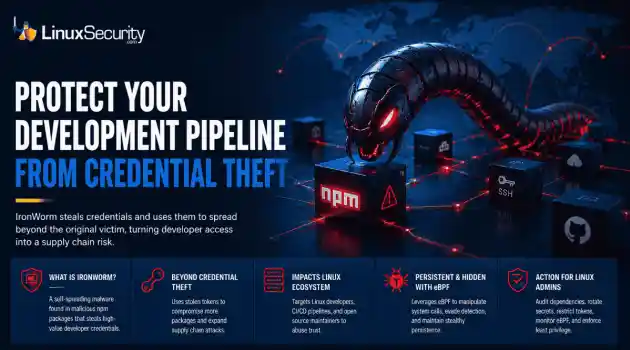
malware linux IronWorm steals credentials and uses them to spread beyond the original victim, turning developer access into a supply chain risk. . A new campaign targeting npm has evolved past simple credential theft. Researchers identified IronWorm, a self-spreading threat. It harvests high-value Linux development secrets—SSH keys, cloud tokens, package publishing credentials. One compromised workstation becomes a launchpad for downstream supply chain attacks. This is not a get-in-and-get-out operation....
Jun 08, 2026

Network Securitysystem security Linux network
system security Linux network The romanticized image of the digital nomad – a laptop on a sun-drenched balcony – rarely accounts for the actual friction of maintaining a professional development environment on the move. . The friction is amplified with Linux. We are looking for a setup that respects our kernel configurations, handles volatile network handovers, and maintains a strict security posture without the hand-holding of a consumer-grade OS – so, put simply, more than just a laptop and a sunny deck. The hardware is...
May 26, 2026
 Refine news
X Clear Filters
Get the latest News and Insights
Get the latest Linux and open source security news straight to your inbox.
Community Poll
What got you started with Linux?
Loading...

Explore Latest Linux Security news
We found -4 articles for you...
82
 data transmissionipv6internet protocol
DOD Mandates IPv6 Transition for Enhanced Internet Address Capacity
The next version of the Internet Protocol, which provides a 128-bit standard to transmit data, is getting a jump-start for adoption with its endorsement by the Department of Defense. The result: A boost in the number of available Internet addresses, to . . . . The next version of the Internet Protocol, which provides a 128-bit standard to transmit data, is getting a jump-start for adoption with its endorsement by the Department of Defense. The result: A boost in the number of available Internet addresses, to eventually number as many as an address for every cell in every person on the planet. The DOD is requiring all contractors involved in its Global Information Grid program to support the new Internet Protocol version 6 as of October 1, 2003. IPv6 is expected to replace the current 32-bit IP version 4 (IPv4) for nearly all Internet traffic by 2008. The replacement is necessary because the number of available of IP addresses is dwindling, say the standard's developers. The Internet Engineering Task Force has warned since the mid-1990s that we're running out of available Internet addresses. Already, 170 billion of the 250 billion Internet nodes available under IPv4 are in use, says Latif Ladid, IPv6 Forum president. The link for this article located at PCWorld is no longer available. . The upcoming Internet Protocol, supported by the DOD, seeks to supersede IPv4, providing enhanced address space and improved data transfer capabilities.. IPv6 Adoption, DOD Requirement, Enhanced Internet Protocol, Next-Gen Address Capacity, Data Transmission Standards. . Anthony Pell
 Jul 02, 2003
•
Jul 02, 2003
• Government

Get the latest News and Insights
Get the latest Linux and open source security news straight to your inbox.
Community Poll
What got you started with Linux?
Search Topics
Powered By

Linux Security - Your source for Top Linux News, Advisories, HOWTOs and Feature Releases
QUICK LINKS
subscribe to newsletters!
Like staying secure? So do we.
Sign up for updates, tips, and alerts!
Discover faster search, smarter navigation, and deeper Linux security insights. Read More