


Security Vulnerabilities  security advisory zero-day
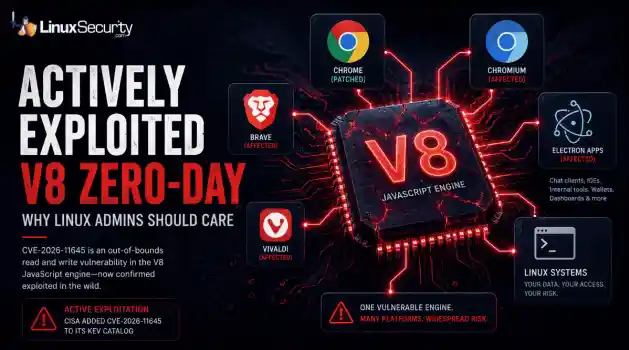
security advisory zero-day CISA added CVE-2026-11645 to its Known Exploited Vulnerabilities catalog after Google confirmed active exploitation of the flaw. The bug sits in V8, the JavaScript engine behind Chrome and Chromium. . That's where this gets more interesting. Most coverage will focus on Chrome because that's where the patch landed. But the affected component is V8. Chromium relies on it. Electron relies on it. Plenty of desktop software Linux users interact with every day relies on it too, often without much...
 Jun 10, 2026

Network Securitysecurity advisory networking
security advisory networking For years, IPv4 was the only proxy type that really mattered for anyone running automation off a Linux box. IPv6 was the protocol everyone said they’d migrate to, but almost nobody actually did. In 2026, that’s finally starting to shift. . The problem is that most admins stick with IPv4 out of habit. They know it; it’s what their tooling defaults to, and they don’t see a reason to change. Some are overpaying for addresses they don’t need. Others would quietly break their scrapers, scripts, or...
Jun 09, 2026
Network Securityopen-source python
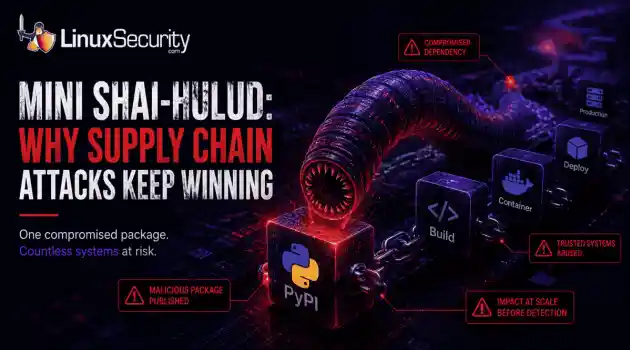
open-source python Researchers recently identified another wave of malicious packages on PyPI linked to the broader Mini Shai-Hulud campaign, a worm-like supply chain attack that spread through trusted software packages. On the surface, the packages looked no different from thousands of others published to the repository each week. . Instead of trying to break into a target network directly, the attackers hid malicious code inside software that developers were already using. A few downloads are all it takes....
Jun 09, 2026
Security Vulnerabilities malware linux
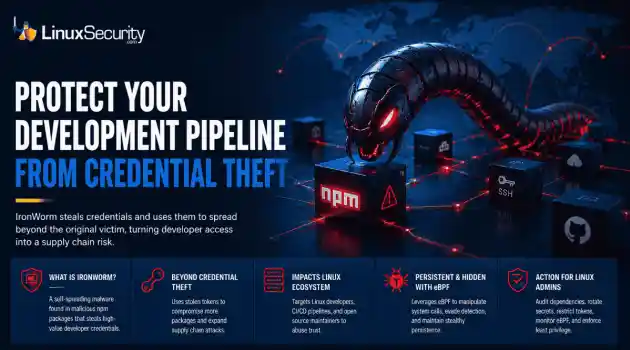
malware linux IronWorm steals credentials and uses them to spread beyond the original victim, turning developer access into a supply chain risk. . A new campaign targeting npm has evolved past simple credential theft. Researchers identified IronWorm, a self-spreading threat. It harvests high-value Linux development secrets—SSH keys, cloud tokens, package publishing credentials. One compromised workstation becomes a launchpad for downstream supply chain attacks. This is not a get-in-and-get-out operation....
Jun 08, 2026

Network Securitysystem security Linux network
system security Linux network The romanticized image of the digital nomad – a laptop on a sun-drenched balcony – rarely accounts for the actual friction of maintaining a professional development environment on the move. . The friction is amplified with Linux. We are looking for a setup that respects our kernel configurations, handles volatile network handovers, and maintains a strict security posture without the hand-holding of a consumer-grade OS – so, put simply, more than just a laptop and a sunny deck. The hardware is...
May 26, 2026
 Refine news
X Clear Filters
Get the latest News and Insights
Get the latest Linux and open source security news straight to your inbox.
Community Poll
What got you started with Linux?
Loading...
Explore Latest Linux Security news
We found 1 articles for you...
82
 information securityinfrastructure protectionresearch center
George Mason And James Madison Establish Federal Cybersecurity Center
Officials from George Mason and James Madison universities announced May 14 that they will create a federally funded center to provide resources and research for government and industry organizations that protect the nation's critical infrastructure. . . .. Officials from George Mason and James Madison universities announced May 14 that they will create a federally funded center to provide resources and research for government and industry organizations that protect the nation's critical infrastructure. The Critical Infrastructure Protection (CIP) Project, funded by a $6.5 million federal grant, will be led by a partnership between James Madison University and the George Mason University School of Law's National Center for Technology and Law. The institutions applied together for the grant from the National Institute of Standards and Technology to provide solutions that combine the technical, policy and legal issues involved in CIP and information security. "This will give us a strength that does not exist anywhere else in the country," said Linwood Rose, president of James Madison University. The link for this article located at FCW is no longer available. . Virginia Commonwealth University and the University of Virginia unveiled a collaboration for sustainable urban development studies and initiatives.. Critical Infrastructure Protection, Research Funding, National Security. . Anthony Pell
 May 20, 2002
•
May 20, 2002
• Government
82
security practicesNISTfederal fundingCongress Targets NIST Expansion for IT Security Measures
Prompted by last year's terrorist attacks, momentum is building on Capitol Hill to expand the role of the National Institute of Standards and Technology in establishing IT security standards and best practices. But the prospect is raising concerns in some circles. . . .. Prompted by last year's terrorist attacks, momentum is building on Capitol Hill to expand the role of the National Institute of Standards and Technology in establishing IT security standards and best practices. But the prospect is raising concerns in some circles. Four bills are pending in the House and Senate that would double or triple the annual funding of NIST's Computer Security Division. One of these bills, the Cybersecurity Research and Development Act, passed the House with overwhelming support. After Sept. 11, the House Science Committee held hearings on the cyberterrorist threat and the lack of a coordinated U.S. response. The hearings focused on the need for more research and targeted NIST for much of the money. Other committees have focused on tightening the security of federal IT systems, which NIST oversees for all but national security systems. Lawmakers believe NIST needs "teeth" to be able to put more pressure on federal agencies. The link for this article located at NetworkWorldFusion is no longer available. . Legislation is gaining traction in Washington to enhance NIST's authority in establishing IT security benchmarks in response to escalating cyber risks.. NIST Role, IT Security Standards, Cybersecurity Legislation, Federal IT Systems. . Anthony Pell
Apr 23, 2002
•
Government

82
homeland securitysecurity initiativeIT investmentFederal Funding Shift: Homeland Security's Impact on IT Investments
Most of the federal money made available after the Sept. 11 terrorist attacks is not going to information technology projects, but technology will play a larger role as agencies determine their homeland security needs during the coming months, industry experts said . . . . Most of the federal money made available after the Sept. 11 terrorist attacks is not going to information technology projects, but technology will play a larger role as agencies determine their homeland security needs during the coming months, industry experts said Jan. 7 at the Federal Convention on Emerging Technologies in Las Vegas. The Government Electronics and Information Technology Association released its annual evaluation of the federal IT market in November 2001, but all of the interviews for the information assurance study occurred before Sept. 11. So GEIA went back for a look at how the new homeland security mission has changed the market. The link for this article located at FCW is no longer available. . Post-Sept. 11, the allocation of federal funds has largely overlooked IT initiatives, though impending adjustments are anticipated.. Federal Funding, IT Projects, Security Investments, Emerging Technology. . Anthony Pell
Jan 09, 2002
•
Government
81
facial recognitionsurveillance technologyfederal fundingFacial Recognition Technology Boosted by Federal Funding for Surveillance
A company that touts its facial identification system as a powerful new tool for security and crime fighting has received millions of dollars in federal funding to improve its surveillance technology for military and intelligence uses, according to documents and interviews.. . .. A company that touts its facial identification system as a powerful new tool for security and crime fighting has received millions of dollars in federal funding to improve its surveillance technology for military and intelligence uses, according to documents and interviews. Visionics Corp. of Jersey City, N.J., specializes in systems that use cameras linked to computers to scan faces and automatically compare them with electronic photographs stored in databases. The company gained widespread attention after its FaceIt system was installed by Tampa police to match images caught by dozens of cameras in an entertainment district against digital mug shots of known criminals. The link for this article located at Newsbytes is no longer available. . An organization focuses on biometric fingerprint recognition technology for safety and has secured government grants to improve monitoring systems.. Facial Recognition Technology, Surveillance Technology, Crime Fighting Applications, Military Surveillance, Federal Funding. . LinuxSecurity.com Team
Aug 02, 2001
•
Privacy
81
free speechfederal fundinginternet filteringGovernment Bill Proposes Internet Filtering in Schools and Libraries
Although the government spending bill carrying a clause requiring Internet filtering on school and library computers that are federally funded is wrapped up in partisan melees, the White House and Republican lawmakers appear to have reached common ground on the filtering . . . . Although the government spending bill carrying a clause requiring Internet filtering on school and library computers that are federally funded is wrapped up in partisan melees, the White House and Republican lawmakers appear to have reached common ground on the filtering question. If the spending bill passes Congress and is signed into law, it would mark the dawn of required Internet information-blocking technology in exchange for federal dollars, which has outraged free speech groups, and stands in some contrast to a congressional panel's recent recommendation. The link for this article located at Computer User is no longer available. . Mandatory web censorship in educational institutions could impede free expression, claim critics of the legislative proposal.. Internet Filtering, Education Policy, Free Speech, Funding Restrictions. . LinuxSecurity.com Team
Nov 02, 2000
•
Privacy
79
internet accessfederal fundingfiltering softwareU.S. Senate Approves Internet Filter Requirement For Education Facilities
Schools and libraries that receive federal funds to help pay for their Internet access would be required to add filtering software to their systems under an amendment to an appropriations bill approved by the U.S. Senate. The Senate voted 95-3 Tuesday . . . . Schools and libraries that receive federal funds to help pay for their Internet access would be required to add filtering software to their systems under an amendment to an appropriations bill approved by the U.S. Senate. The Senate voted 95-3 Tuesday to require schools and libraries receiving E-rate funds to use technology that blocks access by minors to obscenity, child pornography and "any other material that the library determines to be inappropriate for minors." The E-Rate plan is part of the Telecommunications Act of 1996 and is designed to place computers with Internet access into schools and classrooms. The link for this article located at Federal Computer Week is no longer available. . In accordance with the latest Senate amendment, educational institutions and public libraries are required to adopt Internet filtering software to qualify for federal funding.. Internet Filtering, Federal Funding, E-rate Implementation, Libraries Access Control. . LinuxSecurity.com Team
Jun 30, 2000
•
Security Projects

Get the latest News and Insights
Get the latest Linux and open source security news straight to your inbox.
Community Poll
What got you started with Linux?
Search Topics
Powered By

Linux Security - Your source for Top Linux News, Advisories, HOWTOs and Feature Releases
QUICK LINKS
subscribe to newsletters!
Like staying secure? So do we.
Sign up for updates, tips, and alerts!
Discover faster search, smarter navigation, and deeper Linux security insights. Read More