Audit Linux privileges now to limit compromise, escalation, and system-wide damage. Review Linux Privileges×


Security Vulnerabilities  cisa kev vulnerability prioritization
cisa kev vulnerability prioritization Most Linux teams don't struggle to find vulnerabilities anymore. They struggle to decide which ones deserve attention first. Between daily scanner results, vendor advisories, and hundreds of new CVEs each month, the challenge isn't visibility—it's prioritization. . To solve this, organizations typically lean on the National Vulnerability Database (NVD) and CISA’s Known Exploited Vulnerabilities Catalog. But these aren’t competing lists. They answer two entirely different questions. While the...
 Jul 22, 2026

Desktop Securitysecurity advisory vulnerability
security advisory vulnerability GNOME is officially shortening its standard vulnerability disclosure window from 90 days to 30 days, a change that impacts upstream maintainers, downstream Linux distributions, and system administrators in how they handle software vulnerabilities. The policy shift, announced by long-time security coordinator Michael Catanzaro , addresses modern software patching realities and a growing influx of automated submissions. . Because GNOME is the default desktop environment on several major Linux...
Jul 21, 2026

Security Vulnerabilities security advisory moderate
security advisory moderate For organizations that run a self-hosted Git platform, it’s no longer just about hosting static code repositories. Today, Git servers are responsible for deployment pipelines, API tokens, SSH keys, package repositories, and the automation scripts that push code directly. Confirm that the upgrade addresses known vulnerabilities but also provides production environments. . That makes them trusted systems within the development environment and attractive targets for attackers looking to move...
Jul 20, 2026

Server Securitydata privacy automation
data privacy automation Every system admin has lived through the same Monday morning ritual. A queue of forty tickets, half of them password resets, permission errors, or disk space warnings that any experienced technician could resolve in under two minutes. The other half require actual judgment. For years, automation promised that software would eventually sort the two apart on its own. That promise is now being tested in production Linux environments. . Early results are reshaping how IT teams think about tier-1...
Jul 17, 2026

Privacydata collection automation
data collection automation You're running a web scraping project to collect pricing data from e-commerce sites. You set up a pool of datacenter proxies, launch your scripts, and within minutes — banned . CAPTCHAs everywhere. Your data pipeline stops before it really begins. . It's a frustrating scenario that plays out daily in ad verification, market research, and multi-account management. The website doesn't know you're doing legitimate research or monitoring. It just sees traffic coming from IP ranges it recognizes as...
Jul 17, 2026
 Refine news
X Clear Filters
Get the latest News and Insights
Get the latest Linux and open source security news straight to your inbox.
Community Poll
Should Linux servers automatically install security updates?
Trending News
Loading...
Explore Latest Linux Security news
We found 2 articles for you...
209
 security updatemobile securityoffensive security
What Kali Linux 2026.2 Says About Today's Linux Security Priorities
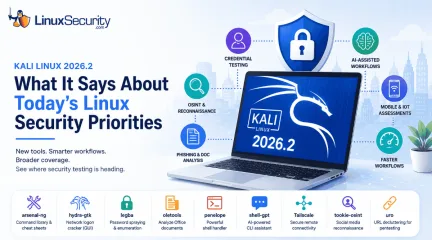
Offensive Security just dropped Kali Linux 2026.2 , and at first glance, it looks like a standard quarterly refresh. You’ve got the usual kernel bumps, desktop environment updates, and a handful of new utilities. But don't write this off as just another routine version update. If you look past the changelog, this release highlights several capabilities that continue to be important in offensive security. From AI-assisted workflows to credential testing and mobile assessments, Kali Linux 2026.2 reflects the techniques many security professionals are incorporating into modern Linux security testing. For Linux administrators and defenders, understanding what tools are being added to Kali can be just as valuable as using them; they reflect the techniques security teams—and attackers—consider most relevant for evaluating modern Linux environments. . Why Kali Releases Matter Even If You Don't Use Kali Most enterprise Linux systems will never run Kali Linux, but administrators still benefit from following its development. New tools often reflect the techniques penetration testers are actively using during real-world assessments. Reviewing each release helps defenders identify emerging testing priorities and evaluate whether their own monitoring, authentication controls, and hardening practices address those attack paths. What's New in Kali Linux 2026.2 The headline for 2026.2 is the inclusion of nine new security tools, but the platform improvements are what really move the needle for daily operations. The distribution is now running on the Linux kernel 6.19, with the desktop experience receiving a facelift through GNOME 50 and KDE Plasma 6.6. Tool Primary Purpose arsenal-ng Cybersecurity command reference and cheat sheets hydra-gtk GUI for Hydra credential testing legba Password spraying and authentication testing oletools Analyze Microsoft Office documents andmacros penelope Shell handler for post-exploitation shell-gpt AI-assisted command generation Tailscale Secure remote connectivity tookie-osint Social media reconnaissance uro URL normalization for web testing Taken together, the new tools cover credential auditing, OSINT, phishing analysis, AI-assisted workflows, remote connectivity, and shell management. They reinforce a broader reality: modern security assessments rarely focus on a single system. Today's engagements often combine identity testing, cloud infrastructure, web applications, mobile devices, and social engineering into a single assessment. Beyond the aesthetics, the team focused on friction reduction. VM deployments are significantly faster this time around, thanks to the removal of graphics firmware from pre-built images, and there’s a marked improvement in NetHunter’s stability. For those running security assessments in virtualized labs, these workflow optimizations save real time when you're spinning up or tearing down testing environments. Another notable addition is Tailscale, which gives security teams a straightforward way to create encrypted connections between testing systems. For organizations with distributed labs or remote team members, it can simplify access to assessment environments without exposing them directly to the internet. Credential Attacks Continue to Be a Priority Among the new tools are additions focused on credential testing, including legba and the re-added hydra-gtk . Their inclusion reflects how identity-based attacks—including password spraying, credential reuse, and authentication testing—continue to play a central role in modern security assessments. If an administrator uses the same password for a local Linux server and a corporate SSO account, that’s an open door. These tools act as a wake-up call: if you aren't enforcing MFA, disabling legacyauthentication, and proactively monitoring for password-spraying attempts, your infrastructure is likely the low-hanging fruit in a credential-stuffing campaign. AI Is Becoming Part of Everyday Security Operations The inclusion of shell-gpt might trigger a knee-jerk reaction about AI replacing security pros, but that’s missing the point. Tools like shell-gpt illustrate how AI is beginning to reduce repetitive command-line work. Rather than replacing expertise, they help security professionals generate commands, reference syntax, and automate routine tasks more efficiently. Offensive security is notoriously repetitive. Whether it's drafting boilerplate command syntax or normalizing log output, the friction of manual scripting slows down an assessment. These tools reduce repetitive command-line work and make common workflows easier to reproduce, allowing analysts to spend more time interpreting results than writing boilerplate commands. Mobile Devices Are Now Part of Enterprise Security Assessments The latest NetHunter improvements highlight a shift in scope. Many organizations that rely on Linux servers also manage Android devices, embedded Linux systems, and IoT endpoints. Expanding NetHunter reflects the reality that enterprise security assessments increasingly extend beyond traditional servers. Strong Linux server hardening is only one part of the equation. If attackers can gain network access through an insecure Android device or wireless infrastructure, they may still be able to pivot toward Linux systems. Kali 2026.2 provides the tools to assess these wireless "flanks" of the enterprise, ensuring that mobile and IoT devices are part of your broader security program. Security Testing Is Becoming Faster There’s a clear emphasis on speed in 2026.2, from the faster VM boot times to the smaller initrd. When you're building disposable lab environments, validating detections, or conducting repeated penetration tests, time is your most limited resource. Faster deployments meanassessments can happen more frequently, which makes security validation a natural part of daily operations rather than a painful, quarterly event. By removing unnecessary graphics firmware from pre-built virtual machine images, Kali reduces boot times for many VM-based testing environments while leaving bare-metal installations unchanged. Office Documents Still Matter in Linux Environments Kali 2026.2 also highlights the ongoing relevance of oletools . While Linux endpoints are less commonly associated with Office malware than Windows systems, Linux administrators frequently investigate phishing campaigns, analyze suspicious attachments, and protect mixed-platform environments. Tools like oletools help incident responders inspect Office documents for embedded macros and other malicious content before those files reach users or move deeper into an organization. What Linux Administrators Should Take Away From the Release One of the most useful aspects of following Kali releases isn't deciding whether to upgrade immediately. It's understanding where offensive security is investing its attention. The tools that enter Kali often mirror the techniques organizations are increasingly testing during security assessments, giving defenders an opportunity to evaluate whether their own controls keep pace. Use this table as a checklist for your own hardening efforts: Area Question to Ask Authentication Could your SSH service withstand password spraying? AI Workflows Have you established guidelines for using AI tools without exposing sensitive commands or data? Email Security Are Office documents scanned for malicious content before users open them? OSINT Is unnecessary organizational information publicly exposed? Mobile Security Are Android and IoT devices included in security assessments? Detection Can your monitoringidentify credential attacks and suspicious shell activity regardless of the specific tool used? Conclusion Kali Linux 2026.2 is more than a collection of new packages and version upgrades. Its newest tools and platform improvements reflect the techniques security professionals are using to evaluate modern Linux environments. Whether your organization performs formal penetration tests or simply wants to strengthen its defenses, the release highlights where security testing is placing increasing emphasis: identity, automation, mobile devices, and operational efficiency. Pay attention to the techniques these tools are designed to test; they reflect the attack paths that penetration testers evaluate today and the behaviors defenders should be prepared to detect. Want more Linux security news, vulnerability analysis, and software supply chain updates? Subscribe to the LinuxSecurity Newsletter and get the latest threats, advisories, and expert insights delivered directly to your inbox. . Kali Linux 2026.2 showcases new capabilities in offensive security, highlighting tools for credential testing, AI, and mobile assessments.. Linux Security Tools,Kali Linux 2026.2,Cybersecurity Tools,Credential Testing Techniques,AI in Security. . MaK Ulac
 Jun 30, 2026
•
Jun 30, 2026
• Security Trends
74
 security advisorypenetration testingoffensive security
Kali Linux 2025: Ethical Pentesting and Blue Team Integration
What is Kali Linux? The 2025 Guide for Security Operations Kali Linux is a Debian-based system built and maintained by Offensive Security. It’s made for penetration testing and security assessments — not for checking email or running spreadsheets. Every tool inside it maps, probes, or breaks something under control. That’s the whole point. . People still picture hackers in dark rooms when they hear it. That reputation stuck from the early days, mostly because Kali ships with tools used to exploit networks. Inside most security teams, though, it’s just another piece of the kit. What matters is the intent behind the keyboard. This guide walks through how Kali Linux evolved, how it fits into modern operations, and what it means to test your own defenses without crossing lines. From BackTrack to Research Platform: How Kali Linux Evolved Origin story: Kali Linux didn’t start from scratch. It came from BackTrack, an older live Linux distribution built for security auditing. BackTrack itself combined two smaller projects, Whoppix and Auditor Security Collection. In 2013, the team rebuilt and rebranded it under Debian to gain structure and long-term support. That rebuild turned a loose community effort into something stable enough for research and training. Governance shift: Then Offensive Security took over maintenance. Their certification tracks, especially OSCP, gave the project direction and legitimacy. They also helped define offensive security as a formal practice instead of an underground skillset. Penetration testing became structured, repeatable, and respected work. Technical leap: Early BackTrack builds supported only a few architectures and relied on rough scripts. Kali Linux expanded support across x86, ARM, virtual machines, and cloud setups, aligning better with other Linux versions. It moved from a one-off toolkit to a real deployment platform. Why it matters: That shift showed how open-source security could mature without losing its edge. Kali Linuxbecame more than a distro full of tools. It turned into a shared lab for testing, training, and collaborative research across the security community. The Role of Kali Linux in Offensive Security Kali Linux sits at the center of modern offensive security work. Offensive Security Defined Offensive security is proactive defense, using attacker methods under control to test how real your resilience is. It’s not about breaking systems for sport. It’s about finding weak spots early and feeding that data back into defense planning. Kali Linux gives teams a consistent platform to do that safely. Real-World Use In production environments, Kali Linux runs quietly in the background for continuous testing. Teams integrate it into CI/CD pipelines, spin it up inside containers, or deploy it in virtual labs to simulate attacks before release. It’s a standard image for red-team operations, letting testers validate configurations without touching production. Across Linux versions, that consistency matters. Same tools, same results, fewer surprises. Tools with Purpose The distro ships with hundreds of utilities, but they fall into clear groups — network mapping, digital forensics, web app testing, and password auditing. What’s changed is how people use them. Automation and scripting have taken over tasks that used to require manual exploitation. Teams build repeatable workflows instead of running one-off attacks. Kali Linux makes that practical, turning toolkits into processes instead of chaos. More on the philosophy and training model behind Kali’s development can be found on Offensive Security’s site . The Shift Toward Ethical Research and Blue-Team Integration Kali Linux has started to look beyond offense. The launch of Kali Purple marked a real change in direction, blending SOC and monitoring tools into what used to be a purely offensive toolkit. It pulls in dashboards, SIEM connectors, and defensive utilities without losing the penetration-testing backbone that definedearlier builds. For a distribution rooted in offensive security, that’s a practical and overdue evolution. The change matters for hybrid teams. Many groups now train both offense and defense under one roof, using the same environment for red and blue exercises. With Kali Purple, analysts can detect and respond inside the same space that attackers use to probe. It keeps both sides honest — no guesswork about toolsets or data flow — and makes cross-team testing a routine part of operations. Newer Linux versions make that flexibility possible. Broader hardware support, cleaner virtualization, and tighter kernel integration let the same Kali Linux image run across laptops, ARM boards, or cloud instances with little adjustment. What once required juggling multiple distros now runs from one build. That’s the real shift in spirit. Kali Linux isn’t just an offensive sandbox anymore; it’s a shared lab for ethical research where intent sets the line between testing and abuse. Kali Linux: Ethics, Governance, and Responsible Use Even open-source tools need oversight. When a signing key incident shook trust across parts of the Linux community, it showed how fragile that chain of trust can be. Kali Linux runs on the same model — if integrity slips, every update and every test image becomes suspect. Governance isn’t optional; it’s the foundation. Accountability through training. Offensive Security’s certifications and community standards help define what responsible use looks like. Testing systems ethically isn’t instinct — it’s learned, verified, and documented. Transparency in practice. Kali Linux is a live example of how open-source security can stay trustworthy. Code is visible, updates are signed, and misuse gets addressed publicly. Teaching boundaries. It’s more than a toolkit. Kali Linux doubles as a classroom for responsible behavior — showing where offensive security stops and professional ethics begin. Why Kali Linux Still Matters in ModernLinux Security For all the changes in tooling, Kali Linux still earns its spot on most security benches. Practical Administration Admins use it to validate systems, probe configurations, and harden networks before issues surface. It fits easily into vulnerability scanning and remediation pipelines. Teams often use it to help security test their networks — mapping exposed services, verifying patch results, and checking resilience after major updates. Education and Simulation Kali Linux is standard gear in cyber ranges and internal labs. It gives new admins real exposure to offensive security tactics without the risk. Practicing detection and response in a controlled space builds muscle memory that carries into live environments. Cross-Version Reliability Different Linux versions behave differently under test, but Kali Linux stays stable across them. That reliability matters for research and repeatable testing. Same scripts, same output, same baseline — small details that keep results consistent across platforms. Comparing Kali to Other Secure Linux Distributions Every security-focused Linux build has its lane. Kali Linux just happens to cover the one most people train in. Here’s how it compares to similar distros: Comparison Overview Distribution Primary Focus Key Use Case Kali Linux Offensive security, research Pentesting, red/blue training Tails OS Privacy and anonymity Secure browsing, whistleblowing Qubes OS Compartmentalization High-security desktop environments Parrot OS Balanced pentesting + daily use Ethical hacking with privacy tools Key Takeaway Each distro supports a different threat model, but Kali Linux stays central for hands-on testing and experimentation. It’s the place admins and analysts go to break, fix, and verify in one loop. Newer Linux versions onlyreinforce that, making cross-platform work smoother and more predictable. For anyone comparing privacy- or research-focused builds, this deep dive into top secure Linux distributions gives a broader view of where Kali fits today. Conclusion: Kali Linux as a Lens on Linux Security Kali Linux isn’t really about the distro itself anymore. It’s more like a mirror for how Linux security keeps changing. Kali Linux stopped being a symbol years ago. It’s just how the work gets done now — quietly, methodically, and in the open. What it actually shows is how testing, documentation, and defense all connect. You can trace a lot of modern security thinking back through how people use Kali. The 2025.1 release is a good snapshot of that. Faster cycles, cleaner integrations, new hardware support. It’s just moving fast, and that pace says a lot about where open-source security is headed. Constant updates, constant testing, no real finish line. As Linux versions spread everywhere — servers, cloud, edge — Kali Linux still ends up being the lab where people figure things out. It’s where you see how systems behave when they’re pushed. It keeps the work grounded. Bottom line. The real difference isn’t the toolkit, it’s what you build with it. Stay ethical, stay curious, and keep pushing the work forward. . Kali Linux transforms ethical pentesting with a blend of offense and defense tools, enhancing security operations.. Kali Linux, penetration testing, ethical hacking, Offensive Security, blue team. . MaK Ulac
Nov 04, 2025
•
Network Security

76
 security insightscyber defensetechnology trends
BHUSA Insights: Exploring Cyber Defense and Political Dynamics
Opening Black Hat USA in Las Vegas, Black Hat founder Jeff Moss commented on the convergence of cybersecurity and political issues and said that world events “have caught up with us and we’re being tested.” . Saying that if offense is a purely technical endeavor, defense is “largely political” in spend, strategy and what is being defended. “I believe the technology we are delivering favors offense, the machine learning, the reinforcing algorithms, so the momentum is on offense, but in defense we’re stuck with politics,” he said. The link for this article located at InfoSecurity is no longer available. . The intersection of digital security and governance is evident, impacting protective measures and tactics amid international conflicts.. Cyber Defense, Political Strategy, Offensive Security, Technology Trends. . Brittany Day
Aug 09, 2018
•
Organizations/Events
82
security practicessoftware bugsoffensive securityUS Intelligence Strategy: Leveraging Software Bugs for Offensive Security
Companies allow US intelligence to exploit vulnerabilities before it patches them: Microsoft Corp. (MSFT), the world's largest software company, provides intelligence agencies with information about bugs in its popular software before it publicly releases a fix, according to two people familiar with the process. . That information can be used to protect government computers and to access the computers of terrorists or military foes. Redmond, Washington-based Microsoft (MSFT) and other software or Internet security companies have been aware that this type of early alert allowed the U.S. to exploit vulnerabilities in software sold to foreign governments, according to two U.S. officials. Microsoft doesn't ask and can't be told how the government uses such tip-offs, said the officials, who asked not to be identified because the matter is confidential. The link for this article located at Schneier on Security is no longer available. . American intelligence agencies capitalize on software flaws prior to public remedies being released, affecting security protocols.. Vulnerability Exploitation, Offensive Security, Government Intelligence. . Alex
Jun 20, 2013
•
Government
76
cyber warfareoffensive securityhacker conferenceExpert Meeting for Offensive Security Hackers Taking Place in Miami
No nametags. No photographs. No video. Attendees remain utterly anonymous -- and that. Formidable American offensive security hackers are meeting in Miami with other top hackers from all over the world to hone their technical expertise, swap war stories The link for this article located at Fox News is no longer available. . Influential cybersecurity experts from the United States convene in Miami alongside top-tier international hackers to exchange cutting-edge methodologies.. Offensive Security, Hacker Conference, Technical Exchange, Cyber Warfare, Networking Event. . Dave Wreski
Apr 15, 2013
•
Organizations/Events
83
proactive securitycyber counterterrorismblack market hackingProactive Strategies for Cybersecurity Against Black Market Hackers
The recent arrest and 17-count indictment against 20-year-old accused hacker and botmaster Jeanson James Ancheta for both using and selling the tools to attack a number of networks, including some within the Defense Department, should be taken as a shot across the bow by anyone who reads this. Ancheta is accused of being part of a new breed of criminal hacker: not just in it for the fame--sure, he's getting his 15 minutes, although it could be more like 50 years--but rather after money. According to the charges against him, Ancheta even managed to collect nearly $60,000 by creating, spreading, and selling bots to the highest bidders. By all accounts, Ancheta is smart and motivated, and there was a market for his black-market guerrilla hacking tactics and tools. How do you stop a smart, motivated attacker from making your life miserable? . To catch a thief, or in this case a cyberterrorist, you have to think like one. IT professionals have been conditioned to think defensively, draping their networks with sensor-studded barbed wire and using firewalls and intrusion-prevention systems to lock down doors and windows around the perimeter. But there's an emerging school of thought that says only a more proactive approach to security can prepare companies for the unexpected. The link for this article located at Information Week is no longer available. . To catch a thief, or in this case a cyberterrorist, you have to think like one. IT professionals hav. recent, arrest, 17-count, indictment, against, 20-year-old, accused, hacker, botmaster, jeanson. . LinuxSecurity.com Team
Nov 09, 2005
•
Hacks/Cracks
76
security conferencecollaborationoffensive securityAustralian Federal Police Collaboration With Hackers At Ruxcon
Patrick Gray submits The Australian Federal Police are taking firm steps toward forging closer ties with the underground hacking community as evidenced at a recent security conference. Ruxcon, a conference organised by and for the Australian computer security community . . . . Patrick Gray submits The Australian Federal Police are taking firm steps toward forging closer ties with the underground hacking community as evidenced at a recent security conference. Ruxcon, a conference organised by and for the Australian computer security community last weekend, witnessed a gathering of around 300 security enthusiasts and consultants. The inaugural two-day conference covered a myriad of topics including defensive and offensive security issues, GSM mobile phone security, secure web applications development and assembly programming. It wasn't a conventional conference by many standards but one which left Alistair MacGibbon pleasantly surprised. The link for this article located at ZDNetAU is no longer available. . The Ruxcon conference merges law enforcement and ethical hacking, fostering dialogue and cooperation against cybercrime while addressing mutual challenges in cybersecurity. Australian Federal Police, Ruxcon Security, Cybersecurity Collaboration. . Anthony Pell
Apr 15, 2003
•
Organizations/Events

Get the latest News and Insights
Get the latest Linux and open source security news straight to your inbox.
Community Poll
Should Linux servers automatically install security updates?
Trending News
Search Topics
Powered By

Linux Security - Your source for Top Linux News, Advisories, HOWTOs and Feature Releases
QUICK LINKS
subscribe to newsletters!
Like staying secure? So do we.
Sign up for updates, tips, and alerts!