


Security Vulnerabilities  security advisory zero-day
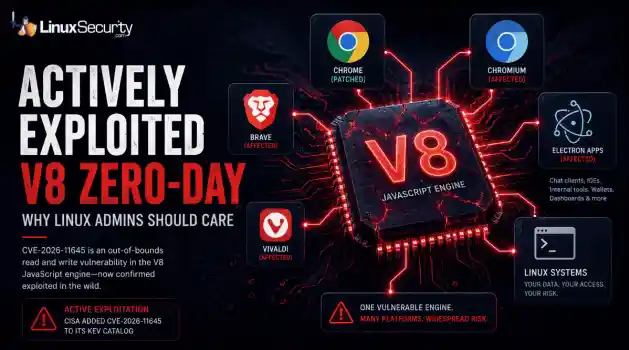
security advisory zero-day CISA added CVE-2026-11645 to its Known Exploited Vulnerabilities catalog after Google confirmed active exploitation of the flaw. The bug sits in V8, the JavaScript engine behind Chrome and Chromium. . That's where this gets more interesting. Most coverage will focus on Chrome because that's where the patch landed. But the affected component is V8. Chromium relies on it. Electron relies on it. Plenty of desktop software Linux users interact with every day relies on it too, often without much...
 Jun 10, 2026

Network Securitysecurity advisory networking
security advisory networking For years, IPv4 was the only proxy type that really mattered for anyone running automation off a Linux box. IPv6 was the protocol everyone said they’d migrate to, but almost nobody actually did. In 2026, that’s finally starting to shift. . The problem is that most admins stick with IPv4 out of habit. They know it; it’s what their tooling defaults to, and they don’t see a reason to change. Some are overpaying for addresses they don’t need. Others would quietly break their scrapers, scripts, or...
Jun 09, 2026

Network Securityopen-source python
open-source python Researchers recently identified another wave of malicious packages on PyPI linked to the broader Mini Shai-Hulud campaign, a worm-like supply chain attack that spread through trusted software packages. On the surface, the packages looked no different from thousands of others published to the repository each week. . Instead of trying to break into a target network directly, the attackers hid malicious code inside software that developers were already using. A few downloads are all it takes....
Jun 09, 2026
Security Vulnerabilities malware linux
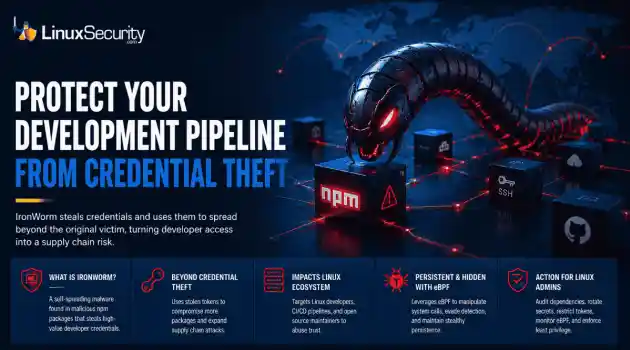
malware linux IronWorm steals credentials and uses them to spread beyond the original victim, turning developer access into a supply chain risk. . A new campaign targeting npm has evolved past simple credential theft. Researchers identified IronWorm, a self-spreading threat. It harvests high-value Linux development secrets—SSH keys, cloud tokens, package publishing credentials. One compromised workstation becomes a launchpad for downstream supply chain attacks. This is not a get-in-and-get-out operation....
Jun 08, 2026

Network Securitysystem security Linux network
system security Linux network The romanticized image of the digital nomad – a laptop on a sun-drenched balcony – rarely accounts for the actual friction of maintaining a professional development environment on the move. . The friction is amplified with Linux. We are looking for a setup that respects our kernel configurations, handles volatile network handovers, and maintains a strict security posture without the hand-holding of a consumer-grade OS – so, put simply, more than just a laptop and a sunny deck. The hardware is...
May 26, 2026
 Refine news
X Clear Filters
Get the latest News and Insights
Get the latest Linux and open source security news straight to your inbox.
Community Poll
What got you started with Linux?
Loading...

Explore Latest Linux Security news
We found -4 articles for you...
77
 security advisorykernel securityUbuntu
AppArmor “Enforcing” Doesn’t Mean What You Think: Verify What It’s Actually Enforcing
“Enabled” does not mean “Protected.” Recent kernel vulnerabilities, including cases like USN-8098-1 , show that a service can stay active while the policies it enforces are quietly swapped underneath it. . This isn’t a bypass in the traditional sense. It’s profile manipulation at the kernel level. In certain scenarios, an unprivileged user can alter loaded rules without triggering alerts. Monitoring still reports “Enforcing,” but the kernel is no longer running the policy you have on disk. That’s why checking status is no longer enough. You need to verify that what’s in memory still matches what you deployed. Beyond “Enabled”: How to Verify AppArmor Is Working (Not Just Running) Tools like aa-status or systemctl status apparmor report state, not integrity. They confirm the service is active, but they cannot tell you whether the active profile matches the one on disk. To actually verify AppArmor is working, you need to compare what’s on disk with what the kernel is enforcing in memory. That means checking the active profiles directly, validating them against a known baseline, and watching for live profile replacement events. Check What it tells you What you should be asking aa-status AppArmor is active Are these the original profiles? systemctl status apparmor Service is running Have profiles been altered? Kernel profile list Profiles are loaded Are the rules intact? If a profile is modified through a kernel flaw, these checks can still return a healthy status while the system applies a different ruleset than what’s on disk. When AppArmor Is Not Enforcing Rules: The In-Memory Mismatch AppArmor does not continuously re-validate /etc/apparmor.d/ against what the kernel is enforcing. Once a profile is loaded, the kernel treats it as the source of truth. If that in-memory version is altered,enforcement continues cleanly, just with different rules. The profile name stays the same and still shows as enforced, but the rules behind it no longer match what was deployed. What that looks like in practice: A profile reload is triggered by an unprivileged user The profile name remains unchanged to avoid detection Deny rules are relaxed or removed The modified profile is enforced immediately Where this tends to surface: Web services (nginx, apache, ssh): unexpected file access patterns Containers: profiles still attached, but isolation quietly weakened “Confined” processes: marked as restricted, but governed by altered rules If you’re stacking LSMs like SELinux or BPF-LSM, you may have partial coverage. Unless you’ve verified overlap at the rule level, assume the AppArmor layer is your primary control and treat compromise accordingly. Where Isolation Breaks Down: The Shared Kernel Problem Containers isolate processes, not enforcement. AppArmor still operates at the kernel level, and every container on a host depends on that same decision layer. If a profile is altered in memory, whether through a kernel flaw or misconfiguration, the change doesn’t stay contained. It applies everywhere that the profile is used. Think of the kernel as the landlord and AppArmor as the locks on each door. The locks can still be in place, but if the landlord has been compromised, the rules behind those locks no longer mean much. That shows up in places where isolation is assumed to hold: A CI runner pulls untrusted code, executes it under a known profile, but the rules have already been relaxed A multi-user system enforces confinement on paper, while certain processes quietly gain broader file access Containers appear restricted, yet share a policy that no longer matches what was deployed From the outside, processes still show as confined. The difference is in what those profiles now allow. The enforcement boundary has already shifted.The kernel is still making decisions, just not the ones you expect. How to Verify AppArmor Is Working: A 60-Second Integrity Audit Checking if AppArmor is running is just a heartbeat check. This is how you verify what it’s actually enforcing. How to Check for Unconfined Processes Start with processes that should never be unconfined: ps -Z | grep unconfined Focus on: nginx apache bind ssh If any of these show as unconfined, something is already out of alignment. Also, watch for profiles running in complain mode, since that’s how restrictions get relaxed without breaking execution. How to Check AppArmor Profiles Are Applied (Baseline Check) Compare what’s on disk versus what’s loaded: ls /etc/apparmor.d/ | wc -l aa-status These numbers won’t match exactly, and they’re not supposed to. Profiles can expand, load dynamically, or originate from different paths. What matters is consistency. Capture a baseline from a known-good system, then monitor for: missing profiles unexpected drops deviations from expected state How to Reload AppArmor Profiles and Verify State If something feels off, reload profiles directly: sudo apparmor_parser -r /etc/apparmor.d/* This replaces whatever is currently in memory with what’s on disk. To see what the kernel is enforcing right now: cat /sys/kernel/security/apparmor/profiles That’s your source of truth. Everything else is reporting around it. How to Verify AppArmor Profiles Haven’t Been Modified Profile manipulation doesn’t raise alerts. It leaves traces in audit logs. Focus on these events: sudo grep 'apparmor="STATUS"' /var/log/audit/audit.log sudo grep 'apparmor="REPLACED"' /var/log/audit/audit.log STATUS → Normal profile loads and enforcement events REPLACED → A profile was overridden on a live system That REPLACED event is the signal. It confirms that a profile changed without a restart, which lines up with howin-memory manipulation behaves. These entries won't stop the system; they just record what happened. This log acts like a black box you come back to when something doesn't line up. If you want to see how these events are handled and what AppArmor actually logs in practice, the AppArmor project documentation covers how profile loads, replacements, and enforcement changes show up. Why “Enabled” Doesn’t Mean Protected A green status is just a heartbeat. It says nothing about integrity. If you’re not: checking for drift auditing REPLACED events occasionally reloading from disk You’re relying on the assumption that memory and disk are still aligned. That assumption is exactly what these vulnerabilities exploit. Stop asking if AppArmor is running and start verifying what the kernel is actually enforcing. Because in the end, your security posture doesn’t depend on the service being active. It depends on whether the rules in memory still match the rules you trust. . Profile manipulation at the kernel level poses a real threat. Discover how to ensure AppArmor is functioning as expected.. AppArmor Security, Linux Kernel Threats, Application Protection, Process Isolation. . MaK Ulac
 Mar 17, 2026
•
Mar 17, 2026
• Server Security

Get the latest News and Insights
Get the latest Linux and open source security news straight to your inbox.
Community Poll
What got you started with Linux?
Search Topics
Powered By

Linux Security - Your source for Top Linux News, Advisories, HOWTOs and Feature Releases
QUICK LINKS
subscribe to newsletters!
Like staying secure? So do we.
Sign up for updates, tips, and alerts!
Discover faster search, smarter navigation, and deeper Linux security insights. Read More