Overly broad permissions can turn one compromised account into a much larger security problem. Learn how to reduce unnecessary access, review privileges, and apply least privilege across modern Linux systems. Review Linux Privileges×


Stay Ahead With Linux Security Features
 identity management security tactics
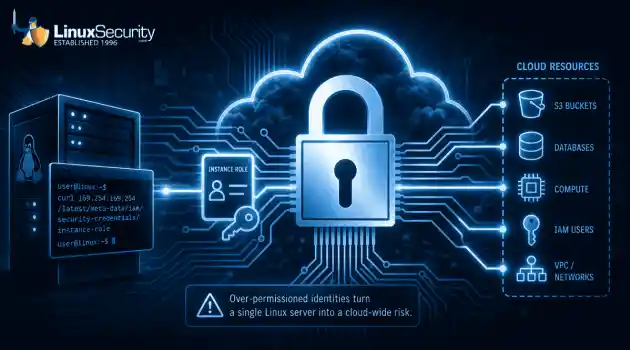
 For years, we secured our Linux infrastructure by building walls: VPCs, security groups, and hardened SSH configurations. We treated the cloud like a virtual data center, assuming that if we kept the "bad guys" out of the network, our workloads were safe. . That model is no longer sufficient. Today, one of the most common paths from an initial compromise to a major cloud breach is the identity assigned to your Linux workload. When an attacker gains code execution on a Linux instance—through a...
 Jul 17, 2026
 security practices patch management
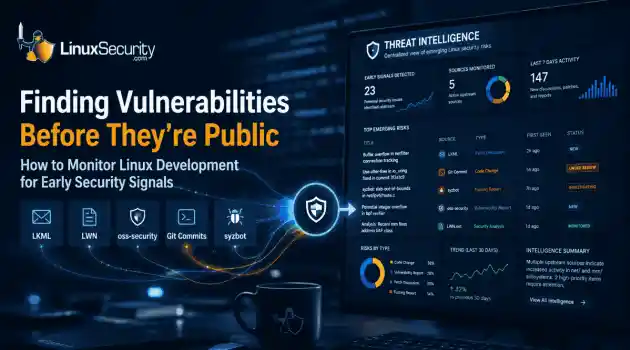
 Most of us don't hear about a kernel vulnerability until a CVE lands in our inbox or the vulnerability scanner starts complaining. By then, the patch isn't new anymore. Kernel developers may have been passing it around for review, arguing over the implementation, or revising it for days before anyone outside that community noticed it. None of those discussions are secret. They're sitting in mailing list archives, Git commits, and patch reviews where they've been the whole time. The strange...
Jul 14, 2026
 Linux security cyber attacks
 Every Linux server in your fleet produces thousands of events every minute. From journald logs and auditd records to kernel-level eBPF hooks, your systems are constantly talking. Most of that noise is just the mundane churn of system services, CI/CD runners, or routine administrative automation. But among that noise, an attacker might be establishing a foothold, moving laterally, or setting up persistence. The challenge for any security team is: how do you separate the routine from the...
Jul 13, 2026
 open-source infrastructure risk
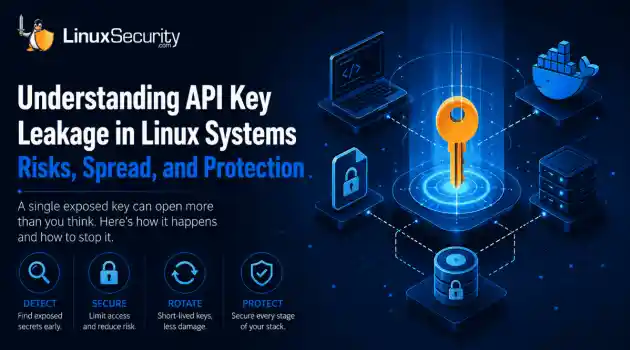
 Security scanners flag exposed API keys in public repositories every day. The initial response is usually predictable: delete the commit, revoke the credential, and move on. That’s a mistake. . In a real Linux environment, an API key never stays in one place. By the time it hits a public repo, it’s already everywhere. It’s in the CI/CD pipeline. It’s in your container registry. It’s in the build logs. It’s in the backups. Git makes this worse because the history never dies. Deleting a file in...
Jul 11, 2026
 open-source rootkit
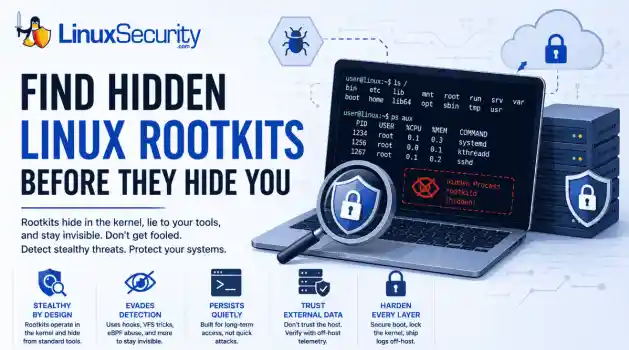
 Most of us think of Linux rootkits as ancient history—the stuff of 90s hacking forums and clunky malware that would crash your system if you looked at it the wrong way. But if you think they’ve gone away, you’re mistaken. They’ve just gotten smarter. . Modern attackers aren't using the noisy tools of the past. Today’s threats are surgical. Many of today’s most advanced Linux rootkits operate at the kernel level or abuse legitimate system features to blend in with normal traffic. They’re...
Jul 09, 2026
 Refine features
X Clear Filters
Get the latest News and Insights
Get the latest Linux and open source security news straight to your inbox.
Community Poll
Should Linux servers automatically install security updates?
Loading...

Explore Latest Linux Security features
We found -4 articles for you...
102
 data breachdigital forensicsincident analysis
Honeynet Forensic Challenge: Engage in Cybersecurity Analysis
David Dittrich, coordinator for the Forensic Challenge, outlines a contest that pits the best efforts by the blackhat community against anyone in the security community who wishes to accept it. . Every day, incident handlers across the globe are faced with compromised systems, running some set of unknown programs, providing some kind of unintended service to an intruder who has taken control of someone else's -- YOUR, or your client's, or customer's -- computers. To most, the response is a matter of "get it back online ASAP and be done with it." This usually leads to an inadequate and ineffective response, not even knowing what hit you, with a high probability of repeated compromise. Enter the Honeynet Project. One of the primary goals of the Honeynet Project is to find order in chaos by letting the attackers do their thing, and allowing the defenders to learn from the experience and improve. The latest challenge, inspired by the Honeynet Project's founder Lance Spitzner, is the Forensic Challenge. Only this time, we're opening it up to anyone who wants to join in. On the law enforcement side, they are hampered by a flood of incidents and a lack of good data. A victim trying to keep a system running or doing a "quickie" job of cleanup usually means incidents are underreported and inadequate handling of the evidence leads to no evidence, or tainted evidence. There has to be a better way to meet the needs of incident handlers and system administrators, as well as law enforcement, if Internet crime is going to be managed and not run amok. One possible answer is effective forensic analysis skills -- widespread knowledge of tools and techniques -- to preserve data, analyze it, and produce meaningful reports and damage estimates to your organization's management, to other incident response teams and system administrators, and to law enforcement. The Challenge The Forensic Challenge is an effort to allow incident handlers around the world to all look at the same data -- an imagereproduction of the same compromised system -- and to see who can dig the most out of that system and communicate what they've found in a concise manner. This is a nonscientific study of tools, techniques, and procedures applied to postcompromise incident handling. The challenge is to have fun, to solve a common real world problem, and for everyone to learn from the process. If what I've said already isn't enough to get you interested, Foundstone is generously offering copies of their extremely popular "Hacking Exposed" (Second Edition) book for the 20 best submissions. To get you started, here are the basic facts about the compromise. Please be aware that these are new images. This is not a system that the Honeynet Project has previously written about or discussed publically. (I.e., you won't get any hints from previous Honeynet papers.) The images were edited to anonymize the system. Only the hostname was modified. Everyone is using the same data, so any anomalies caused by this editing will be identical. You can find the "dd" format disc images at: The image files can be mounted on Linux systems using the loopback interface like this: # mkdir /t # mount -o ro,loop,nodev,noexec honeypot.hda8.dd /t # mount -o ro,loop,nodev,noexec honeypot.hda1.dd /t/boot [ etc... ] Its now your job -- should you choose to accept it! -- to figure out the Who, What, Where, When, How, and maybe even the Why of this compromise. We don't expect that everyone undertaking the challenge can or will address all of the following items, but the list below of questions and deliverables is provided as a guideline for what to produce and what to focus on. To summarize (and standardize) the deliverables, please produce the following: File Contents --------------------------------------------------------------------- index.txt Index of files/directories submitted (including any not listed below) timestamp.txt Timestamp of MD5 checksums of all files listed and submitted (dating when produced -- see deadline information below) costs.txt Incident cost-estimate evidence.txt Time line and detailed (technical) analysis. (Use an Appendix, and/or mark answers to questions above with "[Q1]", etc.) summary.txt Management and media (non-technical) summary advisory.txt Advisory for consumption by other system administrators and incident handlers within your organization files.tar Any other files produced during analysis and/or excerpts (e.g., strings output or dissassembly listings) from files on the compromised file system, which are referenced in the previous files The Rules You are free to use any tools or techniques that you choose, provided that the judges are able to readily interpret your results and duplicate or verify their accuracy using publicly available means (i.e., don't expect us all to have a copy of your favorite "Law Enforcement Only" or multi-hundred dollar commercial Windows-only tool). A good publicly available free forensic toolkit is Dan Farmer and Wietse Venema's The Coroner's Toolkit (TCT) . If you want examples of the use of TCT, or other tools/techniques, see the Forensics section of the following web page: No matter what tools/methods you choose, please make sure you explain them in your analysis and cite references to resources (e.g., RFCs, CERT or SANS "how to" documents) to help others learn by example. Don't forget: this is a Honeynet Project brainchild, so learning is what it's all about. And fun. It's all about learning and fun. Oh yeah, and security. Learning, fun, AND security. ;) You maywork in as a team, but if your entry is selected as a Top 20, you'll have to fight over one copy of the book. Deliver the results of the analysis in such a way that the judges can quickly and easily consume the information, and such that its authenticity, time of production, and integrity can be verified independently. (e.g., ISO 9660 CD-ROM or .tar archive, with digital time stamps, and PGP signatures and/or MD5 checksums.) Please DO NOT SEND COPIES OF COMPLETE FILES FROM THE FILE SYSTEM. We already have a copy of the file system and its contents. Just note the path (e.g., "[See file /bin/foo]"). All submissions MUST be time stamped prior to 00:00 GMT on Monday, February 19, 2001, and delivery to the judges initiated later that same day. (This is to accommodate submissions on IS0 9660 format CD-ROM, which should be postmarked by this time. The digital time stamps and postmarks will be used to determine the 20 "Hacking Exposed" book winners.) One free digital time stamping service you can use is Stamper . All submissions should be sent (or shipping address arranged, if CD-ROMs are being produced) to
 Jan 15, 2001
•
Jan 15, 2001
•

Get the latest News and Insights
Get the latest Linux and open source security news straight to your inbox.
Community Poll
Should Linux servers automatically install security updates?
Search Topics
Powered By

Linux Security - Your source for Top Linux News, Advisories, HOWTOs and Feature Releases
QUICK LINKS
subscribe to newsletters!
Like staying secure? So do we.
Sign up for updates, tips, and alerts!