Audit Linux privileges now to limit compromise, escalation, and system-wide damage. Review Linux Privileges×


Stay Ahead With Linux Security Features
 security advisory vulnerability
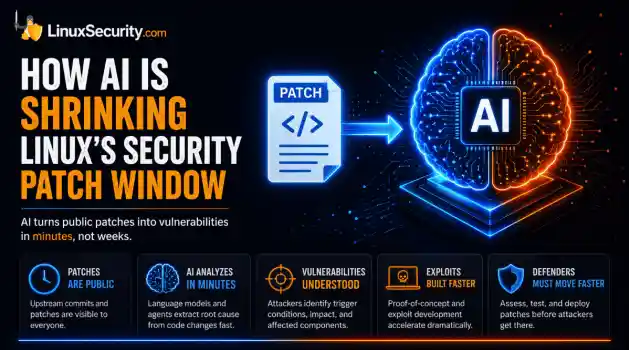
 For decades, Linux defenders relied on a comfortable assumption: a public security patch did not imply an imminent vulnerability. While open-source openness made vulnerability fixes public to everyone on kernel.org or the Linux Kernel Mailing List (LKML), converting a raw commit into a weaponized exploit took a significant amount of manual effort. This delay, estimated in weeks or months, gave businesses enough time to assess exposure, organize testing windows, and push changes across...
 Jul 27, 2026
 security advisory path traversal
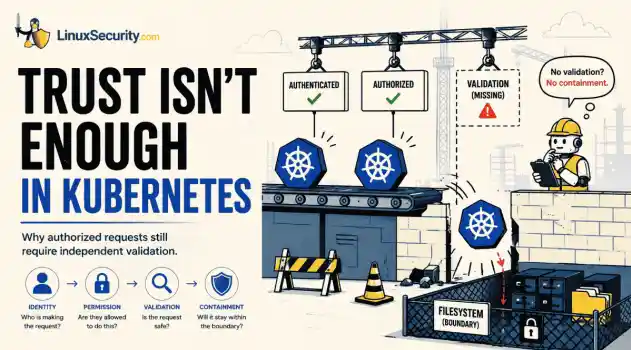
 Two newly fixed storage bugs in Kubernetes showed more than just a problem with path traversal. They found a common security flaw in the cloud: powerful parts often think that requests accepted by a higher system are safe to run. This is a simple lesson for the platform and security teams: RBAC can accept a request without showing that its parameters will stay within a certain filesystem boundary. This is clear from a new study from SentinelLabs into flaws in the Kubernetes CSI drivers for NFS...
Jul 24, 2026
 security advisory update
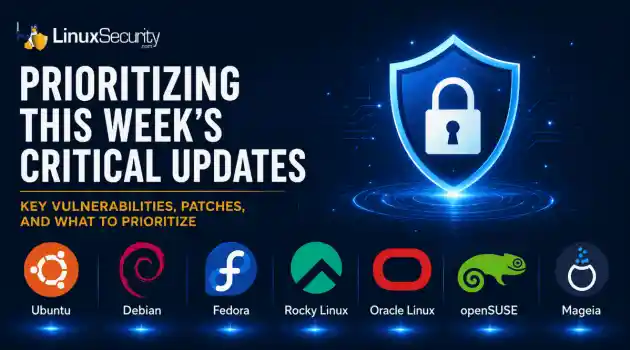
 A large volume of Linux security updates and advisories this week across major distributions once again, but it wasn't just the volume that was the story. Where maintainers and security teams focused their attention was evident in the concentration of fixes targeting Linux kernel updates, identity services, DNS infrastructure, and internet-facing software. . Instead of looking at each advisory in isolation, administrators gain more value from the general trends they reveal about Linux security...
Jul 23, 2026
 identity management security tactics
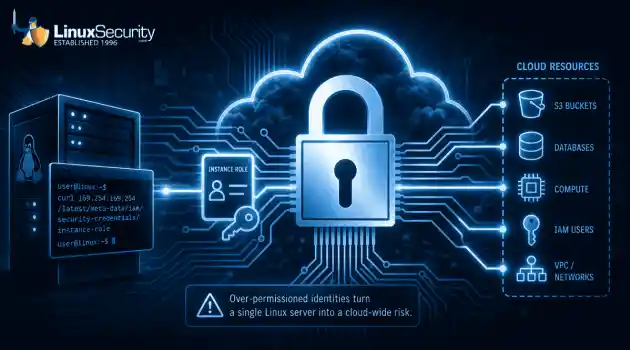
 For years, we secured our Linux infrastructure by building walls: VPCs, security groups, and hardened SSH configurations. We treated the cloud like a virtual data center, assuming that if we kept the "bad guys" out of the network, our workloads were safe. . That model is no longer sufficient. Today, one of the most common paths from an initial compromise to a major cloud breach is the identity assigned to your Linux workload. When an attacker gains code execution on a Linux instance—through a...
Jul 17, 2026
 security practices patch management
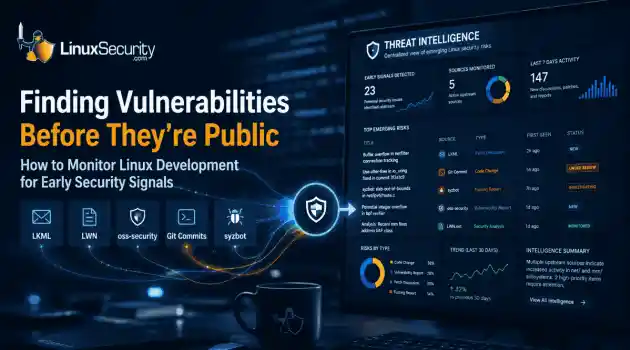
 Most of us don't hear about a kernel vulnerability until a CVE lands in our inbox or the vulnerability scanner starts complaining. By then, the patch isn't new anymore. Kernel developers may have been passing it around for review, arguing over the implementation, or revising it for days before anyone outside that community noticed it. None of those discussions are secret. They're sitting in mailing list archives, Git commits, and patch reviews where they've been the whole time. The strange...
Jul 14, 2026
 Refine features
X Clear Filters
Get the latest News and Insights
Get the latest Linux and open source security news straight to your inbox.
Community Poll
Are host-based firewalls still worth using?
Loading...
Explore Latest Linux Security features
We found -2 articles for you...
102
 network securitydata breachcybersecurity threats
Improving Enterprise Security Posture With ManageEngine Tools
Enterprise vulnerability management is vital to having a robust, proactive endpoint security strategy that enables organizations to identify and address data and network security issues before they lead to an attack or cloud security breach. This cyclical process involves identifying IT assets and correlating them with a continually updated vulnerability database to identify network security threats, misconfigurations, and bugs. Such management prioritizes the urgency and impact of each issue so your company can respond to critical cybersecurity vulnerabilities swiftly prior to exploitation. . Despite the value of establishing and maintaining vulnerability management tools to strengthen and improve security posture, too many organizations still fall short in obtaining such a service due to various challenges and roadblocks. Unfortunately, more businesses fall victim to breaches than ever before; in fact, global cyberattacks increased by 38% in 2022. In order to protect against cybersecurity vulnerabilities, enterprises need an end-to-end vulnerability management and compliance solution that provides 360-degree visibility into their security risk exposure and offers built-in remediation. In this article, we will discuss the obstacles businesses face when setting up their enterprise vulnerability management, the benefits of having this effective service, and how it can help defend against damaging cybersecurity threats and vulnerabilities. Why Are Vulnerability Management & Compliance Critical Challenges for the Enterprise? Despite the central role that vulnerability management holds in an effective endpoint security strategy, there are common roadblocks that organizations face that impede their ability to reliably identify and fix security risks and shortcomings. In most organizations, there are simply too many cybersecurity vulnerabilities across thousands of heterogeneous assets in distributed networks to be tracked manually, and not all of them pose an equal risk. With the window between networksecurity threats and hackers shrinking, organizations must be swift in their detection and remediation of such cybersecurity weaknesses. It is unrealistic for organizations to move forward without the assistance of an automated enterprise vulnerability management and compliance solution, as so few companies have the time, resources, and knowledge to be able to combat network security issues effectively on their own. Anandraj Paul, Head of Development and Endpoint Security at ManageEngine, states, “Many vulnerability management tools on the market offer patching through a third-party integration, but juggling multiple tools for vulnerability assessment and patch management results in a fragmented and inefficient workflow. Moreover, if an adversary does use a vulnerability to gain access to the network, they will exploit overlooked misconfigurations to laterally move and compromise other machines within the network. To prevent this, every loophole and software vulnerability must be addressed to minimize the attack surface and strengthen security." Linux Security expert and LinuxSecurity.com Founder Dave Wreski adds, “ While issuing vendor-published patches to affected machines is the ideal remediation option, having a fail-safe plan to fall back on in the case of unpatchable circumstances like end-of-life software and zero-day vulnerabilities is essential to preventing attacks and breaches.” Security Spotlight: How ManageEngine Vulnerability Manager Plus Meets Our Criteria for an Effective Vulnerability Management Solution ManageEngine Vulnerability Manager Plus is a multi-OS vulnerability management and compliance solution we love since it is an effective and efficient solution. It is an end-to-end vulnerability management tool delivering comprehensive coverage, continual visibility, rigorous assessment, and built-in remediation of cybersecurity threats and vulnerabilities, all from a single console, wherever your endpoints are located. Let’s take a closer look at what makes ManageEngineVulnerability Manager Plus a great option for organizations looking to improve security posture without sacrificing convenience. Cybersecurity Vulnerability Assessment With the plethora of network security issues that exist in OSes, third-party software, programs, and applications today, organizations need to be able to identify and prioritize real data and network security threats, as new vulnerabilities are identified every 90 minutes. ManageEngine Vulnerability Manager Plus enables organizations to assess and prioritize cybersecurity vulnerabilities based on exploitability, severity, age, affected system count, and the availability of the fix. ManageEngine’s cybersecurity vulnerability assessment tool regularly scans your network for weaknesses, delivers insights into risk, and helps close the vulnerability management loop instantly with direct remediation from the console. With ManageEngine, organizations can: Eliminate blind spots and keep track of assets. Gain extensive vulnerability coverage. Catch online and web application security vulnerabilities as they appear using continuous monitoring logs. Assess vulnerability risk and prioritize response. Enable cybersecurity vulnerability management to see critical network security issues at a glimpse with dashboard widgets (pictured below). Leverage built-in security patching to ensure swift and accurate remediation. Compliance Modern IT’s dynamic nature causes inevitable security gaps, as IT teams are forced to make constant changes to configurations, which can lead to newer systems and software being overlooked, leaving them with insecure setups. Poorly configured systems pave the way for malicious hackers and pose significant compliance risks by incurring hefty fines from regulatory bodies. The Center for Internet Security (CIS) benchmarks provide prescriptive guidance for establishing a secure baseline configuration for assets. However, the requirements are challenging to meet, monitor, and maintain without the helpof a solution like ManageEngine Vulnerability Manager Plus. ManageEngine’s CIS compliance feature helps accomplish and maintain data and network security as well as audit objectives, as over 75 CIS benchmarks regularly monitor your endpoints for all applicable CIS benchmarks, instantly detecting violations and suggesting detailed, corrective actions. The feature allows organizations to easily: Group policies. Map targets and schedule audits. Audit and improve compliance. Patch Management Once your cybersecurity vulnerabilities get identified and assessed, the next step is to utilize security patching to protect your company against damaging exploits in cybersecurity. In order to be effective, efficient, and secure, patch management must be carefully planned and orchestrated. If not, it can potentially cause more harm than the vulnerabilities it is supposed to address. ManageEngine Vulnerability Manager Plus has a built-in patching module that helps you customize, orchestrate, and automate complete patching so that the process is to your liking. The module gives organizations the ability to: Seamlessly patch a heterogeneous, multi-platform IT infrastructure. Test, approve, and decline patches. Automate patch deployment. Customize the patch management process with flexible deployment policies Security Configuration Management Zero-day cybersecurity vulnerabilities are inevitable. Without ensuring you have established and maintained ideal data and network security configurations in your endpoints, a single vulnerability could shake your organization to the core. Effective security configuration management tools involve continually detecting configuration drifts and misconfigurations across various components in your endpoints so you can focus on bringing them back into alignment. ManageEngine Vulnerability Manager Plus facilitates the entire cycle of security configuration management from a single interface, including detecting misconfigurations, categorizing andprofiling them, resolving them with built-in remediation, and reporting the final configuration posture. The solution’s capabilities verify that the data and network security of systems is enforced with complex passwords, least privileges, memory protection, and CIS and STIG security guideline compliance. Web Server Hardening Web servers are the point of contact between a business and its customers. Servers deliver web pages to clients upon request and host websites and web-based applications. Since a web server is an Internet-facing device, it can provide an entry point for attackers if not configured properly. In order to keep pace with industry demands, enterprises must constantly make changes to their server configurations, but making these changes manually often results in dangerous configuration drifts. ManageEngine Vulnerability Manager Plus continuously monitors your web servers for default and insecure configurations so it can display them in the console. With a vulnerability management tool, administrators and IT teams can identify servers whose communications are not secured via a Secure Sockets Layer (SSL) certificate. SSL certificates are valuable for ensuring data encryption and decryption to protect companies from unauthorized interception. ManageEngine Vulnerability Manager Plus provides a detailed description of the cause, impact, and remediation of each server misconfiguration. These critical insights can be used to help set up a secure server that is protected against attacks in network security, including URL manipulation attacks, input validation attacks, Denial of Service attacks, brute-force attacks, session hijacking, clickjacking, and source code disclosure, among other network security threats. High-Risk Software Audit The proliferation of different devices and software in recent years, especially post-pandemic, has inevitably put enterprises at risk of unsupported and unauthorized software, including end-of-life software, peer-to-peer software, and remote desktopsharing software. This software can compromise a corporate server with network security threats like information disclosure, malicious code injection, and unauthorized access, all of which can damage an organization's data network security and reputation. It is of critical importance to audit such high-risk software installed in network systems without administrators’ knowledge. With ManageEngine Vulnerability Manager Plus at your disposal, you can: Monitor your network endpoints continuously and detect end-of-life software, peer-to-peer software, and remote sharing tools present in them. Get details on the expiry date and the number of days before software in your network faces end-of-life. Obtain real-time information on the number of machines that are affected by this software. Eliminate this software with just a click of a button from the console. Zero-Day Vulnerability Mitigation Though we would all love to put an end to cybersecurity vulnerabilities once and for all with security patching, such a solution is not always realistic. In some cases, patches aren't available to fix flaws, mainly when they are zero-day vulnerabilities and other publicly disclosed network security threats. Luckily, ManageEngine Vulnerability Manager Plus can help organizations harden their systems and software against network security issues that have no patching options. This vulnerability management tool allows enterprises to: Leverage a dedicated view for zero-days. Deploy mitigation scripts. Stay up-to-date with the latest security patching opportunities. Get notified about zero-day patches. Keep track of OS and application end of life. With ManageEngine Vulnerability Manager Plus, you can stop waiting around for patches and deploy pre-built, tested scripts to secure your network with zero-day mitigation solutions. Beyond the Capabilities of Traditional Vulnerability Management Tools ManageEngine Vulnerability Manager Plus exceeds the capabilities of traditional vulnerabilitymanagement and compliance solutions in the following critical areas to provide stronger, more reliable protection against cybersecurity vulnerabilities: Executive reports : Review and improve security posture to make informed decisions with holistic reports. Antivirus Audits : Gain insight on antivirus protection across your network systems. Deployment Policies : Decide when to patch, what to patch, and how to patch. Role-Based Administration : Define roles and delegate tasks to technicians based on enterprise needs. Final Thoughts on Securing Your Organization Against Cybersecurity Vulnerabilities With the increase in cybercrime and the growing complexity of the modern IT infrastructure, a comprehensive, automated vulnerability management tool and strategy has never been more important for your enterprise. ManageEngine Vulnerability Manager Plus exceeds the capabilities of traditional vulnerability management solutions to improve security posture, increase visibility, and help businesses meet compliance standards. Anandraj Paul, Head of Development, Endpoint Security, ManageEngine, explains, "There's no silver bullet solution that renders your network impenetrable to cyber exploits. But by constantly reevaluating and strengthening the security stance of your network with Vulnerability Manager Plus, you stand a much better chance against detecting and thwarting cyber trespassers in your network." Ready to improve your vulnerability management and compliance strategy to ward off cyberattacks in network security and cloud security breaches? We encourage you to download ManageEngine Vulnerability Manager Plus and see for yourself why we recommend it so strongly! . Evaluating organizational vulnerability management strategies is vital for strengthening endpoint security and reducing the risk of data breaches effectively. Enterprise Security Management, Cyber Threat Mitigation, IT Compliance Strategies, Risk Assessment Tools, Endpoint Vulnerability Solutions. . Brittany Day
 Mar 20, 2023
•
Mar 20, 2023
•
102
 access managementsecurity complianceendpoint security
Key Factors for Choosing Remote Access Software in Linux Environments
Choosing the right software for your enterprise can be a critical decision to make. With multiple remote access software out on the market, it can be perplexing to narrow down to one solution for your enterprise environment. By considering major business use cases and essential security factors, we have compiled a quick checklist to simplify your decision-making process. . Security Software without security features and basic authentications will make your enterprise ecosystem vulnerable to threats and hacks. Ensure the software you choose is coupled with robust authentications like SSO - how SSO works is particularly important for Linux environments since it enables users to access multiple services with a single set of credentials - along with 2FA/MFA, end-to-end encryption, and role-based access, as well as exhaustive recording and reporting features. Compliance It is essential organizations adhere to laws and regulations, which is why most of the industry sectors are compliant to mandates and policies like HIPPA, GDPR, and PCI-DSS. When picking a solution, check whether the software will be compliant with these mandates, as well as your specific organizational policies. One thing to look out for is that the software doesn't establish a remote connection without prompting confirmation on the remote device. Simple to Use In most scenarios you would want to connect to a remote device instantly. A user-friendly interface and simplified workflow are additional factors you must look into before purchasing the software. Installation and initiating remote sessions must be a seamless process and no additional training should be required. Scalable & Flexible Industries and enterprise businesses are growing everyday, resulting in an ever-increasing amount of endpoints that need to be managed. Server and space outages must never be an issue for your organization. The software you choose should be scalable for unlimited endpoints and be available all the time. When it comes to remoteaccess, the major goal is to control a device from anywhere, at any time, even while on the go. Compatible Not all devices in your enterprise run Linux OS. There will be a mix of Windows, Mac, and other OSs to consider, so it is essential to ask "will I be able to access a Linux machine from a Windows or Mac device, or vice versa?" If the software lets you access from an Android and iOS device as well, then that's a bonus. Unlimited & Unbounded Pricing must not limit the number of remote sessions you are allowed to take. Even from the tip of an iceberg, if you have internet connectivity, you must be able to access your endpoints remotely. A secure remote access solution with communication feature like chat and calls will make your troubleshooting process simple. To make the right business decision for your enterprise, all you need is a boundless and reasonably priced solution. "If a remote access solution checks each of these, then that's the one you're looking for." How Remote Access Plus Covers this List! > Remote Access Plus is a robust remote access and troubleshooting solution for an enterprise ecosystem. It double ticks the checklist by prioritizing security and unifying a solution for various business use cases. Exclusive trusted communication between endpoints and servers. End-to-end encryption during remote sessions, file transfer etc. HIPPA, GDPR, PCI-DSS compliant access from desktops and mobile apps. Authenticate with SSO, MFA/2FA, SAML, and more. Configure instant notifications for data breaches. Provide confined access based on roles. Secure servers from vulnerabilities by automating security patches. Cloud-based solution to scale up seamlessly. Initiate unlimited remote sessions to your endpoints. Made user-friendly with a simple web based console. Access your Linux computers from Mac, Windows, Android, and iOS devices in a matter of minutes. It can be confusing to make the right decision when consideringdifferent features, various pricing estimations, and perplexing editions provided by vendors. But choosing the right secure remote access solution will simplify your work rather than increasing your burden. So create an exclusive checklist, evaluate multiple solutions and pick out the one that best suits your Linux environment. . Security Software without security features and basic authentications will make your enterprise ecos. choosing, right, software, enterprise, critical, decision. . Brittany Day
Oct 17, 2022
•

102
 security toolkernel exploitLinux kernel
BlackHat USA 2022: eBPF Kernel Exploitation Detection and Prevention
Let's take a brief look at what Guillaume Fournier from Datadog presented at Blackhat USA 2022: “One of the fastest growing subsystems in the Linux Kernel is, without any doubt, eBPF (extended Berkeley Packet Filter)." . He elaborates, "Although eBPF initially targeted network monitoring and filtering use cases, its capabilities have been broadened over time. With each new kernel version, the capabilities of eBPF are getting closer to that of a kernel module with additional benefits: system safety and stability. Like any other kernel features, eBPF has introduced its fair share of kernel bugs and vulnerabilities, questioning the maturity of a solution that introduces a rich feature set but considerably increases the kernel attack surface. On the other hand, eBPF is now powering an increasing amount of endpoint protection solutions, showcasing original ideas to detect threats at runtime. Unlike many projects that aim at detecting malicious behaviors in user space, this talk focuses on how eBPF can be leveraged to detect and prevent various kernel exploitation strategies.” Now I know you may be wondering: what exactly is eBPF? Well, let's go through it together! Given the linux kernel's unrestricted ability to monitor and manage the entire operating system, it has always been the ideal location to incorporate observability, security, and networking features. At the same time, because of its key function and high requirements for stability and security, the kernel is difficult to use when it comes to applications. Berkeley Packet Filter, or BPF for short, introduced a new interface for programs to make kernel requests alongside syscalls, making a significant modification to the old kernel model. Big name companies such as Netflix and Facebook run many BPF applications due to its capability of running new types of user-defined and kernel-mode applications. BPF is essentially a kernel and user-space observability mechanism for executing code in kernel or user space that reacts to events such asfunction calls, function returns, and trace points. BPF programs offer both rapid and extremely powerful and flexible ways of deep observability of what is happening in the Linux kernel or user space. Understanding the Linux Kernel Architecture When it comes to the Linux Kernel, there are roughly three parts to it: the user space, the linux kernel itself or the OS, and then finally we have the actual hardware. Essentially, this all works together and is wrapped in a process. Anything that is not a kernel process, such as normal apps, operates in the user space. Any code that runs within the user space has restricted hardware access and relies on kernel space code for privileged activities, such as reading and writing on the disk, or even network interaction such as sending data via a BSD or TCP socket. The Kernel space, on the other hand, contains the operating system's core. It has complete and unlimited access to all hardware, including RAM, storage, and the CPU. As we stated earlier, the kernel space is secured and only permits the most trusted programs to execute, including the kernel itself and numerous device drivers, which means code within the user space has limited access. In the image below, it basically sums up the this entire process: While the system call interface might be enough in some cases, developers may require complete flexibility to handle new hardware, create new programs, etc, and this requires expanding the underlying kernel without directly modifying the kernel source code. This is where eBPF comes into play. How eBPF Works What eBPF allows users to do is quite incredible; it allows users to take a system call and run a program that takes over on its behalf. With this in mind, it can be used to create programs for networking, debugging, tracing, firewalls, and more. eBPF was inspired by dtrace, a dynamic tracing tool available primarily for the Solaris and BSD operating systems, since there was a need for better Linux tracing capabilities. Unlike dtrace, linux at thetime could not provide a layout of systems that were running hence the need to improve eBPF, giving a similar set of functionalities as dtrace. To avoid hazards such as limitless loops, eBPF applications are evaluated within the kernel. As a result, as compared to an arbitrary Linux loadable kernel module, eBPF applications represent less risk. There is an eBPF Runtime within the kernel, and the runtime ensures that these programs guarantee and meet all programmability standards. Additionally, programs are written and executed in bytecode when using eBPF. As a result, eBPF allows programmers to securely run custom bytecode within the Linux kernel without altering or adding to kernel source code, allowing applications with custom code to interact with protected hardware resources while putting the kernel at little risk. Benefits of eBPF eBPF can be adapted to do a variety of things, and its benefits are highlighted below: Performance : eBPF allows packet processing to be moved from the kernel to the user space. eBPF is also a just-in-time (JIT) compiler. eBPF is invoked after the bytecode is compiled, rather than a fresh interpretation of the bytecode for each method. Invasiveness is minimal: When used as a debugger, eBPF does not require the application to be stopped in order to examine its status. Security: Programs are essentially sandboxed, as shown in the image below, which means that kernel source code stays safe and unmodified. The verification phase guarantees that resources are not overburdened by programs that perform infinite loops. Moreover, eBPF provides a unified, robust, and user-friendly framework for tracing processes which improves both visibility and security. Convenience: It takes less effort to write code that hooks into kernel functions than it does to construct and maintain kernel modules. There are many reasons why people should use eBPF as listed above, but here are some reasons why you shouldn’t: Detecting post compromission isfighting a lost battle There are dozens of ways to disable an eBPF program eBPF can have a significant in kernel performance impact Known Issues within the Linux Kernel Critical CVEs are regularly discovered within the Linux Kernel. As of now, there are a recorded 3349 CVE Records for the linux kernel alone. This causes security administrators and daily users to worry about: Keeping up with security updates Deploying security patches Monitoring & protecting vulnerable hosts As of now, we already have 2 vulnerabilities for the month of August with regards to the linux kernel. Firstly, we have CVE-2022-1012 , which consists of a memory leak problem that was found in the TCP source port generation algorithm in the net/ipv4/tcp.c file due to the small table perturb size. This flaw could allow an attacker to leak information and can give them free rein to cause a denial of service problem or carry out a full-fledged DoS attack. The second vulnerability would be CVE-2022-1973 , which consists of a use-after-free flaw that was found in the Linux kernel in the log_replay in fs/ntfs3/fslog.c file in the NTFS journal. Essentially, this flaw allows a local attacker to crash the system and leads to a kernel information leak problem. With the implementation and modification of eBPF, we can monitor kernel activity and patch zero-day attacks and vulnerabilities before they are found. For the sake of what was presented at Blackhat USA 2022, we will be discussing how to prevent the following 3 vulnerabilities with eBPF: Execution flow redirection Logic bugs Post compromise kernel runtime alteration DataDogs Solution: KRIe Kernel Runtime Integrity with eBPF is an Open-Source, Compile Once Run Everywhere tool that aims to detect Linux Kernel exploits with eBPF. KRIe is far from being a bulletproof strategy: from eBPF related limitations to post exploitation detections that might rely on a compromised kernel to emit security events, it is clear that a motivated attacker willeventually be able to bypass it. That being said, the goal of the project is to make attackers' lives harder and ultimately prevent out-of-the-box exploits from working on a vulnerable kernel. Requirements This project was developed on Ubuntu Focal 20.04 (Linux Kernel 5.15) and has been tested on older releases down to Ubuntu Bionic 18.04 (Linux Kernel 4.15). golang 1.18+ (optional) Kernel headers are expected to be installed in lib/modules/$(uname -r), update the Makefile with their location otherwise. (optional) clang & llvm 14.0.6+ To best show how this tool works, the developers created two scenarios for us users: Scenario 1: the attacker controls the address of the next instruction executed by the kernel Scenario 2: the attacker is root on the machine and wants to persist its access by modifying the kernel runtime In scenario 1, machines with SMEP & SMAP can prevent an attacker from carrying out the instruction executed in the user space, however, what about machines without SMEP & SMAP? KRIe places a kprobe and checks if the Stack pointer / Frame pointer / Instruction pointer registers point to user space memory. Remember earlier we said that KRIe is not bulletproof and attackers can find a way around the kprobe by disabling it using the commands echo 0 > /sys/kernel/debug/kprobes/enabled Or sysctl kernel.ftrace_enabled=0 An attacker can also disable a kprobe by killing the user space process that loaded it to begin with. KRIe combats this by setting up what they call booby traps, essentially setting the Return Object Programming or ROP chain to set the instruction the attacker is trying to take over to null. In scenario 2, the attacker could: Insert a rogue kernel module Hook syscalls to hide their tracks Using kprobes By hooking the syscall table directly Use BPF filters to silently capture network traffic Use eBPF programs to implement rootkits KRIe combats thisby: Monitoring All bpf() operations and insertion of BPF filters Kernel module load / deletion events K(ret)probe registration / deletion / enable / disable / disarm events Ptrace events Sysctl commands Execution of hooked syscalls All syscall tables are checked periodically and KRIE is also able to detect and report when a process executes a hooked syscall whilst also locking down the execution flows in the kernel by controlling call sites at runtime. Moreover, every detection is configurable whether it be Log, Block, Kill, or Paranoid which are different detection definements. Our Thoughts Powerful defensive tools can be implemented with eBPF as shown with the KRIe tool however, eBPF is not really the ideal technology to detect kernel exploits. KRIe is realistically a last resort and not a bulletproof strategy but why not put that to the test! Follow along with us in our next article as we put this open-source tool through various test-environments. . Uncover the ways eBPF elevates the monitoring and protection of the Linux kernel by detecting vulnerabilities and reinforcing the overall integrity of system operations.. Kernel Exploitation, eBPF Monitoring, Security Tools, Linux Kernel, Runtime Protection. . Brian Gomez
Aug 29, 2022
•

Get the latest News and Insights
Get the latest Linux and open source security news straight to your inbox.
Community Poll
Are host-based firewalls still worth using?
Search Topics
Powered By

Linux Security - Your source for Top Linux News, Advisories, HOWTOs and Feature Releases
QUICK LINKS
subscribe to newsletters!
Like staying secure? So do we.
Sign up for updates, tips, and alerts!