Audit Linux privileges now to limit compromise, escalation, and system-wide damage. Review Linux Privileges×


Stay Ahead With Linux Security Features

 security advisory path traversal
 Two newly fixed storage bugs in Kubernetes showed more than just a problem with path traversal. They found a common security flaw in the cloud: powerful parts often think that requests accepted by a higher system are safe to run. This is a simple lesson for the platform and security teams: RBAC can accept a request without showing that its parameters will stay within a certain filesystem boundary. This is clear from a new study from SentinelLabs into flaws in the Kubernetes CSI drivers for NFS...
 Jul 24, 2026
 security advisory update
 A large volume of Linux security updates and advisories this week across major distributions once again, but it wasn't just the volume that was the story. Where maintainers and security teams focused their attention was evident in the concentration of fixes targeting Linux kernel updates, identity services, DNS infrastructure, and internet-facing software. . Instead of looking at each advisory in isolation, administrators gain more value from the general trends they reveal about Linux security...
Jul 23, 2026
 identity management security tactics
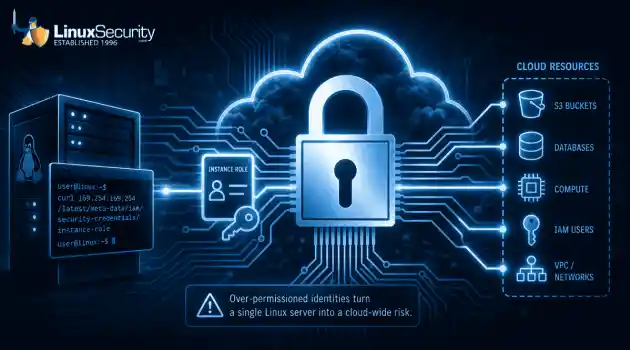
 For years, we secured our Linux infrastructure by building walls: VPCs, security groups, and hardened SSH configurations. We treated the cloud like a virtual data center, assuming that if we kept the "bad guys" out of the network, our workloads were safe. . That model is no longer sufficient. Today, one of the most common paths from an initial compromise to a major cloud breach is the identity assigned to your Linux workload. When an attacker gains code execution on a Linux instance—through a...
Jul 17, 2026
 security practices patch management
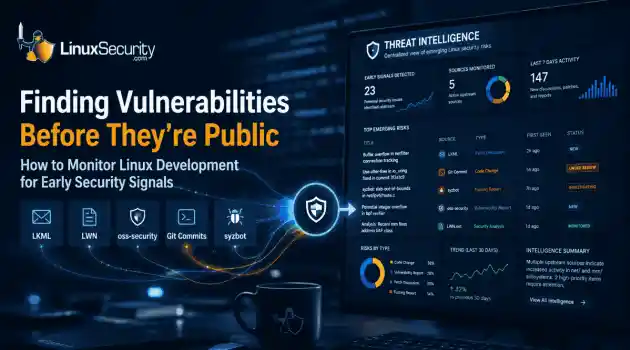
 Most of us don't hear about a kernel vulnerability until a CVE lands in our inbox or the vulnerability scanner starts complaining. By then, the patch isn't new anymore. Kernel developers may have been passing it around for review, arguing over the implementation, or revising it for days before anyone outside that community noticed it. None of those discussions are secret. They're sitting in mailing list archives, Git commits, and patch reviews where they've been the whole time. The strange...
Jul 14, 2026
 Linux security cyber attacks
 Every Linux server in your fleet produces thousands of events every minute. From journald logs and auditd records to kernel-level eBPF hooks, your systems are constantly talking. Most of that noise is just the mundane churn of system services, CI/CD runners, or routine administrative automation. But among that noise, an attacker might be establishing a foothold, moving laterally, or setting up persistence. The challenge for any security team is: how do you separate the routine from the...
Jul 13, 2026
 Refine features
X Clear Filters
Get the latest News and Insights
Get the latest Linux and open source security news straight to your inbox.
Community Poll
Should Linux servers automatically install security updates?
Loading...
Explore Latest Linux Security features
We found -3 articles for you...
102
 network securitydos attackvoip
IPv6 SYN Flood Analysis: DoS Threats and Protection Strategies
In this paper, we describe and analyze a network-based DoS attack for IP-based networks. It is known as SYN flooding. It works by an attacker sending many TCP connection re¬quests with spoofed source addresses to a victim's machine. Each request causes the targeted host to instantiate data structures out of a limited pool of resources to deny further legitimate access. Part I Part II Part III Part IV . Result Analysis Most powerful and flexible L4-7 security and content networking test solution proven for: Firewalls, edge routers, session controllers, proxies, IDS/IPS, and VPN concentrators. Servers, content switches/caches, load balancers, SSL accelerators Mix real VoIP calls (H.323 & SIP) over integrated DHCP, IPSec, PPPoE, and 802.1 xs Realistic testing, faster set-up, no need for scripting I ntegrated IPv6, IPsecv6, VLAN, and SNMP support -Rapidly test next-generation dual-stack devices and Stress the management plane at the same time. Create a realistic mix of application traffic with H.323, SIP, RTSP, SNMP, messaging on each test interface, and DoS. /spam /virus attacks with over 150 measurements. Final Thoughts on IPv6 approach for TCP SYN Flood attack over VoIP This paper has described and analyzed a network-based denial of service attack called SYN flooding. It has contributed a detailed analysis of a practical approach to application Performance validation for VoIP applications with IPv6/IPv4 configurations and TCP SYN Flooding attacks over connection-oriented networks. To protect from DoS attacks for secure, scalable, high-availability IPV6 services over VoIP performance, the above methods have proven to have better results. It has also proved to work for spam and virus attacks over TCP connections with network tester methods of MoonV6. Acknowledgment We would like to thank Zlata Trhulj for the design documentation of IPv6 services and network tester methods presented at the North American IPv6 Coalition Meeting, Reston, VA, 25 May 2005. About theAuthor: Suhas A Desai Undergraduate Computer Engineering Student, Walchand CE, Sangli, INDIA. Previous Publications in the area of "Linux Based Biometrics Security with Smart Card" include ISA EXPO 2004, InTech Journal, TX, USA, IEEE Real-Time and Embedded System Symposium 2005, CA, USA.,e-Smart 2005, France. Writes security newsletters and features for many security sites. . Explore the challenges of network-centered Denial of Service attacks in IPv6 VoIP environments. Investigate strategies to strengthen defenses and enhance communication integrity. tcp syn flood, ipv6 security, voip testing, dos solutions, network analysis. . Benjamin D. Thomas
 Jan 11, 2024
•
Jan 11, 2024
•
102
 network securitycybersecurityransomware
IceFire Ransomware: Tactics, Protection, and Security Practices for Linux
IceFire Ransomware, which already utilizes exploits in cybersecurity to attack Linux systems, has recently developed a new strain . This threat takes advantage of an IBM Aspera Faspex file-sharing vulnerability ( CVE-2022-47986 ) that had previously only targeted Windows systems and media and entertainment companies. Since Linux systems tend to be quite powerful in mitigating risks, IceFire Ransomware is all the more concerning, as it can breach robust cybersecurity systems and cause substantial harm. . The ransomware operators' tactics are consistent with those of the "Big-Game Hunting (BGH)" ransomware families, as the variant focuses on attacking large enterprises, leveraging double extortion, utilizing evasion techniques like deleting log files, and implementing numerous persistence mechanisms. Double extortions are detrimental since these attacks in network security typically demand twice as much for the ransom payment. As network security issues rise, you must stay up-to-date on the latest security news. Knowing the best security practices can help you mitigate risks before they damage your server. This article will review ransomware, dive into IceFire Ransomware, and show you how to protect your server. What Is Ransomware? Ransomware cybercriminals focus on breaching a company’s system, decrypting sensitive files and valuable data, and forcing victims to pay a ransom, or a large sum of money, before returning company work to employees. This type of malware is more damaging to a business than typical malware and phishing email attacks since money is involved. What Does a Ransomware Attack Look Like? During a ransomware attack, users might receive a phishing email that appears to be from a trustworthy sender due to the use of social engineering tactics. Users will open the message and download attachments or links that lead to legitimate-looking documents and websites. Then, cybercriminals can install ransomware they please onto a server, infecting a system and taking away primaryaccess to data companies need for daily operations. What is IceFire Ransomware and its Characteristics? IceFire Ransomware on Linux systems comes across as 2.18 MBs, 64-bit Executables, and Linkable Binary Files (ELF) with open-source GNU Compiler Collection (GCC) for AMD64 system processor architecture. Cybercriminals deployed the services against CentOS hosts so they could run successfully on Intel-based Ubuntu and Debian distributions. Impacted systems download the IceFire payloads, execute them to encrypt files, and rename them with the ".ifire" extension. Then the payload stealthily deletes itself to avoid detection. IceFire Linux payload scripts exclude encryption for specific system-critical files and paths like the following: .cfg, .o, .sh, .img, .txt, .xml, .jar, .pid, .ini, .pyc, .a, .so, .run, .env, .cache, .xmlb, p, /boot, /dev, /etc, /lib, /proc, /srv, /sys, /usr, /var, /run. This intentional deletion prevents encryption so companies can still operate their server. The variant exploits cybersecurity vulnerabilities by implementing itself into the system rather than relying on phishing emails and third-party frameworks. As a result, network security threats may go undetected for an extended period while devising a plan of attack. Once the business faces a breach, there is very little they can do to stop it since the cybercriminals have done extensive research when sitting inside the company's server for so long. The Linux IceFire ransomware payload uses an RSA encryption algorithm with an RSA public key hard-coded into the binary. The payload drops a ransom note from an embedded resource and writes it to each directory targeted for file encryption. The ransom note includes a predefined username and password that you must use to access the ransom payment website hosted on a Tor hidden service to ensure anonymity. How Could IceFire Break Into Secure Linux Systems? Linux security expert and LinuxSecurity.com Founder Dave Wreski remarks, “Linux presents more challenges forransomware operators than Windows, especially on a large scale. Many Linux systems are servers less susceptible to common infection methods like phishing or drive-by downloads. Thus, attackers have resorted to exploiting application vulnerabilities, as we have recently seen with the IceFire ransomware group.” How Can I Secure My Linux Systems Against IceFire Ransomware? Cybercriminals target Linux operating systems more frequently since their highly secure servers outperform Windows and macOS in data and network security. More online customers rely on Linux to power a company's high-value devices as the necessity for email protection skyrockets. Malware , rootkits , and more malicious network security threats put Linux users at risk even more as the system popularizes. Unfortunately, we know only one threat management platform that can combat and stop evasive ransomware attacks in network security: Vali Cyber's ZeroLock . What is ZeroLock? How Can It Protect Against IceFire? ZeroLock rapidly and reliably reacts to attacks in network security by deploying email security solutions that effectively combat malware, rootkits, and ransomware. This service injects code into all aspects of a system so it can monitor the controls organizations use frequently. ZeroLock can suspend, delete, or cache any files, links, or downloads that it considers suspicious. Cybersecurity hardening with ZeroLock keeps cloud security breaches far away from your business and ensures email protection throughout your server. What Other Email Security Options Do I Have to Combat Threats? If you are searching for solutions to add to your security tactics on top of Vali Cyber’s ZeroLock, consider implementing these best email security practices that can improve security posture in your Linux system: Stay up-to-date on the latest cybersecurity vulnerabilities impacting your systems. Register as a LinuxSecurity user, subscribe to our Advisory Watch newsletter, and customize your advisories based on distros toknow the latest security news that could cause network security issues for your business. Follow @LS_Advisories on X for real-time updates. Avoid a Single Point of Failure (SPOF) attack by backing up critical files and diversifying your storage media so cybercriminals cannot utilize repetition in a breach. This solution will not stop attacks, but it can mitigate damage. Integrate the principle of least privilege for your users so accounts only provide the access an employee needs and nothing more, reducing the likeliness of an internal breach. Monitor network activity and system logs closely to stop any attack or risk as quickly as possible. Identify anomalous behavior when keeping tabs on event activity. Regularly checking prevents harm from reaching your company. Use a combination of IP filtering, an Intrusion Detection System (IDS), and an Intrusion Prevention System (IPS). These three options can quickly improve security posture and combat more network security threats. Use Linux security extensions that control and restrict access to data or network resources. Such applications will prevent cybersecurity vulnerabilities from being abused during a possible attack. Implement robust network segmentation and data compartmentalization to minimize the impact of a potential ransomware attack. Utilize cloud security audits on systems regularly. Test them and utilize security patching as needed to prevent any risk that could severely harm the productivity of your business. Our Final Thoughts on Securing Linux Systems Against Ransomware Understanding the data and network security issues you may face during a ransomware attack is vital in guaranteeing your company knows how to protect itself from such threats in the first place. IceFire can encrypt files and delete itself from servers to go undetected when hacking into a system and inflicting damage. Although IceFire Ransomware is not the most significant risk out there, it can be detrimental to a business, especially considering itcan get through Linux security systems, which are relatively defensive in their approach to email security. Fortunately, you can utilize various solutions to prevent an IceFire attack from reaching your organization. Wreski concludes, "Linux ransomware is a serious and increasingly prevalent threat, but luckily, attacks can be prevented with sound administration, the implementation of the right technology, and the other security best practices shared in this article." Continue learning how to strengthen your server's email protection by checking out our blog and articles about other types of ransomware and phishing attacks reaching Linux systems. . Discover IceFire ransomware's strategies and implement robust measures to protect Linux environments from evolving cyber threats successfully.. IceFire Ransomware, Linux Security Threats, Protect Linux Servers, Ransomware Prevention Tips, Cybersecurity Practices. . Brittany Day
Mar 13, 2023
•


Get the latest News and Insights
Get the latest Linux and open source security news straight to your inbox.
Community Poll
Should Linux servers automatically install security updates?
Search Topics
Powered By

Linux Security - Your source for Top Linux News, Advisories, HOWTOs and Feature Releases
QUICK LINKS
subscribe to newsletters!
Like staying secure? So do we.
Sign up for updates, tips, and alerts!