Explore top 10 tips to secure your open-source projects now. Read More
×


Stay Ahead With Linux Security Features

 identity management security tactics
 For years, we secured our Linux infrastructure by building walls: VPCs, security groups, and hardened SSH configurations. We treated the cloud like a virtual data center, assuming that if we kept the "bad guys" out of the network, our workloads were safe. . That model is no longer sufficient. Today, one of the most common paths from an initial compromise to a major cloud breach is the identity assigned to your Linux workload. When an attacker gains code execution on a Linux instance—through a...
 Jul 17, 2026
 security practices patch management
 Most of us don't hear about a kernel vulnerability until a CVE lands in our inbox or the vulnerability scanner starts complaining. By then, the patch isn't new anymore. Kernel developers may have been passing it around for review, arguing over the implementation, or revising it for days before anyone outside that community noticed it. None of those discussions are secret. They're sitting in mailing list archives, Git commits, and patch reviews where they've been the whole time. The strange...
Jul 14, 2026
 Linux security cyber attacks
 Every Linux server in your fleet produces thousands of events every minute. From journald logs and auditd records to kernel-level eBPF hooks, your systems are constantly talking. Most of that noise is just the mundane churn of system services, CI/CD runners, or routine administrative automation. But among that noise, an attacker might be establishing a foothold, moving laterally, or setting up persistence. The challenge for any security team is: how do you separate the routine from the...
Jul 13, 2026
 open-source infrastructure risk
 Security scanners flag exposed API keys in public repositories every day. The initial response is usually predictable: delete the commit, revoke the credential, and move on. That’s a mistake. . In a real Linux environment, an API key never stays in one place. By the time it hits a public repo, it’s already everywhere. It’s in the CI/CD pipeline. It’s in your container registry. It’s in the build logs. It’s in the backups. Git makes this worse because the history never dies. Deleting a file in...
Jul 11, 2026
 open-source rootkit
 Most of us think of Linux rootkits as ancient history—the stuff of 90s hacking forums and clunky malware that would crash your system if you looked at it the wrong way. But if you think they’ve gone away, you’re mistaken. They’ve just gotten smarter. . Modern attackers aren't using the noisy tools of the past. Today’s threats are surgical. Many of today’s most advanced Linux rootkits operate at the kernel level or abuse legitimate system features to blend in with normal traffic. They’re...
Jul 09, 2026
 Refine features
X Clear Filters
Get the latest News and Insights
Get the latest Linux and open source security news straight to your inbox.
Community Poll
Is continuous patching actually viable?
Trending Features
Loading...
Explore Latest Linux Security features
We found 1 articles for you...
102
 security advisorydenial of servicecritical
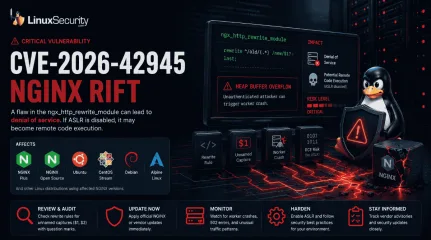
Critical NGINX Vulnerability CVE-2026-42945: What Linux Admins Should Check Now
New flaw leads to denial-of-service on affected NGINX configurations. If ASLR is disabled, it may become a remote code execution. . Known as NGINX Rift, CVE-2026-42945 affects NGINX’s ngx_http_rewrite_module and can allow unauthenticated attackers to crash worker processes with crafted requests. That matters because NGINX often sits at the edge of Linux infrastructure, handling web traffic, redirects, reverse proxy rules, API routing, load balancing, and application delivery. The configuration requirement may look narrow at first, but active exploitation changes the urgency. Vulnerable rewrite rules can sit in production for years without anyone reviewing them closely, leaving exposed NGINX servers as more than just another routine patch item. For Linux administrators, the immediate question is simple. Are any internet-facing NGINX systems using risky rewrite patterns, and have they been updated through official vendor channels? What You Need To Know CVE-2026-42945 affects NGINX Plus and NGINX Open Source. The flaw exists in the ngx_http_rewrite_module . The issue is tied to rewrite configurations using unnamed PCRE captures such as $1 or $2 , with replacement strings that include a question mark. An unauthenticated attacker can send crafted HTTP requests to trigger a heap buffer overflow in the NGINX worker process. The most likely impact is denial of service through worker crashes and restarts. Remote code execution may be possible in weakened environments, especially where ASLR is disabled. Administrators should prioritize official NGINX and vendor update s, then audit rewrite rules across internet-facing systems. Who Should Prioritize This First Not every NGINX server is automatically vulnerable. The risk depends on version, configuration, exposure, and whether vulnerable rewrite logic is reachable by an attacker. Still, some environments should move faster than others. Administrators should prioritize: Internet-facing NGINXservers Reverse proxies handling untrusted traffic API gateways using rewrite rules Kubernetes ingress deployments based on NGINX behavior Older virtual host configurations inherited from previous applications Containers or images that package NGINX directly Systems using unnamed capture references such as $1 or $2 Linux systems where ASLR has been disabled This is especially important for servers that have accumulated rewrite logic over time. Redirects, backend mappings, language routing, legacy URL support, and API path changes are often copied between systems and forgotten. That is where risk can sit unnoticed. Why This NGINX Flaw Matters NGINX is everywhere in Linux environments. It sits in front of web apps, Kubernetes ingress controllers, API gateways, cloud services, containers, and internal dashboards. In many environments, it is the first layer that handles untrusted traffic before a request ever reaches the application. That is what makes this flaw different from a bug buried deep inside one service. An attacker does not need shell access. They do not need stolen credentials. They do not need to reach the backend directly. If the vulnerable rewrite configuration is exposed, crafted HTTP requests may be enough to crash NGINX worker processes and disrupt availability. In production, that could look like intermittent 502 errors, failed API calls, broken redirects, unstable ingress behavior, or repeated worker restarts. In shared reverse proxy or Kubernetes environments, one exposed traffic layer may affect several services behind it. The second concern is how quickly bugs in edge-facing services attract attention. CVE-2026-42945 affects a widely used component and sits in rewrite logic that many teams probably have not reviewed in years. Public proof-of-concept activity has also been reported, which makes patching and configuration review harder to delay. What Makes CVE-2026-42945 Important The vulnerability is not triggered simply because NGINXis installed. According to F5’s advisory , the flaw exists when a rewrite directive is followed by a rewrite, if, or set directive and an unnamed PCRE capture, such as $1 or $2 , is used with a replacement string that includes a question mark. Under those conditions, crafted HTTP requests may cause a heap buffer overflow in the NGINX worker process. That creates a practical problem for Linux teams. Rewrite rules are often old. They are copied between servers, inherited from previous application versions, reused across reverse-proxy templates, and buried in site configs that no one has touched in years. In large environments, administrators may not immediately know which NGINX deployments use vulnerable rewrite patterns. That delay matters in response, since the vulnerability reportedly dates back many years, meaning older, long-lived systems may be exposed if they have not been updated through vendor channels. Old configuration logic has a way of surviving infrastructure migrations. A server might move from bare metal to the cloud. A site might move behind a load balancer. A service might become part of a containerized platform. But the rewrite rules often stay almost exactly the same. Quick 5-Minute Check Administrators should begin by identifying where NGINX is running, especially on internet-facing Linux systems. Check installed NGINX versions: nginx -v Review the active configuration: nginx -T Search for rewrite directives: nginx -T 2> /dev/null | grep -n "rewrite" Search for unnamed capture references: nginx -T 2> /dev/null | grep -E '\$[0-9]' Administrators should pay close attention to rewrite logic that uses captures such as $1 or $2 , especially when the replacement string includes a question mark. Additional priorities should include: Reviewing NGINX virtual host and site configuration files Checking reverse proxy and API gateway rewrite rules Auditing Kubernetes ingress configurations that rely on NGINX behavior Reviewing container images that package older NGINX versions Confirming whether ASLR is enabled on Linux systems Prioritizing externally reachable NGINX deployments first This quick check will not replace patching, but it can help teams find the highest-risk systems faster. Patching Is the Priority The safest response is to update NGINX through official channels. Administrators should apply fixes from F5, NGINX, or their Linux distribution rather than manually modifying source code or relying only on partial configuration changes. Organizations should monitor advisories and package updates from: Red Hat Ubuntu Debian Fedora SUSE AlmaLinux Rocky Linux NGINX upstream sources Cloud image and container image providers should also be checked closely. NGINX is often embedded in base images, reverse proxy containers, ingress controllers, and application delivery stacks. Updating the host operating system alone may not update every NGINX instance running across the environment. That is where teams often miss exposure. A patched server does not help if an older NGINX container is still deployed in production. Temporary Mitigation Requires Configuration Review For organizations that cannot patch immediately, configuration review becomes the next priority. F5’s advisory indicates that the vulnerable condition involves unnamed PCRE captures in certain rewrite patterns. Some reports have recommended replacing unnamed captures, such as $1 and $2 , with named captures where appropriate, but this should be tested carefully before production rollout. Administrators should be careful here. Rewrite rules can affect routing, redirects, authentication flows, API paths, application compatibility, SEO behavior, and backend request handling. A rushed change can break production traffic even if the security goal is valid. The better approach is controlled review: Identify exposed NGINX systems Find rewrite rules using unnamed captures Map whichapplications depend on those rules Test named-capture replacements in staging Deploy patched NGINX packages as soon as they are available Monitor logs for crashes, abnormal requests, and repeated worker restarts Temporary configuration changes can reduce exposure, but they should not become a substitute for patching. Why ASLR Still Matters One of the more important details in the current reporting is the difference between denial of service and code execution. On default hardened Linux systems, the most likely impact appears to be worker process crashes and restarts. That can still be serious, especially against high-traffic services where repeated crashes can degrade availability. But remote code execution becomes a larger concern when exploit mitigations are weakened. ASLR, or Address Space Layout Randomization, makes memory corruption exploitation harder by randomizing where code and data are loaded in memory. If ASLR is disabled, attackers may have a more reliable path from memory corruption to code execution. Administrators can check ASLR status with: cat /proc/sys/kernel/randomize_va_space A value of 2 generally indicates full randomization. A value of 0 means ASLR is disabled. If ASLR is disabled on exposed Linux systems, that should be treated as a serious hardening gap beyond this one vulnerability. Memory corruption flaws become more dangerous when basic exploit mitigations are turned off. Cloud and Kubernetes Environments Need Extra Review This gets more complicated in cloud and Kubernetes environments. If a vulnerable rewrite rule is exposed through an ingress controller or reverse proxy, the impact may not stop at one application. Crafted requests could repeatedly crash NGINX worker processes, trigger restarts, break routing, or affect several services sitting behind the same ingress layer. Cloud-hosted reverse proxies and API gateways run into the same problem. NGINX is used because it is fast, flexible, and familiar. But thatflexibility is also where old risk builds up. Teams add redirects, backend mappings, path normalization, language routing, legacy URL support, and API rewrites. Then those rules get copied, reused, migrated, and forgotten. Years later, they may still be running in production. That is why teams should check more than just traditional Linux servers. They should also review container images, Helm charts, ingress controller configurations, CI/CD deployment templates, and cloud images that include NGINX. Default Impact vs. Weakened-System Impact The impact depends heavily on configuration and hardening. Condition Likely Risk Vulnerable rewrite config exposed NGINX worker crash or denial of service ASLR enabled Exploitation is harder ASLR disabled Remote code execution risk may increase NGINX is used in the ingress or shared proxy layer Multiple services may be affected The older NGINX container is still deployed Host patching may not fully remove exposure This is why administrators should treat the issue as both a patching task and a configuration review task. Immediate Actions for Linux Admins Patch affected NGINX deployments immediately. Audit rewrite rules using unnamed captures such as $1 and $2 . Prioritize internet-facing NGINX servers and reverse proxies. Check container images and Kubernetes ingress deployments. Confirm ASLR is enabled on exposed Linux systems. Monitor logs for worker crashes, abnormal requests, and restart loops. Review vendor advisories for updated NGINX packages. Test any rewrite-rule mitigation before production rollout. Why Exposed Infrastructure Bugs Still Matter Linux servers now sit underneath nearly every modern environment. They power web applications, containers, cloud platforms, CI/CD systems, internal tools, and customer-facing services. Attackers know that edgeservices are valuable because they process untrusted traffic all day. A flaw in a public-facing web server, reverse proxy, or ingress layer can create immediate operational risk, even before attackers reach the application behind it. CVE-2026-42945 is a reminder that mature infrastructure components still need close attention. Old code paths, legacy rewrite behavior, and inherited configuration patterns can carry risk for years. Because in modern Linux environments, attackers do not always need to compromise the application first. Sometimes, they only need the traffic layer in front of it. Want more Linux security breakdowns and vulnerability response checklists? Subscribe to our newsletter for weekly infrastructure, hardening, and security updates. Related Reading Enhance Nginx Security With 25 Best Practices for Linux Linux Security in 2026 Hardening Monitoring and Defense Strategies Container Security Misconfigurations Kubernetes Threats Understanding Container Security Best Practices for Linux Admins The Linux Kernel in 2025: Security Enhancements, Emerging Threats & Best Practices . Known as NGINX Rift, CVE-2026-42945 affects NGINX’s ngx_http_rewrite_module and can allow unauthen. leads, denial-of-service, affected, nginx, configurations, disabled. . MaK Ulac
 May 18, 2026
•
May 18, 2026
•
102
 security advisorycriticalremote code execution
The Ni8mare Chain: How n8n RCE Turns Auth Bypass Into Linux Host Compromise
n8n (CVE-2025-68613) is an open-source automation tool used to connect APIs, databases, and SaaS apps into workflows. It is commonly used to move data between systems, trigger jobs, and tie services together, and in many environments, it also holds credentials and access to internal services. . A remote code execution issue disclosed in December 2025 did not look unusual at first. Patches were released late last year in versions 1.120.4, 1.121.1, and 1.122.0. It was treated as a routine update. The issue lies in how workflow expressions are evaluated. User input was not properly isolated from the Node.js runtime. That gap allows an authenticated user to execute code with the same privileges as the n8n process. On March 11, 2026, CISA added it to the Known Exploited Vulnerabilities catalog. Active exploitation was confirmed, with a March 25 deadline for federal systems. That is where this stops being routine. What looked like a normal patch cycle is now an active exposure window for systems still running older versions. Actively Exploited n8n RCE Puts Linux and Docker Hosts at Risk CISA adding this to the Known Exploited Vulnerabilities catalog confirms active exploitation. The patch has been available since December, but exposed systems stayed unpatched. This isn’t a new issue. It’s one that remained unpatched long enough to be exploited. The n8n vulnerability allows authenticated remote code execution. On its own, that would limit exposure. In practice, attackers are not using it alone. They are pairing it with CVE-2026-21858 (Ni8mare), a separate issue that exposes internal files without authentication. Those files include session data and encryption keys. Enough to recreate or take over valid sessions. Ni8mare provides the session, and the n8n RCE executes within it, so the exploit still follows the expected path but no longer depends on legitimate access. Because Ni8mare targets how n8n handles webhooks, attackers don’t need valid credentials to reach the application,and in many cases, a single exposed webhook or form node is enough to start interacting with the instance and pulling internal data. Why Linux Admins Should Care About the n8n RCE Vulnerability n8n usually runs on Linux hosts, most often Ubuntu or Debian, and a lot of deployments go through Docker or Compose, which looks isolated at first glance but sits closer to the host than people expect. The RCE executes with the same privileges as the n8n process, so the access gained reflects what the service already has, which in real environments typically includes: /etc and system configuration files .ssh directories and private keys Environment variables acting as the primary secret store Internal APIs and services wired into workflows That access exposes high-value data directly, including API keys, OAuth tokens, database credentials, and CI/CD secrets. Most of this lives in environment variables or stored configurations, so what starts at the application layer does not stay there and turns into broader Linux system access tied to whatever those credentials can reach. In newer deployments, that access often extends into AI-related systems. n8n is increasingly used to orchestrate LLM workflows, which means it may have write access to vector databases or internal knowledge stores. Once compromised, that access can be used to modify stored data or influence how downstream systems retrieve and generate information. Attack activity is not just opportunistic. Proof-of-concept exploit code has been published by researchers, and scanners built around it are already circulating. Exposed n8n instances are easy to identify and target at scale. How the n8n RCE Vulnerability Leads to Full Linux System Access At a basic level, n8n lets users build workflows that include small bits of logic called expressions. These are supposed to run in a restricted environment so they can’t affect the rest of the system. That restriction is where the problem is. n8n confirmed in their securityadvisory that these expressions were not properly isolated from the underlying Node.js runtime, which means user-controlled input could break out of that restricted environment and run as normal system code. Once that happens, the application is no longer in control. The code runs with the same permissions as the n8n service itself, which allows attackers to execute system commands, read files like /etc/passwd or SSH keys, access environment variables, and modify workflows or behavior. This is why the impact goes beyond the application. The web interface becomes a direct path to system-level access. How n8n RCE Leads to Full Linux Host Compromise in Docker Environments n8n often runs through Docker Compose, and a lot of those setups run containers as root while also mounting /var/run/docker.sock for automation, which means the app isn’t really contained. It has direct access to the Docker daemon on the host. Once RCE lands inside that container, it doesn’t stay there, because talking to Docker is already part of what the service is allowed to do. With access to the socket, attackers can start new containers, set privileges, mount whatever they want, and the host filesystem is usually the first target. Something as simple as: docker run --privileged -v /:/host alpine cat /host/etc/shadow …is enough to read from the host directly, and from there it’s not just file access, it’s the ability to spin up privileged containers and run commands outside the original container entirely, because nothing is being escaped. The access was already there. Container compromise leads straight to host access in these setups, not because of a complex breakout, but because the configuration hands over control by default, which turns a workflow-level RCE into full Linux host takeover without needing anything extra. Thousands of Exposed n8n Instances Increase Real-World Risk Over 24,000 internet-facing n8n instances have been identified, and many are still publicly accessible, weaklyauthenticated, or running outdated versions, which makes it easy to scan for and exploit at scale. n8n sits in the middle of automation pipelines, so access to one instance usually extends beyond the application itself. Here’s what that access connects to: Cloud services Internal APIs Databases SaaS platforms In newer deployments, that scope expands further because n8n is being used for AI orchestration, where it often has write access to: Vector databases Internal knowledge systems Automation pipelines tied to sensitive data That combination of exposure and reach is why this is getting automated, with scanners and proof-of-concept code already circulating in n8n RCE scanner and exploit code already in circulation, because a single exposed instance is rarely just a single system. What Attackers Do After Exploiting n8n Servers Once RCE is established, attackers start by pulling what the process already has access to, which usually includes environment variables, connected services, and credentials tied to workflows, all available without changing anything or triggering obvious alerts, and that initial access is enough to map out what the instance is connected to. From there, the .n8n directory becomes the priority, because it holds the instance encryption key, and once that key is retrieved, attackers can decrypt stored credentials, which typically include: AWS credentials GitHub tokens Slack tokens Database access With credentials exposed, access doesn’t stay tied to the original exploit, and persistence gets layered in through system changes like reverse shells or cron jobs, but also inside n8n itself through modified or injected workflows that run through webhooks or schedules and blend into normal automation. Those same credentials are then used to pivot into cloud environments, internal networks, and source code repositories, so what started as access to a single service turns into a foothold across connected systems. How to Secure n8n on Linux Servers and Docker Environments If an instance is exposed or was exposed recently, assume access already happened and work from that position, because patching alone doesn’t remove credentials or persistence. This is not a container escape. The access comes from how the container is configured. Immediate Actions to Secure n8n After RCE Exposure Start with containment, not patching, because exposed systems should be treated as already accessed. Remove public access to n8n immediately (block port 5678 or restrict via firewall/VPN) Disable or restrict workflow editing to trusted users only Stop or isolate the service if exposure is confirmed Patching should still be applied, but it does not remove existing access: update to: 1.120.4+ 1.121.1+ 1.122.0+ Assume compromise if the instance was reachable before patching: rotate all credentials: API keys OAuth tokens database credentials n8n encryption key Focus on what the process could access, not just the application itself. Long-Term Fix: Securing n8n with Task Runner Isolation (2.x) Patching fixes the bug, but the execution model is what made it exploitable. n8n 2.x introduces Task Runner isolation Separates execution from the core application Reduces sandbox escape risk tied to expression evaluation Treat 1.122.0 as a short-term fix and plan migration to 2.x. How to Harden n8n on Linux Servers Reduce exposure at the service level, not just the application version. Remove public access to the n8n UI (port 5678) Restrict workflow creation and edit permissions Audit user access and roles Docker Security Fixes for n8n Deployments Most real-world risk comes from how containers are configured. Do not run containers as root remove /var/run/docker.sock unless absolutely required restrict container capabilities segment network access How to Detect n8n Server Compromise Look for signsof use, not just presence, because compromised systems often keep running normally. Review workflows for unknown nodes or external webhooks. Inspect logs for unusual execution patterns or unexpected triggers. Check for new users, cron jobs, or unauthorized SSH keys. n8n Security Checklist: 60-Second Audit Quick validation of exposure, configuration, and activity. Version below 1.122.0 → update immediately Port 5678 is publicly accessible → restrict access /var/run/docker.sock mounted → remove unless required Unexpected /webhook/ POST requests → investigate for Ni8mare activity Workflows recently modified → review for unknown changes Credentials not rotated after exposure → assume compromise and rotate Logs show unusual workflow execution or triggers → trace source and scope Why the n8n RCE Vulnerability Is More Than a Patch Issue This started as a workflow bug and turned into system-level access because of where n8n sits and what it connects to. Patching closes the entry point, but it does not remove exposed credentials or undo access that has already been established. In environments where n8n is tied into automation pipelines, that access often extends beyond the original host into cloud services, internal systems, and anything those credentials touched. . A remote code execution issue in n8n exposes Linux hosts, requiring urgent attention from Linux administrators and security teams.. n8n security, Linux RCE, n8n vulnerabilities, Docker security, automation exploits. . MaK Ulac
Mar 18, 2026
•

102
 security advisorysecurity issuecritical
Active Wing FTP Exploits Demand Immediate Action from Linux Admins
Picture this: It’s July 2, 2025, and you’re unwinding from a long day, only to hear about a zero-day vulnerability being actively exploited. If you’re running Wing FTP Server on Linux—or any other OS, for that matter—you might’ve just lucked into a sleepless night. CVE-2025-47812 is here, and it’s not messing around. Attackers are already out there, leveraging it to turn vulnerable servers into their playgrounds. If your servers are part of a production setup, the stakes are even higher. . We’re talking about a remote code execution vulnerability, exploitable by anyone with an internet connection and just enough knowledge to craft the exploit. And let me be blunt: when successfully exploited, this flaw doesn’t just dent your system—it can tear the entire thing wide open, handing attackers SYSTEM or root access, depending on the platform. Whether it's sensitive data, system integrity, or just your peace of mind, CVE-2025-47812 wants it all. So, What’s the Deal with CVE-2025-47812? Wing FTP Server hosts are at risk if they’re running versions prior to 7.4.4. This newly disclosed vulnerability takes advantage of how the server processes null bytes and Lua injection in the username field during authentication. Null bytes, it turns out, are tricky little devils, and the way they’re mishandled here lets crafty attackers disrupt session handling and inject malicious Lua code into session files. From there, the exploit chain practically executes itself. How Does This Flaw Work? Here’s a simplified rundown of the exploit sequence: The Initial Jab Attackers hit the server’s loginok.html endpoint using a carefully crafted POST request. The payload includes a null byte (%00) and malicious Lua code appended to the username parameter. This isn’t just gibberish—it’s a calculated move to mess with how the server parses data. Dropping the Payload The manipulated login request causes Wing FTP Server to store malicious Lua code in session files.Normally, these files are innocuous bits of session data, but now they've become loaded weapons, sitting on your server. Execution, No Questions Asked The next time Wing FTP Server loads those session files—for example, when the malicious “user” interacts with the server—the embedded Lua code executes. And if you’re running as root, congratulations, the attacker is now root too. Sticking Around Persistent attackers might go the extra mile to create new backdoor accounts, install malicious binaries, or just quietly wait for the right moment to exfiltrate data. Even after you think you’ve booted them out, their hooks could still be deep in your system. Why Should You Care About This Threat? It’s not just about the mechanics; it’s about the implications. Successful exploitation means the attacker gets full administrative rights over your server. Think about that for a second—full control. All it takes is an unpatched Wing FTP Server exposed to the internet or, worse, running with weak credentials or anonymous access switched on. The fact that this exploit surfaced just one day after public disclosure is chilling. It tells you two things: (1) there’s a low technical barrier to pulling this off, and (2) attackers are organized enough to deploy quickly. This isn’t some wannabe hacker; these are pros picking servers apart in real time. What Linux Admins Should Do In Response to CVE-2025-47812 Here’s the deal: If you’re running Wing FTP Server and you haven’t patched it yesterday, there’s no time left to procrastinate. Start by checking your version. Anything older than 7.4.4 is vulnerable. Upgrade immediately. You can grab the latest version from Wing FTP’s official site . It comes with specific fixes for null byte injection and Lua execution vulnerabilities. While you’re at it, let’s clean house. Patching is just step one. This is a wake-up call to revisit everything you thought you knew was "secure." Here’s a checklist to get started: LockDown Authentication: Disable anonymous access. Unless you have a painfully good reason to allow it, shut it off. Also, it is crucial to enforce strong passwords. Randomized, long, and never reused. Make it harder for someone to brute force or guess their way in. Restrict Network Exposure: Limiting where your server is reachable from can’t be overstated. Roll out firewall rules that restrict Wing FTP access to known, trusted IPs. Got HTTP/S or FTP/S functionality enabled, but not using it? Kill it. Every open port is just another potential way in. Dig Through the Logs: Heads-up! Attackers aren’t subtle. Check your logs for any user entries that look out of place. Exploit attempts may show up as malformed usernames like anonymous\n or session files with strange Lua scripts planted inside. Look for .lua session files with odd filenames—maybe around 64 random hex characters. Got inflated session files? That’s a potential red flag. Commands like curl , wget, or even whoami in forensic data? Someone’s likely made themselves at home. Stop Future Damage: Apply an SELinux or AppArmor profile to Wing FTP so the app can only do what it’s supposed to. Lock down the permissions of the Wing FTP directory. Install runtime protection tools like auditd or something heavier to catch anything sketchy in real time. And here’s a simple but often skipped step: Backups . If you haven't been keeping encrypted, offline backups of critical data, do it now. A backup could mean the difference between a headache and an outright disaster. Our Final Thoughts: Be Proactive, Not Lucky CVE-2025-47812 isn’t the kind of vulnerability you can afford to ignore. Whether you’re the one staying up 24/7 to fight the fire or just the admin who wants to stay a step ahead, patching your system should be non-negotiable by now. The exploitation is active, it’s automated, and it’s effective. Don’t be the server admin who gets caught with their guard down. Even after patching, securitydoesn’t end there. This incident should remind us all that our systems are only as secure as the attention and care we give them. So stay sharp. Because as soon as this CVE fades, we can be sure there’s another one waiting in the shadows. . Active exploitation of CVE-2025-47812 in Wing FTP Server demands urgent upgrades for Linux security.. picture, you’re, unwinding, about. . Brittany Day
Jul 14, 2025
•
102
 buffer overflowremote code executionsql injection
Essential Cybersecurity Knowledge: Buffer Overflows, DoS, And More
The popularity of web applications is constantly growing as businesses and corporations host several services through them. However, as companies utilize web applications, they still face the threat of cybersecurity vulnerabilities. . Web application security vulnerabilities refer to any flaws in your system that hackers may exploit to obtain unauthorized access, run malicious code, install malware, and perhaps steal sensitive information. Remediating these attacks on network security could be near impossible, especially since most small businesses, corporations, and even daily users lack the resources to fix several network security issues at a time. As network security threats become a critical risk for every company, it is valuable to have an expansive range of security knowledge to prevent carelessness from being the cause of application layer web application security issues. In general, a vulnerability scanner will scan your environment and compare it to a vulnerability database or a list of known flaws. However, in order to grasp what cybersecurity threats and vulnerabilities you may be facing, it is best to start with the basics. Throughout this article, we will go through the fundamentals of web application security vulnerabilities and how they may or may not be affecting your system. What Are the Vulnerability Basics I Should Know? Buffer Overflow To correctly manage Linux buffer overflow vulnerabilities to prevent buffer overflow attacks, you should first understand what they are, the threats they pose to your applications, and the exploits that cybersecurity attackers utilize in their tactics. A buffer overflow attack occurs when a program attempts to put more data in a buffer than it can store or a program tries to place data in a memory region past a buffer. In doing so, this can destroy the application and possibly trigger the execution of malicious code, allowing cybercriminals to gain unauthorized access to systems and networks. Although buffer overflow is a well-knownnetwork security threat, it continues to pose a risk to both companies and small organizations. Attackers use a buffer overflow to corrupt a web application’s execution stack, execute arbitrary code, and take over a machine. Flaws in buffer overflows can exist in both application servers and web servers, especially web applications that use libraries like graphics libraries. Buffer overflows can also exist in custom web application codes. Types of Buffer Overflow Cybersecurity Vulnerabilities According to OWASP, there are two types of Linux buffer overflow vulnerabilities: A Stack-based buffer overflow attack occurs when an attacker sends data containing malicious code to an application, which stores the data in a stack buffer. This overwrites the data on the stack to give the attacker transfer control. A Heap-based buffer overflow attack specifically targets the heap. It involves flooding a program’s memory space beyond the memory it uses so the data in the heap can be overwritten to exploit aspects of the programming. Once this is completed, an attacker can grant themselves access to edit the software. DoS Basics A DoS attack, or Denial of Service attack, is a cloud security breach meant to shut down a machine or network so it and its services are inaccessible to intended users. DoS attacks flood the target with traffic or send the target information that triggers a crash. In both instances, the DoS attack deprives legitimate users, such as employees or account holders, of the service. Thankfully, when it comes to DoS attacks, the remediation process is quicker since they are easier to block and trace, as only a single device is in play. Types of DoS Attacks There are a variety of DoS attack types to keep in mind: Buffer Overflow : Buffer Overflow attacks, as listed above, are a common type of DoS attack that relies on sending an amount of traffic to a network resource that exceeds the default processing capacity of the system. Ping of Death : Also knownas ICMP Flood and Smurf Attack, the Ping of Death involves attackers sending spoofed, enlarged, or malicious packets that ping every computer on the targeted network. The target responds and becomes flooded with responses from the malicious packet. When an attacker sends a packet larger than that size, the target system will break it down into smaller-sized packets, allow the packets through, and when it gets pieced back together, it causes a buffer overflow, which can cause the machine to freeze or crash. SYN Flood : A SYN Flood attack exploits the TCP handshake. The attacker sends a SYN message, and the handshake is left incomplete either because the server does not acknowledge the SYN message or because it sent back a SYN/ACK message and the attacker never answered. Doing this leaves the connected host in an occupied status and unavailable to take further requests. Attackers will increase the number of requests, populating all open ports and preventing anyone from connecting to the network. Teardrop : In a Teardrop attack, IP data packet fragments are sent to the target network, which then reassembles the fragments into the original packet. The process of reassembling these fragments exhausts the system and it ends up crashing. In some cases, attackers might even try to find a TCP/IP vulnerability to do the same thing. Ultimately, the server is unable to reassemble these packets, causing an overload. SQLi Attacks SQL Injection is a type of injection attack that makes it possible to execute malicious SQL statements that can control a database server behind web applications. Attackers can use SQL Injection on cybersecurity vulnerabilities to bypass security measures in a system. SQLi interferes with the queries that get sent to the database, such as modifying or deleting data, and can cause persistent changes to an application's behavior. Scanning for SQLi vulnerabilities is a must to make sure that important information is not accessed and to be able to reinforce your server and mitigateSQLi attacks in network security. There are many different situational SQLi attacks, and threat actors can: Retrieve hidden data to modify an SQL query and return additional results and data that would not be normally available otherwise Change application logic by changing a query to interfere with the app Perform a UNION attack where it is possible to retrieve data from different database tables using the UNION SQL selector Execute a Blind SQL injection, one of the most well-known SQLi attacks, where the results of a query you control are not returned Cross-Site Scripting (XSS) Cross-site scripting (XSS) targets application users by inserting code, typically client-side like JavaScript, into the output of an online application. The principle of XSS is to change client-side scripts of a web application so that they run in the way that the attacker wishes. XSS enables attackers to run scripts in the victim's browser, allowing them to hijack user sessions or possibly cause redirects, sending users to malicious sites. Since XSS allows unauthenticated users to execute code in trusted users' browsers and access certain types of data, XSS web application security vulnerabilities also allow attackers to intercept and control data from users. This can lead to an attacker taking control of a site or an application if an administrative or elevated user is targeted. Ultimately, when it comes to XSS, there are two things to remember: The web application is not the target - the user is Attackers plan to manipulate these users by injecting malicious code Cross-Site Request Forgery (CSRF) Cross-Site Request Forgery is in the OWASP Top 10 Web Application Security Vulnerabilities list. CSRF is a malicious attack that tricks a user into executing an act they did not plan to do. The attacker then can gain access through the victim's already established browser. Web applications like email clients, Facebook, Instagram, and online banking applications can be targets. Attacks trickusers by having them log in or change their email addresses in order to gain information on their credentials. If you have input a login and have the information saved for the future, the attacker can take those credentials and redirect your browser to input money into other websites without your knowledge. Remote Code Execution Remote Code Execution (RCE) cybersecurity vulnerabilities allow an attacker to execute arbitrary code from a remote device and place it onto a computer. RCE network security issues can lead to attacks that range from malware executions to threat actors obtaining full control over a compromised machine. A Remote Code Execution Attack can lead to a full-scale network security threat that could harm an entire web application and web server. RCE could also lead to privilege escalation, network pivoting, and establishing persistence. Why Are the Basics Important? It is valuable to understand any web application security vulnerabilities you may encounter because they form the backbone for attacks in network security, whether well-known or not. Having this knowledge gives you a larger understanding of the threats you face. You must be educated on what these web application security vulnerabilities are, how they can be used in attacks, and different scenarios in which an attacker might use these exploits in cybersecurity so that you can fight attacks and better prepare your company for any risks. Our Final Thoughts on Vulnerability Basics Educating yourself and your team on basic cybersecurity vulnerabilities is essential to being able to mitigate these attacks in network security. To better understand network security threats, it might be helpful to implement a daily vulnerability scanner to minimize the amount of security flaws your applications might have. Make sure to read our Complete Guide to Using Wapiti Web Vulnerability Scanner to get an idea of how we can assist you with your data and network security. . Web application security vulns involve flaws hackersexploit for unauthorized access, risk management, and mitigation.. popularity, applications, constantly, growing, businesses, corporations. . Brian Gomez
Mar 27, 2023
•
102
 security advisorycriticalremote code execution
Log4j: Critical Remote Code Execution Threat, Risk Evaluation Insights
Security researchers have warned users that attackers are attempting to exploit a critical vulnerability in the Java logging library Apache Log4j. Log4j is a widely used java library that logs error messages in applications used by enterprise software applications as well as custom-built applications intended for in-house usage. . The flaw, which was found to allow unauthenticated remote code execution and access to servers, was discovered first in Minecraft on December 9th, but experts are warning cloud users may also be at risk. There is a variety of software that is potentially vulnerable to being exploited since Log4j is a part of so many different forms of enterprise and open-source software, ranging from email services, cloud platforms, and web applications. The severity of this risk has been deemed a 10 out of 10 after exploits began on the 1st of December. Back in 2013, however, the code was first introduced into the codebase that has now been exploited since December 1st, nine days after public disclosure. CISA’s Advisory And Evaluating Your Risk The Apache Software Foundation addressed the concern that is affecting versions 2.0beta9 to 2.14.1 with an update, 2.15.o-rc1. CISA has recommended admin and users either upgrade to the latest patch or apply the recommended mitigations to reduce the vulnerability. An organization that has been using the aforementioned versions of Log4j should examine log files that may have been compromised. If you notice user-controlled strings, “Jndl:Idap” could be among those affected. To best mitigate vulnerabilities, it is recommended users change log4j2.formatMsgNoLookups to true by adding: "‐Dlog4j2.formatMsgNoLookups=True". As well as the recommended mitigations, the original CVE includes some vendor descriptions and tools that can be used to test your own systems against this vulnerability after patching to make sure you're protected. On December 17th, it was confirmed that two new issues had been discovered and the following day, Apachereleased another patch. It is expected that this will be an ongoing cycle of discovering new vulnerabilities, releasing a patch, rinse and repeat as both attackers and research continue to focus efforts on Log4j. Resources for Determining Your Exposure The vulnerability has been deemed a 10.0 on the CVSS scale so it is crucial that you evaluate your risk level. Complications stem from the different ways that Log4j can be deployed, such as a java project or installed directly from the source or in different packages. Below are methods for identifying your vulnerabilities to log4j: The easiest way to detect if a vulnerability is by triggering a DNS query. CanaryTokens.org is an Open Source web app that automatically scans for the exploit string and will notify you via email notification when the DNS is queried. Comb through your logs for IP addresses that are commonly associated with attackers and then add them to your blocked list. GitHub users using Maven can use Dependabot to identify any location that has explicitly declared depending on Log4j. After enabling, you’ll be notified of the upgraded patch, which has already sent over 175,000 requests to users. This technique doesn’t work for Gradle or other managers for java dependencies, but GitHub is working to include the capability for Gradle in an upcoming update. You can also use the following for active or dynamic testing: NMAP Scripting Engine - NSE scripts work by checking the most popular exposed services on the internet, in this case, log4j vulnerabilities. CyberReason - After configuring the settings to disable the lookup mechanism, the vulnerability is flagged insufficient and all other JNDI mechanisms will fail as well, and the log4j jarfile will be remade and patched. Huntress Tester - Copy and paste the generated JNDI syntax provided into application input boxes, username inputs, or even other customizable HTTP headers. Check the results page for any connections and after verifying a detected IPaddress and timestamp, you can confirm the tested application is vulnerable. FullHunt - An automated and extensive scanner that locates vulnerable hosts, that features support lists of URLs, fuzzing for more than 60 HTTP request headers, fuzzing for HTTP POST and JSON data parameters, and supports DNS callback for vulnerability discovery and validation. Yahoo Check for Log4j -This works to try and determine if the host is likely to be vulnerable to log4j, as opposed to previous tools which specify what service is liable for exploitation by triggering the exploit. How Far The Exploitation Is Going Researchers at Check Point have reported attackers making at least 100 attempts every minute of scanning the internet for chances to exploit this vulnerability of Log4j. Bugcrowd founder and CTO Casey Ellis said, “This is a worst-case scenario. The combination of log4j's ubiquitous use in software and platforms, the many, many paths available to exploit the vulnerability, the dependencies that will make patching this vulnerability without breaking other things difficult, and the fact that the exploit itself fits into a tweet. It's going to be a long weekend for a lot of people… It's the kind of software that can quite easily be there without making its presence obvious, so we expect the tail of exploitability on this vulnerability to be quite long." These attackers are aiming to install cryptocurrency-mining malware, as well as reports of several botnets attempting to take advantage of the flaw in the code, including Mirai, Tsunami, and Kinsing. Microsoft researchers are also stating concern over active efforts of cryptomining malware and the potential to have Cobalt Strike installed on these compromised systems, which would give attackers the ability to steal usernames and passwords. Experts warn that over 40 percent of corporate networks have already been targeted and the list of vendors with popular products still considered vulnerable include Atlassian, Amazon, Microsoft Azure,Cisco, Commvault, ESRI, Exact, Fortinet, JetBrains, Nelson, Nutanix, OpenMRS, Oracle, Red Hat, Splunk, Soft, and VMware, but is even longer when factoring in products where a patch has been released. Fixes For Open Source Vendors Since the vulnerability was disclosed to the public, several distributions have published their fix for their packages including: openSuse Debian Ubuntu Magela RedHat CVE-2021-44228 (CVSS score: 10.0) - A remote code execution vulnerability affecting Log4j versions from 2.0-beta9 to 2.14.1 (Fixed in version 2.15.0) CVE-2021-45046 (CVSS score: 9.0) - An information leak and remote code execution vulnerability affecting Log4j versions from 2.0-beta9 to 2.15.0, excluding 2.12.2 (Fixed in version 2.16.0) CVE-2021-45105 (CVSS score: 7.5) - A denial-of-service vulnerability affecting Log4j versions from 2.0-beta9 to 2.16.0 (Fixed in version 2.17.0) CVE-2021-4104 (CVSS score: 8.1) - An untrusted deserialization flaw affecting Log4j version 1.2 (No fix available; Upgrade to version 2.17.0) It is recommended that you follow Apache’s advice and update to 2.17.0 as soon as possible. Visit our Linux Security Advisories page for more updates. Putting A Patch On The Problem Log4j was released for mass usage 20 years ago in 2001, leaving many wondering how long has the flaw in the code been wild and why it took so long to have been discovered and taken advantage of. Why wasn’t it reviewed sooner and how might we keep this source code from being vulnerable to exploitation in the future? Two things are certain, this is a serious threat that needs to be remedied as soon as possible, and it is crucial to stay on top of the latest security vulnerabilities and the updates and patches issued to remedy them. . The flaw, which was found to allow unauthenticated remote code execution and access to servers, was . security, researchers, warned, users, attackers, attempting, exploit, critical, vulnerabi. . Justice Levine
Dec 20, 2021
•
102
 security advisorycriticalremote code execution
Exim: 21Nails Urgent Notice on Remote Code Execution Vulnerability
The Qualys Research Team has discovered multiple critical vulnerabilities in the popular Exim mail server , which they have named 21Nails . Some of these flaws can be chained together to obtain full remote unauthenticated code execution and gain root privileges. With 60 percent of the world’s public email servers worldwide running on Exim, this set of flaws represents a serious threat to many organizations. . Qualys submitted this information to our team yesterday to share with the LinuxSecurity community and offer advice on how to secure Linux systems against this dangerous set of bugs. Patches are now available for the 21Nails vulnerabilities, and security teams should apply these updates as soon as possible prevent dangerous remote code exectuion (RCE) and privilege escalation exploits. Bharat Jogi, Senior manager of Vulnerability and Threat Research at Qualys, explained to LinuxSecurity researchers , "Exim Mail Servers are used so widely and handle such a large volume of the internet's traffic that they are often a key target for hackers. The 21 vulnerabilities we found are critical as attackers can remotely exploit them to gain complete root privileges on an Exim system - allowing compromises such as a remote attacker gaining full root privileges on the target server and executing commands to install programs, modify data, create new accounts, and change sensitive settings on the mail servers. It's imperative that users apply patches immediately." Jogi also offered a broader perspective on the state of Exim mail server security, "This is not the first time Qualys Researchers have identified serious vulnerabilities in Exim Server. Qualys Researchers identified a vulnerability in the Exim server named "RETURN OF THE WIZARD - CVE-2019-10149" in June 2019. This was later exploited by threat actors and NSA had released advisories to warn users of it being exploited by Russian advanced persistent threat (APT) group Sandworm." Have additional questions about 21Nails and how you cansecure your Exim mail server against this set of dangerous vulnerabilities and other similar threats? Our experts would be happy to help you out! Connect with us on social media: Twitter | Facebook | LinkedIn . CISA warns of severe vulnerabilities found in Apache Web Server, advocating for prompt updates to mitigate potential data breaches.. Exim Mail Server, Remote Code Exploit, Security Threats, Patch Management. . Brittany Day
May 05, 2021
•

Get the latest News and Insights
Get the latest Linux and open source security news straight to your inbox.
Community Poll
Is continuous patching actually viable?
Trending Features
Search Topics
Powered By

Linux Security - Your source for Top Linux News, Advisories, HOWTOs and Feature Releases
QUICK LINKS
subscribe to newsletters!
Like staying secure? So do we.
Sign up for updates, tips, and alerts!