Audit Linux privileges now to limit compromise, escalation, and system-wide damage. Review Linux Privileges×


Stay Ahead With Linux Security Features

 security advisory path traversal
 Two newly fixed storage bugs in Kubernetes showed more than just a problem with path traversal. They found a common security flaw in the cloud: powerful parts often think that requests accepted by a higher system are safe to run. This is a simple lesson for the platform and security teams: RBAC can accept a request without showing that its parameters will stay within a certain filesystem boundary. This is clear from a new study from SentinelLabs into flaws in the Kubernetes CSI drivers for NFS...
 Jul 24, 2026
 security advisory update
 A large volume of Linux security updates and advisories this week across major distributions once again, but it wasn't just the volume that was the story. Where maintainers and security teams focused their attention was evident in the concentration of fixes targeting Linux kernel updates, identity services, DNS infrastructure, and internet-facing software. . Instead of looking at each advisory in isolation, administrators gain more value from the general trends they reveal about Linux security...
Jul 23, 2026
 identity management security tactics
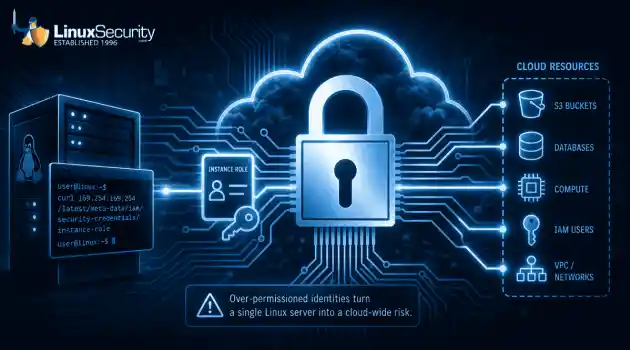
 For years, we secured our Linux infrastructure by building walls: VPCs, security groups, and hardened SSH configurations. We treated the cloud like a virtual data center, assuming that if we kept the "bad guys" out of the network, our workloads were safe. . That model is no longer sufficient. Today, one of the most common paths from an initial compromise to a major cloud breach is the identity assigned to your Linux workload. When an attacker gains code execution on a Linux instance—through a...
Jul 17, 2026
 security practices patch management
 Most of us don't hear about a kernel vulnerability until a CVE lands in our inbox or the vulnerability scanner starts complaining. By then, the patch isn't new anymore. Kernel developers may have been passing it around for review, arguing over the implementation, or revising it for days before anyone outside that community noticed it. None of those discussions are secret. They're sitting in mailing list archives, Git commits, and patch reviews where they've been the whole time. The strange...
Jul 14, 2026
 Linux security cyber attacks
 Every Linux server in your fleet produces thousands of events every minute. From journald logs and auditd records to kernel-level eBPF hooks, your systems are constantly talking. Most of that noise is just the mundane churn of system services, CI/CD runners, or routine administrative automation. But among that noise, an attacker might be establishing a foothold, moving laterally, or setting up persistence. The challenge for any security team is: how do you separate the routine from the...
Jul 13, 2026
 Refine features
X Clear Filters
Get the latest News and Insights
Get the latest Linux and open source security news straight to your inbox.
Community Poll
Should Linux servers automatically install security updates?
Loading...
Explore Latest Linux Security features
We found 6 articles for you...
102
 linux solutionssecurity featurescost management
Business Intelligence with Open-Source Tools for Linux: Secure Solutions
Business intelligence platforms are specific technologies based on creating a system that enables companies to monitor and analyze data like never before. What is the goal of these systems? . It is simple to collect data from multiple sources onto a single platform (a great solution, especially for the lazy!). This data can include sales, financial data, accounting, and more. The data is then organized and sorted into a visualization that makes it easy to understand, often with the help of data visualization tools, enabling companies to make strategic decisions using insights derived from real-time data analytics and efficient data integration tools. Why organizations need BI platforms To succeed in the dynamic corporate world, today's organizations must be data-driven and foster a data-driven culture. For this to be possible, leaders need a modern business intelligence platform that enables everyone to observe and understand data. Business intelligence platforms go beyond business analytics software packages. They support the organization's BI strategy by making accessing and analyzing data easier. Basic analytics platforms import, clean up, analyze, and forecast data. On the other hand, business intelligence platforms are more effective and dynamic and adapt to the development of your BI strategy. Standard features of BI platforms A platform for enterprise use supports business agility without compromising governance or security. Here are five aspects to consider when evaluating a modern BI platform. Total cost of ownership without surprises Open Open-source BI tools are often customizable and work seamlessly with data integration tools to support complex business environments. Many organizations, especially smaller ones, switch to open-source software to meet their data mining and ad hoc reporting needs. When evaluating platforms, however, consider the total cost of ownership. Do not decide based on the price alone. Do a complete comparison. To all the other extra elements, add theneed to make that “free” platform work in your business environment (today and in the future). Free tools are anything but free and can contribute to a sizeable total cost. Often, they make other products, subjects, and infrastructure necessary to meet enterprise-wide requirements. Although there are online resources for learning how to use open-source software, those resources will not tell you how to use the platform for your organization's specific needs. In other words, no matter how customizable, an open-source solution cannot be as flexible as your organization is dynamic. In contrast, superior commercial open-source BI tools have built-in resources, support, and enterprise scalability. Dynamic dashboards One of the most popular features of a BI platform is the ability to create and customize dashboards. People can create forms, charts, and graphs that can be updated almost in real-time. It is also possible to publish dashboards on separate internal platforms. One should choose a platform offering self-service capabilities, allowing users to leverage data visualization tools to create intuitive and interactive dashboards. This way, everyone can access the data, create their analytics , and assist the organization in creating a culture of analytics. Intuitive visual analytics Choose an intuitive visual analytics platform. This allows you to explore data, offering visual information wherever you are visually. The platform should also allow you to share results by creating beautiful visualizations, all from the same intuitive interface, without switching between different products for different types of analytics. Do not just watch a demo. Sign up for a free trial version and test the platform. Try answering multiple questions to test the processing power and efficiency of the tool. The power to drive your BI strategy Even the most potent BI reporting platform is only valid if it can easily connect to the data. The right analytics platform provides optimized native connections to thedata, and it does not matter if you are in Hong Kong or Beijing. You can easily access analytics wherever you are. The platform must allow access and analysis of data in real-time without downloading it, and it must be possible to run a query with little or no coding effort quickly (we do not like to overwork ourselves!). The BI platform must also allow you to deploy analytics wherever you want: in the cloud, on the local server, or hosted off-site. The platform must also integrate seamlessly with your existing data strategy, combining real-time data analytics and data integration tools to revolutionize your current data infrastructure. In addition, it must be easily integrated into other companies' portals and business applications. In this way, you can cater to users wherever they are. This flexibility is critical when evaluating business intelligence programs and choosing a BI platform. Tools that are not flexible increase the total cost of ownership. Data Integrity and Security with Open Source BI Tools As Linux admins, we know that securing our systems is a top priority. Data protection is critical when it comes to open-source BI tools. While open-source platforms may seem risky, many tools like Apache Superset and Metabase have robust security features. They allow us to store and transmit encrypted data, ensuring our analytics are as secure as any commercial offering. These tools help us maintain data integrity and protect our insights, all while ensuring compatibility with modern business intelligence platforms for seamless performance. Managing Total Cost of Ownership with Open Source BI Tools Open-source BI tools might appear free, but we Linux admins recognize there can be hidden costs. Sometimes, additional products or infrastructure are needed to meet all business needs. However, great tools like KNIME and Redash scale well and integrate advanced data visualization tools and real-time data analytics for optimal performance. These features help us predict and managecosts better than some proprietary solutions. By leveraging these tools, we avoid unexpected expenses and get the support we need without blowing our budgets. Flexibility and Integration of Open Source BI Tools Flexibility is critical in our dynamic business environments. Open-source BI tools like Metabase and KNIME shine here, offering powerful data integration tools that align perfectly with leading business intelligence platforms. They integrate smoothly with other business applications and portals, making our lives easier. We can cater to users wherever they are without compromising performance or security. These tools are adaptable, helping us keep up with ever-changing business demands without being locked into a rigid system. Examples of Open Source BI Tools As Linux administrators, understanding and implementing the right open-source BI tools can significantly transform your data analysis and decision-making processes. This section explores industry-leading options like Apache Superset, with its cutting-edge data exploration capabilities; Metabase, known for its intuitive, user-friendly analytics interface; KNIME, which excels in comprehensive, scalable data workflows; and Redash, celebrated for its effortless data connectivity and query execution. By diving into these tools, you'll learn how each can enhance your data infrastructure, making it more secure, scalable, and efficient. Discovering these BI solutions' unique strengths and features will empower you to make informed choices that drive better insights and business outcomes, ensuring you're equipped with the best tools to handle the complexities of modern data environments. Apache Superset Apache Superset is a modern and intuitive platform for exploring and visualizing data. It integrates real-time data analytics with user-friendly data visualization tools. It is easy to navigate, supports a wide range of data connectors, and very skillfully handles high-volume data. Its flexibility and solid security features make it agreat choice for embedding powerful analytics into our setups. Metabase Metabase lets us ask questions and get answers from our data quickly. It’s designed to be simple so everyone in our organization can use it, not just the data experts. It also secures data access, ensuring only authorized users can view sensitive information. KNIME KNIME is perfect for data analytics and integration. It's scalable, which means it grows with our team’s needs. KNIME offers robust security features, so we can be confident our data transformation processes stay protected. Redash Redash helps democratize data access while emphasizing secure sharing, making it a perfect addition to any organization's suite of business intelligence platforms. It connects multiple data sources and supports real-time interaction, making it a versatile and safe option for all our data needs. It Makes Us More Efficient Users While Keeping Data Secure The right platform for your organization must enable everyone to interact with and benefit from the data, regardless of skill level. It allows your organization to foster a data culture, putting data at the center of everyone's business decisions. To maximize the value of your data, you must deploy controlled self-service analytics on a scale. In addition, to make the entire organization more efficient, you need an analytics tool that the business loves and the IT department trusts. The right business intelligence software allows the organization to equip itself with a business-centric, IT-enabled approach to analytics. It enables the IT department to establish a secure and controlled environment that protects data and ensures its integrity without compromising business agility and innovation. . Explore how open-source BI tools enhance data management with secure solutions for Linux admins to drive insights and efficiency.. business, intelligence, platforms, specific, technologies, based, creating, system, enables. . MaK Ulac
 Nov 25, 2024
•
Nov 25, 2024
•
102
 security featuresopen-source solutionsautomation tools
Exploring Linux Cloud Solutions for Enhanced Business Efficiency
Cloud computing has significantly changed the business landscape as various organizations have benefited from the ability to harness scalable infrastructure, flexible storage, and high performance. . At the core of this change is Linux, an open-source operating system that is now the foundation of nearly every cloud computing platform. Due to its flexibility, security, and performance , Linux has gained significant popularity as an operating system in data centers. As businesses have slowly shifted to cloud computing, the demand for Linux will also rise. In this article, we’ll focus on using Linux in cloud computing, some of the powerful Linux cloud platforms today, and why Linux is advantageous for businesses in cloud computing. We will also discuss how solutions based on the Linux cloud can minimize software development costs and maximize business performance. The Rise of Linux in Cloud Computing Linux is, more or less, the foundation of cloud computing because of its open-source policy, flexibility, and scalability. When companies started moving towards cloud environments, Linux became optimal for operating large-scale distributed environments. A major driver of this growth has been the versatility of hardware on which Linux can operate, which is essential for virtualized environments that rely on cloud platforms. Furthermore, Linux's structure is quite simple, and its community is large, so the system is updated regularly, and new security patches are always available. This has placed Linux as the favored operating system for cloud platforms, thus fueling the expansion of cloud services. Currently, most of the cloud infrastructure, whether virtual machines or containers, runs on Linux, making the role of Linux in cloud computing clear. Why Is Linux Dominating Cloud Computing? The benefits of Linux in cloud computing cannot be overstated. Here are some key reasons why Linux has become integral to cloud computing. Open Source and Costs Since Linux is anopen-source operating system, businesses can implement cloud solutions while avoiding expensive license costs related to proprietary operating systems. This significantly lowers the cost of mobile app and software development, making cloud solutions affordable for startups and large enterprises. Open source also implies continuous development because developers worldwide update the Linux kernel and related software. Stability and Reliability Linux is well-known for its stability and reliability, especially for large-scale and business-critical applications. In cloud computing scenarios where availability and performance are crucial issues, Linux has a reliable and solid structure capable of providing very low downtimes and high performance, even when the loads are very high. Security Features Security is a significant issue in cloud computing, and Linux has integral firewalls, strong user authentication, and secure booting. Most cloud service providers in the United States also provide Linux distributions with a special focus on security, known as Red Hat Enterprise Linux and Ubuntu LTS. Scalability and Flexibility Small-scale and well-designed, Linux can smoothly be installed and run in any environment, from a virtual machine to a container. This is critical for organizations that need elastic cloud services to address dynamic business needs and application demands. Support for Containers and Microservices The use of containers and microservices is currently revolutionizing how applications are developed and hosted in the cloud. Linux has emerged as the leading platform for container applications primarily because of the compatibility of the operating systems with container technologies like Docker . It is particularly relevant for organizations considering cloud microservices adoption as one of their architectural styles. Automation and DevOps Tools Support Linux supports automation tools and DevOps, which allows businesses to apply continuous integration and deployment (CI/CD) processes . Most of the automated tools, such as Ansible , Puppet , and Chef , are compatible with Linux to enhance the automation of cloud infrastructures. This makes operations smooth, requires minimal human interaction for necessary changes, and shortens the development cycle, enabling businesses to quickly implement changes and new features. Four Popular Linux-based Cloud Platforms Several excellent cloud-based platforms are available to Linux users. Our four favorites are as follows: 1. Amazon Web Services (AWS) AWS continues to dominate the cloud services market, providing numerous services with Linux as the underlying technology. AWS was indeed one of the pioneer cloud platforms that realized the significance of Linux in the cloud for business and integrated Linux-based services as a primary service offering. Key Linux-based Services on AWS Amazon EC2 (Elastic Compute Cloud) is an AWS core service that enables the deployment of virtual servers. Customers can select from Amazon Linux, Ubuntu, CentOS, and Red Hat Enterprise. These virtual machines are quite manageable, as the organization can easily upgrade or downgrade them depending on its needs. Amazon ECS (Elastic Container Service): A container orchestration service that lets users schedule and manage Docker containers on a Linux platform. This service benefits organizations that want to grow and deploy their containerized applications. Amazon RDS (Relational Database Service): AWS provides Linux solutions for organizations to host MySQL, PostgreSQL, and other databases efficiently and securely. Benefits of AWS for Linux-based Cloud Solutions Scalability: AWS offers flexible capacity; this implies that any business can acquire, modify, or release resources based on its requirements. Global Reach: AWS has a vast infrastructure in various parts of the globe; thus, providing Linux services across different regions ensures low customer latency. Cost Management: When deployed inAWS, Linux costs nothing regarding software licensing since it is an open-source operating system, saving costs. 2. Microsoft Azure While Microsoft is mainly associated with Windows, Azure has gone all in for Linux in the past few years. Today, over 60% of Azure’s marketplace virtual machines run on Linux. Azure offers various Linux cloud computing services to help businesses leverage open-source flexibility. Key Linux-based Services on Azure Azure Virtual Machines (VMs): Azure has various Linux-based VMs, including Ubuntu, CentOS, Red Hat, and SUSE Linux distributions. These VMs are suited for large-scale applications, databases, and workloads in the cloud environment. Azure Kubernetes Service (AKS): AKS is Azure’s managed service for Kubernetes . It is based on the Linux environment and allows enterprises to manage and orchestrate containerized workloads. AKS fully supports the integration with Azure Active Directory to ensure security for cloud-native applications. Azure App Services: This is a platform-as-a-service (PaaS) mainly for the deployment of Linux-based applications. Developers can deploy code in languages like Node.js, Python, PHP, and Java on Linux-based infrastructure. Benefits of Azure for Linux-based Cloud Solutions Hybrid Cloud Support: Azure shines in hybrid cloud scenarios. Organizations can connect their on-premises Linux servers with Azure services seamlessly. Robust Security : Microsoft offers a comprehensive security layer for Linux applications on Azure, enabling enterprises to achieve compliance while adopting Linux's agility. Extensive Integration: Azure works cohesively with other Microsoft services, such as Microsoft 365, which could benefit business organizations that use Linux in their operations. 3. Google Cloud Platform (GCP) Google Cloud has supported open-source and Linux-based technologies since its early days. Linux remains GCP’s dominant platform, and the company offers diverse tools forLinux-based solutions, especially for containerized environments. Key Linux-based Services on GCP Google Compute Engine (GCE): Google’s IaaS provides an environment where Linux-based virtual machines can be run for business on a global platform. Debian, CentOS, Ubuntu, Red Hat, and SUSE are supported distributions. GCE provides flexibility in configuring a Linux environment while leveraging Google’s advanced infrastructure to meet business needs. Google Kubernetes Engine (GKE): GKE is a fully managed Kubernetes service offered by Google based on Linux containers. Kubernetes allows businesses to run and orchestrate extremely scalable and containerized applications with the support of the Google Cloud platform. Google Cloud Functions: Google Cloud’s serverless computing environment is Linux-centric, enabling developers to create and run event-based functions in languages like Python, Go, and Node.js. Benefits of GCP for Linux-based Cloud Solutions Performance and Speed: Google Cloud is known to provide performance-optimized infrastructure to run Linux-based workloads, especially for high-end services such as artificial intelligence, machine learning, and big data processing jobs. Cost Efficiency: Google Cloud has a reasonable pricing structure for its services, and combined with Linux, it makes software development costs easily manageable for businesses. AI and ML Integration: GCP’s Linux-based services are AI-optimized and fully compatible with Google’s AI and Machine Learning tools, making them ideal for businesses that want to build AI applications. 4. IBM Cloud IBM Cloud is another critical player that provides reliable Linux solutions for enterprises. Having actively contributed to the open-source community, IBM has been offering Linux-based cloud solutions for quite some time now. Their cloud offerings meet the needs of companies interested in a hybrid cloud model, artificial intelligence, and dynamic computing power. Key Linux-basedServices on IBM Cloud IBM Cloud Virtual Servers: These virtual servers offer flexible computing capacity derived from several Linux distributions, including Red Hat, Ubuntu, and SUSE. IBM Cloud is also closely connected to Red Hat OpenShift, which enables businesses to run Kubernetes workloads on Linux. IBM Cloud Kubernetes Service: Like AWS and GCP, IBM provides a KaaS service that runs on Linux. This service allows businesses to run containerized applications in a secure and highly flexible environment. IBM Watson: Watson, an AI developed by IBM, also uses Linux-based technologies. Through Watson, businesses can analyze data using machine learning and deep learning while still using the security and open-source flexibility of Linux. Benefits of IBM Cloud for Linux-based Cloud Solutions Enterprise-Grade Solutions : IBM Cloud was developed for enterprises emphasizing hybrid cloud plans, enabling organizations to simultaneously operate on-premises and cloud-based Linux environments. Security and Compliance : IBM Cloud has enhanced security features for Linux workloads, such as encryption, secure multi-tenancy, and comprehensive compliance. AI and Data Analytics : Combining IBM Watson with Linux-based cloud solutions gives enterprises an effective tool for implementing innovative AI solutions and gaining value from big data. Our Final Thoughts on the Benefits of Linux-based Cloud Computing Solutions Linux has become one of the primary pillars of cloud computing because of its stability, versatility, and expansibility for companies of any size. Whether you are a startup or a big corporation, using Linux-based solutions for your cloud environment will allow you to grow and protect your data while leveraging the modern technologies introduced by cloud services. The decision to adopt Linux for cloud computing is not only about technology but about making the right strategic decision to prepare your business for the future. . Linux leads in cloud computing withinnovations enhancing performance, cost efficiency, and security. Its open-source nature allows tailored solutions for businesses.. Linux Cloud Solutions, Open Source Computing, Cloud Infrastructure, DevOps Automation. . Anthony Pell
Sep 14, 2024
•

102
 security featuresLinux technologysmart contracts
Top 5 Open-Source Blockchain Technologies For Linux Users
With hundreds of thousands of open-source projects underway, it’s easy to say that open-source has become a standard in software development. And when discussing open source, the first development environment that comes to mind is Linux. . One factor contributing to Linux’s popularity is security , among the most attractive features of blockchain, a strategic technology trend we’ve seen in the past few years. Because of blockchain's level of security and decentralized nature, incorporating this technology into a wide range of industries holds significant promise. As such, it only makes sense for developers to explore blockchain use within the Linux environment. In this article, we delve into five open-source blockchain technologies for Linux. But first, let’s examine what blockchain is, how it works, and how its application has evolved over the years. Understanding Blockchain Blockchain is the record-keeping technology behind the Bitcoin network. In this context, the words “block” and “chain” describe digital information (the “block”) stored in a public database (the “chain”). Blockchain refers to multiple blocks strung together. For a block to be added to the blockchain, a series of criteria must be met: a transaction has to occur and be verified, and that transaction must be stored in a block and given a unique identification code known as a “hash.” Once a block is added to the blockchain, it becomes publicly available for anyone to view. Blockchain technology is designed to be highly secure, accounting for potential security issues in several ways. First, new blocks are always stored linearly and chronologically. Because each block contains its hash and the hash of the block before it, it is very difficult for malicious actors to edit the contents of a block. To change a single block, they would have to change every single block after it in the blockchain - a virtually impossible task. Blockchain addresses the issue of trust by implementing testscalled “consensus models” for computers looking to join and add blocks to the chain. These consensus models require users to “prove” themselves before they are allowed to participate in a blockchain network. One of the most popular testing methods is “proof of work,” where computers must prove that they have done “work” by solving a complex computational math problem before adding a block to the blockchain. Overview of the Evolution of Blockchain Blockchain has come a long way since the 2009 Genesis Block transaction. It was initially launched to create a decentralized version of the financial sector, particularly in transferring funds from one person’s account to another without a middleman (and, therefore, without transaction fees). However, blockchain is being studied for many different applications outside of finance. We previously mentioned the healthcare industry, which blockchain can significantly benefit patient data management, clinical trials, and drug traceability. Blockchain could also prove to be a game-changer in the agriculture sector . For one, the blockchain ledger allows farmers to create accurate documentation and reports, which could prevent illegal food trade that costs farmers around US$40 billion a year. The music industry could also benefit significantly from turning to blockchain technology. With the help of blockchain, artists may not have to contend with the hefty commissions that go-betweens take. With blockchain, revenue from a song could easily be divided among those with royalty rights - and every transaction would be transparent. Finally, blockchain could help the cybersecurity industry in its never-ending fight against distributed denial-of-service (DDoS) attacks. Leveraging blockchain technology is like fighting fire with fire — its decentralized nature could defend against DDoS attacks. Developers need an agile, secure platform to explore blockchain's wide range of possibilities fully. Here are five great open-source blockchainplatforms compatible with the Linux environment. 5 Open-Source Blockchain Technologies for Linux Users Many great open-source blockchain technologies are available to Linux users. Our top five are as follows: Hyperledger Hyperledger is more than just an open-source blockchain project - it’s an umbrella project comprising 12 other projects, the most popular of which is Hyperledger Fabric . The platform has been used to develop different tools and solutions in several industries, such as: Advertising Agriculture Data access Insurance Healthcare Finance Ethereum Ethereum has already made a name for itself as the blockchain platform that made smart contracts well-known. Ethereum also has a permission and open-source enterprise version that allows businesses to create blockchain applications. Several Enterprise Ethereum applications have gone live and are being used across various industries. For example, Utah County uses Enterprise Ethereum through Titan Seal to send users digital marriage licenses and certificates. In 2018, Enterprise Ethereum became an open-source collaboration between Enterprise Ethereum Alliance (EEA) and Hyperledger . Both communities aim to hasten the advancement of blockchain technology. HydraChain Like its parent platform, Ethereum, HydraChain allows developers to create a Permissioned Blockchain —a type of blockchain that requires participating parties to perform specific actions before access is granted. It was developed by Ethereum and Brainbot Technologies and is fully compatible with Ethereum protocols. HydraChain is primarily used to deploy smart contracts and decentralized applications using Python. As it is Python-based, its development time is significantly reduced, and debugging is easy. The platform is also highly customizable. Users can easily adjust essential aspects such as gas limits, transaction fees, and block time. HydraChain is available on GitHub . Corda What sets Corda apart from other platforms is that it does not make transactions available to the public. Corda has the interoperability of the blockchain network, but its privacy policy is stringent. Data can only be seen by authorized entities. Corda mainly targets companies in the financial industry, where privacy and security are top priorities. Prominent organizations that support Corda include U.S. Bank and HSBC . Smart contracts using the Corda framework require human intervention, although the execution depends on the computer code. These smart contracts are legally enforceable as a safety measure against human input. Users who act unfairly or do not honor the smart contract within the Corda network are liable for litigation. To develop on the Corda Platform using Ubuntu , you need a computer running Ubuntu 16.04 or above. BigchainDB An attractive feature of BigchainDB is that it is based on a production-ready database. BigchainDB is built using several enterprise-ready database nodes (MongoDB), which store immutable data in an organized and synchronized manner. With BigchainDB, users can enforce strict access control by setting permissions at the transaction level. Depending on their requirements, users can also custom-fit different aspects of BigchainDB. Perhaps the system's signature aspect is that it is designed to host large datasets. One application of BigChainDB is Resonate , a music streaming service that operates in a cooperative setting. The platform allows artists to receive payments directly from listeners, eliminating intermediaries and associated costs. Our Final Thoughts on Open-Source Blockchain Technologies The five open-source blockchain platforms we’ve introduced here are already used in different applications across several industries. Some developers and entities are attracted to blockchain's stringent security features, but the technology’s decentralized nature is the game-changer. We are still in the early days ofdecentralization, with blockchain technology at the forefront of this innovation. While we see blockchain being explored in different industries, more applications will be developed as it continues gaining popularity. Open-source blockchain technologies have the potential to hasten the process as hundreds of companies and thousands of developers join hands. One thing’s for sure—the ever-growing Linux community will contribute significantly to advancing open-source blockchain technology. . Explore top 5 open-source blockchain technologies ideal for Linux users focusing on security and decentralized design.. open-source, hundreds, thousands, projects, underway. . Brittany Day
Aug 31, 2024
•
102
 network securitydata protectionencryption
Benefits of VPN for Linux, Windows, and Mac OS Users Explained
Regardless of whether you are a Windows, Linux, or MacOS user, you use the Internet to stay connected with friends, relatives, and colleagues. While doing so, you must remain safe while exploring the Internet by using a trustworthy VPN (Virtual Private Network) . . It doesn't make a difference if you're a learned techy or a beginner; getting started with a VPN can be beneficial for anybody looking to protect their data and network security, privacy, and anonymity online. This article covers what you need to know about VPNs for Linux, MacOS, and Windows to help you secure your information on any device. What Is a VPN? A Virtual Private Network is a secure way to access the Internet. When you connect to a website or service over a VPN, your internet connection is securely encrypted to keep your data and identity safe from prying eyes. Having a VPN is like having an extra layer of security on top of your existing Internet connection. With the privacy-enhancing technology and cryptography cybersecurity that comes with using a VPN, you can feel more comfortable when connecting to websites or services that require personal information like banking details, credit card information, and more. Accessing content in other countries may be easier with a VPN since it can help bypass geo-restrictions that websites place on users. Using a VPN can give you peace of mind, knowing that your data is protected whenever you're connected to the web, no matter what operating system you have. How Does a VPN Work? A VPN uses a public network (typically the Internet) to connect remote sites or users. These "virtual" connections routed through the Internet, whether from a private network or a third-party VPN service to a remote site or user, help mask online behavior from snooping third parties . This is done by creating an encrypted connection or "tunnel" between your device and a remote server operated by the VPN service. This ensures that anyone who is able to bypass security and intercept the encrypted datacannot read it. A VPN also hides your IP address so you can access content that may be blocked in one country but accessible in another. In addition, using a VPN will protect you on public WiFi networks like those you find in airports or cafes. What Are the Benefits of Using a VPN? Let’s explore some of the key advantages of using a VPN on your Windows, Linux, and Mac OS systems: Security Benefits Using a VPN helps protect your privacy and keeps your data secure with end-to-end encryption . It also adds an extra layer of security to your internet activity , hiding it from hackers or snoopers tracking you. If you're worried about leaving a digital footprint, you'll be pleased to know that VPNs are also great for masking online data and preventing advertisers from tracking you. All of these efforts maintain data and network security for your business and reduce the chance of any cloud security breaches headed your way. Unblocking restricted content Whether it's content from another country or unwanted ads, using a reliable VPN can help access trustworthy sites. This can be useful when streaming geo-restricted content and reaching blocked sites from anywhere worldwide. It will also enable you to bypass firewalls at work or at school. Cost savings Using a secure VPN is more than convenient and can save you money. By taking advantage of the best VPN deals , you’ll gain access to servers worldwide and save money on flights, accommodations, and other purchases by simulating another country’s IP address. It is a perfect choice for travelers who want to keep their identities safe while traveling abroad. Why Should Windows, Linux, and Mac OS Users Use a VPN? For Windows, Linux, and Mac OS users, it is important to understand that a VPN provides an extra layer of security for everything you do online. Whether on a Wi-Fi network at the airport or office or accessing a website or app containing sensitive information, a VPN lets you encrypt your data and protect it fromprying eyes. Here are some more reasons why Windows, Linux, and Mac OS users should use a VPN: Provides Anonymity : A VPN masks your IP address so that anyone, not even your Internet service provider, can't track your online activity. Bypass Censorship : A VPN helps circumvent government censorship by allowing you to access websites and apps even if they're blocked in your country. Improves Speed : A good VPN can also help reduce latency (lag time) when accessing content from far-away servers. Increases Privacy : By connecting through a secure tunnel when accessing websites or apps, a VPN shields all kinds of personal information, such as passwords and bank account details, from hackers. These VPN advantages are incredibly helpful in ensuring data and network security and keeping all of your information safe, even if a hacker is able to bypass security. What Should I Look for When Choosing a VPN Provider? Security Security is usually the top priority, so ask your provider the right questions. Are they using advanced encryption protocols? Do they have protocol selection options? What level of encryption do they use? Knowing these details will help you decide when choosing your VPN provider. Server Options The number of servers available can determine the quality of your online experience. You should look for a VPN provider that offers a wide variety of servers worldwide and unlimited bandwidth so you can access content without lags or interruptions. Logging Policy & Privacy Policy The best VPN providers don't keep logs of user activities, including IP addresses, web activity, and any other data that could be traced back to them. Ensure that your provider has a trustworthy privacy policy and an explicit logging policy that protects your data from any malicious actors or third-party companies that might try to access it. The stronger the privacy-enhancing technology, the safer your network. These are the essential features to look out for when choosing a VPN providerthat’s right for you, whether you’re using Linux, Windows, or MacOS. Keep in mind that it is important to do some research before signing up for any service. Final Thoughts on Using a VPN on Linux, Windows or MacOS A VPN is one of the most useful network security toolkits to use for protecting yourself and your data online, regardless of the operating system. Every OS has its share of viruses, malware, malicious data, and network security threats, but arming yourself with a trustworthy VPN service will go a long way toward protecting your business. No matter which OS you choose, it is critical to ensure your VPN service is reputable, reliable, fast in speed, and robust in protection. Each OS has a wide selection of VPN services from which to choose, and making the right choice for your operating system will help keep your data safe and secure. . Ensure your online security with this VPN tutorial tailored for Linux, Windows, and Mac OS platforms, highlighting essential advantages and characteristics.. VPN Security, Protect Data Online, Encryption Privacy, Secure Internet Access. . Brittany Day
Mar 27, 2023
•
102
 security featuresopenvpnvpn protocol
Comparing Open-Source VPN Protocols: WireGuard, OpenVPN, IKEv2 Insights
There are many reasons why one might choose a VPN whether it be for privacy or unlocking geo-restricted content however, no one really takes into account the VPN protocols that these VPN providers use. . When using a VPN, I'm sure many users just think it’s an easy, quick download and install, connect to a location & you’re done! However, there is much more to that. Nowadays, cyber criminals can make the internet a scary place & believe it or not, your choice for a VPN provider (and the protocols that they support) can affect your reasons for wanting to use a VPN in the first place. Some VPN services let you choose from a wide range of protocols whilst other VPNs don’t let you choose at all. Each protocol has its own strengths and weaknesses and you must understand the differences between them in order to choose the right protocol for your specific needs. In this article, we will compare some of the most popular VPN protocols to help you decide which one to use for your use case. WireGuard What is WireGuard? When it comes to VPNs, especially ones for Linux, I am sure you have heard of Wireguard and that raises the grand question: What is WireGuard? WireGuard is a security-focused VPN, originally made for the Linux kernel, known for its simplicity and ease of use. It uses proven cryptography protocols and algorithms to protect data. How WireGuard’s Cryptography Works WireGuard is an open source VPN that was designed with the goals of ease of use, high speed performance, and low attack surface. It uses state-of-the-art cryptography, like the Noise protocol framework , Curve25519 , ChaCha20 , Poly1305 , BLAKE2 , SipHash24 , HKDF , and secure trusted constructions which essentially includes novel cookie construction to mitigate denial of service attacks, key-compromise impersonation, and replay attacks. WireGuard has been designed with ease-of-implementation and simplicity in mind. It is meant to be easily implemented in very few lines of code, and easily auditable forsecurity vulnerabilities. Wireguard also has a smaller code base, and generally has a smaller surface area susceptible to outside attacks. Compared to behemoths like *Swan/IPsec or OpenVPN/OpenSSL, in which auditing the gigantic codebases is an overwhelming task even for large teams of security experts, WireGuard is meant to be comprehensively reviewable by single individuals. At the heart of WireGuard is a concept called Cryptokey Routing, which works by associating public keys with a list of tunnel IP addresses that are allowed inside the tunnel. The premise behind CKR is that it allows you to define routes stating that specific subnets should be routed to a given node on the network, identified by their public encryption key which allows the traffic to be encrypted from end-to-end. This gives us effectively the ability to run VPNs over the network without the need for additional software. With cryptokey routing, administrators can rely on simple firewall rules to filter packets arriving on the WireGuard port. The protocol that WireGuard uses is also secure, as it does not respond to any packets from peers it doesn’t recognize. How Well Does WireGuard Perform? In theory WireGuard should achieve very high performance. Speed is the first major advantage of WireGuard. It does not consume a lot of your device's CPU resources, and it uses a quicker, optimized protocol overall. This speed boost also includes connection and reconnection speeds. When looking at Wireguard benchmarks, you can see that it is almost 4x the speed of openVPN and greatly outperforms many other VPNs available out there. Issues with WireGuard Protocol Support Since WireGuard only supports UDP and not TCP, this causes for a lot of people using the WireGuard protocol to run into some issues in many places like universities and businesses alike. A lot of network administrators tend to only allow traffic on port 80 / 443 from a TCP connection, so using the WireGuard protocol can cause many issues depending on the network youare connected to. Does not assign dynamic IP addresses and unusable without logs? WireGuard has no dynamic IP address assignment, meaning that the client’s addresses, or whoever uses the WireGuard protocol, has static IP addresses. Users would have to register every active device and assign a static IP address on each of their VPN servers. Moreover, they would have to store the last login timestamp for each device in order to reclaim unused IP addresses. How WireGuard integrates into the Linux kernel Here at LinuxSecurity, we are avid supporters of open-source. When it comes to VPNs, it can be hard to choose one for your specific purpose. The open-source way of thinking would be to run your own and that is exactly what you can do! As of March 29th, 2020, the official release of WireGuard was incorporated into the Linux 5.6 Kernel release tree. Because WireGuard is easy to deploy and use, daily users and administrators alike can configure it in their standard Linux distribution. WireGuard VPN Protocol Explained There is an initial very simple handshake that establishes symmetric keys to be used for data transfer within Wireguard. This handshake occurs every few minutes, in order to provide rotating keys for perfect forward secrecy. Moreover, It only supports UDP, which uses no handshake protocols, but also one of the reasons why it's so fast - It does not have to perform the complete TCP check that many other protocols do, yet still remains reliable and secure. Moreover, it has a lighter code base which can be easily audited by security analysts. It also uses the follow cryptographic protocols: ChaCha20 for symmetric encryption, authenticated with Poly1305 Curve25519 for ECDH Siphash24 for hashtable keys BLAKE2s for hashing and keyed hashing HKDF for key derivation WireGuard also has a built-in mechanism to make sure the keys and handshakes are up-to-date and authenticated. OpenVPN What Is OpenVPN? OpenVPN is considered the god of all VPN protocolsbeing that it has been around for a long time. OpenVPN is an open-source VPN protocol that makes use of a VPN provider to perform various functions. Being that OpenVPN is open-source, it has allowed developers to access its source code and furthermore, has allowed for the VPN protocol to be continuously modified by large groups and communities of developers which means users and companies alike can configure OpenVPN to their specific need. This protocol is especially popular due to its AES-256 bit key encryption with 2048-bit RSA authentication and a 160-bit SHA1 hash algorithm. How OpenVPN’s Cryptography Works OpenVPN’s cryptography utilizes two different methods: Static Key -- Use a pre-shared static key TLS -- Use SSL/TLS + certificates for authentication and key exchange Before the tunnel is established in static key mode, a pre-shared key is generated and shared by both OpenVPN peers. This static key includes four distinct keys: HMAC send, HMAC receive, encrypt, and decrypt. In static key mode, both hosts will use the same HMAC key and encrypt/decrypt key by default. The other method OpenVPN uses is the OpenSSL library and SSL/TLS protocols which allows for a strong, secure, and reliable connection no matter what. OpenVPN encryption includes data channel encryption as well as control channel encryption. To protect the data, the data channel encryption consists of a cipher and hash authentication. To protect the connection between your device and the VPN server, the TLS encryption consists of a cipher, hash authentication, and handshake encryption. The cipher or algorithm encrypts the data, the secure hash algorithm authenticates the data and the SSL/TLS connection, and the handshake encryption protects the connection. Additionally, OpenVPN uses perfect forward secrecy, which generates distinct private keys and then discards them after each connection. The cryptography of OpenVPN is considered very secure and is considered the industry standard in use today. How Well DoesOpenVPN Perform? OpenVPN might offer great security, but when it comes to speed, there are some potential issues. Being that the code base for OpenVPN isn’t very lightweight like WireGuards, it can really cause some tremendous slowdowns. Of course, the primary cause of this could very easily be your own internet connection speed; however, even if you have a fast enough connection, you could still experience major drops in speed. In various tests conducted by OpenVPN community members, their download speed went from upwards of 1Gbps all the way down to 49MBps. Now, the connection could still be viable for searching stuff on the web and potentially watching videos but for more high-demanding applications and tasks, that is nowhere near enough. When it comes to OpenVPN, there is a trade-off that takes place. You sacrifice internet speed for security and it might not mean much to people who value their privacy more, however, for the people who still want to remain private and have that quick internet connection, OpenVPN might not be for them, even if it is considered industry standard. Issues with OpenVPN Aside from speed, one may think that OpenVPN has no issues however, that is not the case. As of 2022, OpenVPN only has 1 vulnerability. This one vulnerability is so severe that it is still undergoing reanalysis. According to OpenVPN.net, this vulnerability is listed as CVE-2022-0547, which states that “OpenVPN 2.1 until v2.4.12 and v2.5.6 may enable authentication bypass in external authentication plug-ins when more than one of them makes use of deferred authentication replies, which allows an external user to be granted access with only partially correct credentials.” As of now, there has been no updates to this issue with OpenVPN but we will be closely monitoring this as changes are bound to happen. It is safe to mention that with OpenVPN v2.4.12 and v2.5.6, this issue has been resolved but for users and companies using older versions of OpenVPN, this could be an issue. How OpenVPN Integratesinto the Linux Kernel Unfortunately, Linux does not come with OpenVPN pre-installed, so you will actually need to install it yourself and configure the config.ovpn file as well if you plan on not using a VPN provider. On the brighter side, to install the OpenVPN client on Linux, it is possible to just install the version that is in the software repository for whichever Linux distribution you may be using. You can run the command below to install the OpenVPN client: $ sudo apt-get install openvpn OpenVPN Protocol Explained For the time being, OpenVPN will be the standard secure VPN connection protocol. It's not perfect, but it's one of the most powerful on the market right now. It is not only safe, but it is also open-source, which means you won't have to pay for it. Furthermore, it is safe, completely bypasses firewalls, and is incredibly adaptable. If you want a highly secured internet connection, OpenVPN is a good option to explore. Furthermore, its encryption techniques are top-tier, making it an excellent choice for a VPN protocol. IPSEC IKEv2 What Is IPSEC IKEv2? The IKEv2 VPN protocol has become more and more popular over the past years. More specifically, IKEv2 is better suited and popular amongst mobile devices. IKEv2 is a tunneling protocol within the IPSec protocol suite. It is responsible for setting up the Security Association for secure communication between VPN clients and VPN servers within IPSec. IKEv2 is the mechanism that generates encryption keys, ensuring safe data flow between your device and the VPN server you’re connected to. How IPSEC IKEv2’s Cryptography Works As previously stated, IKEv2 is used in conjunction with IPSec and is mostly used for mobile devices. IKEv2/IPSec is a reliable and secure protocol for mobile devices since it is capable of reestablishing a connection when it has been temporarily lost or dropped. We also saw that IKEv2 manages the SA characteristic, but what exactly does it entail? Simply put, it is the act ofestablishing security qualities between two networked devices by generating the same symmetric encryption key for each. This key is then used to encrypt and decrypt all data sent over the VPN connection. IKEv2 also supports the most recent IPSec encryption algorithms and ciphers such as 256-bit encryption, AES, Camellia, and ChaCha20, supports MOBIKE, a mechanism that allows the protocol to withstand network changes, perfect forward secrecy, and uses X.509 certificates when it handles the authentication process, and also uses the Isakmp , Skeme, and Oakley security protocols. How Well Does IPSEC IKEv2 Perform? IKEv2 is widely regarded as one of the quickest and most secure protocols available, making it a popular choice among VPN users, particularly those using mobile devices. IKEv2 is quicker than other VPN protocols since it uses less CPU resources. As is often the case, there are several variables that influence speed, so this may not be applicable in all use scenarios, but from a performance aspect with mobile users, IKEv2 may be the best option because it works well establishing a reconnection. IKEv2 is also supported in Linux via the strongSwan package, which is available for most Linux versions. Issues with IPSEC IKEv2 Despite the fact that the IKEv2 VPN protocol is popular among users and is the first choice for constructing a "continuous" VPN connection owing to its reconnection capabilities, IKEv2 nevertheless confronts certain specific obstacles. Firewalls frequently block IKEv2, preventing connection. Another less well-known issue with IKEv2 is fragmentation. Because IKEv2 uses UDP, this might result in failed connectivity that is difficult to resolve. If the packet exceeds 1500 bytes, it will. be divided into smaller fragments. Followed by authentication chaining and RSA keys, this can be a problem since many routers and firewalls are set to discard IP fragments by default, causing your IKEv2 connection to fail. How IPSEC IKEv2 Integrates into the Linux Kernel UnlikeWireGuard, IKEv2 is not preloaded in the Linux kernel. IKEv2 is supported in Linux, however, with the strongSwan package, which is available for most Linux versions. StrongSwan is a comprehensive IPsec and IKEv2 implementation for Linux that is compatible with the majority of existing IPsec-based VPN protocols. IPSEC IKEv2 VPN Protocol Explained IKEv2 on its own does not really work well which is why it works best when paired with IPSEC! It’s combination of AES-256-GCM cypher for encryption, coupled with SHA2-384 for integrity, perfect forward secrecy, and 3072-bit Diffie Hellmann keys allows for IPSEC IKEv2 to remain secure whilst also not using too many hardware resources and allowing no downtime when you lose connection. In a sense, you can consider IPSEC IKEv2 as a lossless connection, as you feel seamless connectivity. Linux VPN Protocols Compared WireGuard is built to be more efficient than OpenVPN and IKEv2, but that doesn’t necessarily mean it will always perform better. Here, we will discuss how WireGuard holds up against OpenVPN and IKEv2. However, these comparisons ultimately depend on many factors, such as: The speed of your Internet connection How busy the VPN servers are. How compatible your device is with the VPN software. How close you are to the VPN server. Wireguard vs. OpenVPN Speed: The VPN speed represents the speed of your Internet connection while connected to the VPN and it depends on a lot of factors. Many tests carried out through various people have proven that Wireguard is more than 2x faster than OpenVPN. According to this website, Is Wireguard faster than OpenVPN? We tested 114 VPN servers. . Against the 114 VPN Servers tested, Wireguard was faster than OpenVPN on UDP by about 19% and faster than OpenVPN on TCP by about 57%. When it comes to this test, there is a clear difference due to the reasons we stated earlier. Security and Encryption: While people may think that there is a tie between Wireguard and OpenVPN when it comes tosecurity and encryption, or that OpenVPN may be more secure, tests show otherwise. Keeping in mind that these two prot ocols use different types of encryption, Wireguard is actually the better option. As of now, Wireguard has no known vulnerabilities. On top of that, paired with a strong VPN and state of the art encryption, it becomes a very secure, speedy, reliable VPN. However, OpenVPN on the other hand, has many known vulnerabilities. According to CVE-2022-0547 , OpenVPN versions 2.1 until v2.4.12 and v2.5.6 may “enable authentication bypass in external authentication plug-ins when more than one of them makes use of deferred authentication replies, which allows an external user to be granted access with only partially correct credentials.” This vulnerability was just released recently and this is just one of the few of many. Depending on the version of OpenVPN you are using, you could be facing different types of vulnerabilities that could lead to Bypassing, XSS attacks, and much more. Bypassing Firewall/Firewall Connectivity: This is where OpenVPN gains the upper hand on Wireguard. Since OpenVPN uses TCP, it makes it pretty much usable on any network with any VPN provider. Wireguard on the other hand strictly uses UDP connections which for some networks, using ports such as port 80 and 443 HTTP/HTTPS respectively, requires a TCP connection. If you find yourself in a University or building that only allows TCP connections on that part, it might be a safer option to use OpenVPN. Mobility: In regards to mobility, Wireguard offers a better solution. This is because Wireguard handles network changes seamlessly without any interruption and lag. VPN and Device Compatibility: It was only just recently that Wireguard has been implemented into the Linux kernel and has also been implemented with some major commercial VPN providers. Moreover, Wireguard is available on MacOS, Linux, Windows, iOS, and Android just like OpenVPN. However, OpenVPN has been recognized more by VPN providers and therefore,provides more VPN provider compatibility. Privacy and Logging: Whilst neither VPN protocol does traffic logging, Wireguard does have to be paired with a strong VPN provider to be able to give its users more privacy or anonymity in regards to their network traffic. WireGuard vs. IPSEC IKEv2 WireGuard has two advantages: its encryption implementation is faster, and it is now built into the Linux kernel. Many tests have shown that WireGuard is more consistent, reliable, and quicker in speed and security across the board but by no means does this mean that IPSEC IKEv2 is bad. IKEv2 uses AES 256 bit key encryption which is still very secure. Furthermore, it is still fast and can switch between networks seamlessly. It is even faster than OpenVPN in most instances! Additionally, for WireGuard, you need to install additional files but nevertheless, its more modern encryption library does have advantages. IKEv2 also has some vulnerabilities as listed by the NSA that states IKE could be exploited in an unknown manner to decrypt IPSec traffic, but they are not at liberty to disclose specifics. Likewise, IKEv2 uses UDP 500 for the initial key exchange, protocol 50 for the IPSEC encrypted data (ESP) and UDP 4500 for NAT traversal, which makes it easier to block than Wireguard, even though both can still end up being blocked. Final Thoughts In theory, each VPN protocol does certain things better than the other and there is no “set in stone” perfect VPN protocol. Keep in mind, no single VPN protocol can guarantee your security, privacy, nor speed and the protocols listed are no different. Does this mean that you should disregard each one listed here? Absolutely not! There is no solid answer here when it comes to choosing a VPN protocol and choosing a VPN provider that supports each protocol. Try each of the protocols out and use the one that gives you the smoothest experience and best suits your needs. . Explore the pros and cons of WireGuard, OpenVPN, and IKEv2 regarding performance, security, andfunctionality to make an informed VPN choice. VPN Comparison, WireGuard Features, OpenVPN Performance, Linux Protocols, IKEv2 Insights. . Brian Gomez
Aug 17, 2022
•
102
 kernel managementsecurity featurescentos replacement
Oracle Linux: Secure Alternative to CentOS for Enterprises
Red Hat’s recent decision to discontinue CentOS 8 has left a critical void in the enterprise Linux market, shifting the spotlight onto other enterprise-ready Linux distributions. One distro that stands out as a viable CentOS 8 replacement among respected enterprise Linux distributions such as Ubuntu, Red Hat Enterprise Linux (RHEL), AlmaLinux and SUSE is Oracle Linux , an OS compiled from the same open-source code as RHEL. . Oracle Linux provides a secure open-source platform for the enterprise and is ideal for database environments. LinuxSecurity researchers worked with Honglin Su from the Oracle Linux and Virtualization product management team along with the Kernel development team to answer our questions regarding why Oracle Linux is an excellent OS for the security-conscious enterprise, what makes the distro a logical enterprise-ready CentOS replacement, what the future holds for Oracle Linux, and more! Oracle Linux: A Comprehensive Open-Source OS with an Emphasis on Security Since Oracle Linux's inception in 2006, Oracle Linux has been completely free to download and use without any license fee. Support contracts are available from Oracle for a complete operating environment that delivers an integrated suite of virtualization, management and cloud native computing tools, along with the Linx OS. Oracle Linux is optimized out of the box for all Oracle software workloads and enables enterprises to run Oracle Database on the same OS it was developed on. With security breaches on the rise, the ability to apply security fixes quickly and seamlessly is becoming increasingly critical - especially as more businesses adopt container technology to build cloud-based applications. Oracle Linux mitigates the risk of attacks exploiting unpatched vulnerabilities with Ksplice automated patching without reboot, making it the only Linux distro that provides zero-downtime automated patching for kernel, hypervisor, and critical user-space libraries. By eliminating the trade-off between security andavailability, Oracle Linux saves customers 500 hours each month, or about $375,000 each year . What Makes Oracle Linux More Secure and Optimized? Oracle Linux ships with secure defaults and brings top notch security features like zero-downtime updates via Ksplice patching for kernel, hypervisor and userspace, known exploit detection , and modern Linux kernels to the enterprise. More importantly, Oracle has "bet the farm" on Oracle Linux. As a leading database vendor and premier Cloud provider, everything Oracle does is built on and runs on Oracle Linux. Oracle is a member of the industry’s Linux pre-embargo security response team, working with others on industry-wide security issues, enabling secure hardware technologies, addressing and removing security issues proactively, delivering innovative open source technologies such as SELinux, Kata containers, multiprocess QEMU, etc. FIPS validation and Common Criteria (CC) certification demonstrate Oracle’s commitment to security. In addition, Oracle performs routine auditing and has an internal “ethical hacking team”. They use fuzzing tools in their internal development workflow, and run multiple static analysis tools (parfait, etc.) as a normal part of the build process. Many Linux distributions, especially in the enterprise space, tend to stick with the same kernel for five to 10 years and provide fixes and feature backports to that kernel. Oracle Linux comes with a choice of two kernels, the Unbreakable Enterprise Kernel (UEK), which is installed and enabled by default, and the Red Hat Compatible Kernel. UEK for Oracle Linux allows customers to take advantage of the latest developments in upstream Linux. UEK closely follows the Linux Kernel's Long Term Stable (LTS) release, releasing a monthly update which is a KABI-stabilized version of those updates. The kernel LTS maintainer, Greg Kroah-Hartman has observed that nearly half of all security vulnerabilities reported against the kernel are "retroactive", i.e. they are filed for patchesthat are already included in upstream Linux, and often already included in the Long Term Stable branches. Oracle’s strategy of tracking modern Linux kernels means that customers can be running with the latest security fixes even before the CVE identifier is assigned to those patches. And if they aren't, that's where Oracle Ksplice comes in. Oracle Linux with UEK is well-tested and used to run Oracle’s Engineered Systems (Exadata, Private Cloud Appliance, and so on), Oracle Cloud Infrastructure, and large enterprise deployments for Oracle customers. For example, UEK Release 6 , based on the mainline Linux kernel 5.4.17, is available with Oracle Linux 7 and 8 and supports Intel/AMD (x86-64) as well as Arm (aarch64) platforms. It provides the latest open source innovations, key optimizations, and security to cloud and on-premises workloads. Customers can run the same modern Linux kernel across major Linux releases. While the corresponding RHEL 7 and 8 kernels are still based on the mainline kernels 3.10 and 4.18. Running Oracle Linux can also enhance the security and performance of critical applications by implementing Oracle Linux KVM with Oracle Real Application Clusters (RAC) , which helps create a virtualized data center for highly available applications. The DTrace feature provides comprehensive kernel and application tracing, enabling admins and developers to efficiently and concisely answer questions about the behavior of the OS and user programs in real-time. The latest open-standards–based cloud native tools, along with KVM server virtualization and oVirt-based virtualization manager , are included at no extra cost with Oracle Linux Premier Support. Based on the Open Container Initiative (OCI) and Cloud Native Computing Foundation (CNCF) standards, Oracle Cloud Native Environment delivers a simplified framework for installations, updates, upgrades and configuration of key open source technologies for orchestrating microservices. Using a curated set of open source components that aretested and supported, such as Kubernetes and Kata Containers – Oracle Cloud Native Environment with Oracle Linux is ideal for Hybrid Cloud. Need A Stable, RHEL-Compatible CentOS Replacement? Oracle Linux Has You Covered. Red Hat’s decision to discontinue CentOS 8 has left many users scrambling to find a cost-efficient, secure and RHEL-compatible replacement. If you are currently faced with this important decision and are in the process of researching a viable CentOS replacement, don’t overlook Oracle Linux. Oracle Linux could potentially be a better alternative to CentOS. The OS is reliable, affordable, and 100% RHEL-compatible. But there’s more - the distro gives you access to some of the most cutting-edge innovations in Linux such as Ksplice and DTrace. In addition, Oracle Linux releases consistently track Red Hat Enterprise Linux with errata typically released within 24 hours, update releases usually available within five business days and major version releases within three months, ensuring that by switching to Oracle Linux you don’t risk another inconvenient CentOS delay! Now the question you’re likely asking yourself: “But is it free like CentOS?” The answer is “Yes, with an optional support offering.” You can decide which of your Oracle Linux systems should be under support. There is no all or nothing clause. However, non-paying users get the same kernel releases and rock-solid code quality as paying customers. A pretty good deal if you ask me, especially given Oracle develops and runs its business on Oracle Linux. Oracle Linux offers the same operating system on-premises in the data center and in the cloud for paying customers and non-paying users alike. All applications developed on Oracle Linux will also run—without modification—on Oracle Engineered Systems and Oracle Cloud Infrastructure. This consistency is essential for agility. To put the point into a real-world context, Oracle Linux provides customers/developers with the confidence they need to “develop onceand run everywhere.” Making the Switch from CentOS to Oracle Linux is Seamless & Easy! The Oracle Linux team has created a simple script with instructions that you can use to switch your CentOS 8, 7 and 6 systems to Oracle Linux. The script has two main functions: it switches your yum configuration to use the Oracle Linux yum server to update some core packages and installs the latest Oracle Linux’s latest Unbreakable Enterprise Kernel. It is not necessary to restart after switching, but we recommend you do to take advantage of UEK. Yes - it really is that easy! . Oracle Linux provides a secure open-source platform for the enterprise and is ideal for database environments with unique features.. hat’s, recent, decision, discontinue, centos, critical, enterprise, linux. . Brittany Day
Nov 10, 2021
•
102
 security managementuser profilesecurity features
Discover New User Profiles And Enhanced Features on LinuxSecurity
Soon we will launch a brand new LinuxSecurity with a completely new experience. As part of a select group of LinuxSecurity users, we'd like to offer you early access to take the site for a spin and let us know what you think. How does it work for you? . Here's a preview of some of the benefits and added capabilities of the new site we know you'll love: Easier, More Intuitive Site Navigation Find what you’re looking for easily and efficiently with more intuitive site navigation. Readily access the information you’re most interested in by customizing the distribution security advisories and RSS feeds you track in your User Profile , and bookmarking site content for easy future access. Personalized User Profiles Enhanced User Dashboard with ability to bookmark articles, track comments and customize your view. Enjoy a rich, interactive user experience with the ability to easily contribute content and view article comments you have given and received. Valuable, Expert Commentary Expert commentary on the week's most significant news that you can use to secure your systems. Engage with community members and security experts on the topics that impact us most. See you there! Explore LinuxSecurity Now> . Unveil the latest enhancements in LinuxSecurity designed for seamless usability and enhanced control in your cybersecurity administration.. User Profiles, Site Navigation, Security Management, Community Interaction. . Brittany Day
May 15, 2021
•
102
 kernel securitysecurity toolssecurity improvement
Enhancing Linux Kernel Defense: Open-Source Tools and Strategies
Kernel security is a key determinant of overall system security. After all, the Linux kernel is the foundation of the OS and the core interface between a computer’s hardware and its processes. Luckily, Linux now supports a range of effective open-source extensions and external tools engineered to boost kernel security. From the threats you should be aware of to the initiatives and technologies designed to reinforce and enhance the security of the Linux kernel, here's what you need to know. . The Open-Source Security Advantage Enterprise IT environments are becoming increasingly reliant on open-source technologies, but companies too often fail to approach those technologies with the same attention to security as they do with commercial and closed-source alternatives. Of course, open-source technologies are traditionally more secure than IT products that have been commercially developed. The Linux OS, for example, is known for its high level of security and has been exposed to far fewer bugs than its closed-source counterparts. This can largely be attributed to the nature of open-source development - higher levels of transparency and user scrutiny than proprietary development results in the rapid identification and elimination of potential security vulnerabilities in open-source code. The Impact of OpenSFF Launched in August 2020, the Open Source Security Foundation (OpenSSF) was created with the sole intention of improving the security of open-source software (OSS). A combination of The Linux Foundation’s Core Infrastructure Initiative, Github’s Open-Source Security Coalition and the Joint Open-Source Software Initiative, OpenSSF is a cross-industry collaboration that intends to continuously work to improve OSS security. OpenSSF has lofty goals and is already producing real-world results. Along with the accessible courses open to software developers (the Secure Software Development Fundamentals), they have also launched scoring systems that auto-generate reports into security andcriticality. The launch of a security metrics dashboard is still in its early stages but seems to be a very promising addition that should help boost kernel security. Overall, OpenSSF is one of the most significant steps forward in terms of improving OSS security. What Are Some Common Linux Kernel Attacks? From kernel data attacks that change the way that an OS functions to malware attacks that remain a serious, persistent threat, Linux kernel attacks are as dangerous and disruptive as ever. Let’s take a closer look at some of the main threats to the Linux kernel. Rootkits & Kernel Data Attacks Threat actors wishing to breach open-source security systems will commonly alter the in-memory kernel data so they can manipulate and change the way that the OS behaves. Doing this means that they don't have to worry about inputting any form of malicious code. This type of exploit is known as a kernel data attack and, although somewhat rare, these attacks could quickly become as disruptive as more traditional kernel rootkits - a particularly damaging type of malware that is able to hide from both antivirus software and the human eye. Rootkits work by modifying files (and in some cases replacing them entirely). While other OSes suffer from rootkit insertion to a much greater extent than Linux, Linux users can be just as susceptible to data theft, the intrusion of remote access, or even recruitment into a botnet. The transparency of open-source kernel security technologies is becoming less of a determining factor of security as those systems grow. For example, just a few years ago Linux kernel code consisted of only two million lines. Now, that number is closer to 28 million Malware and Open-Source Technologies In the early days of the Internet, malware was used primarily as a form of digital vandalism. The purposes of malware have evolved and expanded as cybercriminals have become increasingly sophisticated in both their motives and their tactics. Now, their goals and methods of attack vary greatly and,as a result, open-source kernel security technologies have to work harder to detect malware and rootkits and to avoid exposure to different types of DDoS attacks , as well as the myriad of other ways that threat actors can breach modern digital environments. For the most part, cyber criminals' main goal is now financial gain, although there are still those with ideological reasons for attacking organizations. Implementing Linux Kernel Security with Open-Source Technologies The most common method of enhancing kernel security is the use of a software layer that sits within the OS itself. With hardware at the heart of the technology, the kernel is the next layer, and regulates all authentication instructions and governs access control. The kernel cannot then be tampered with or changed, and by using open-source kernel security technologies, transparency becomes a key aspect of improving security. As the world grows increasingly reliance on digital technologies, open-source kernel security technologies must be built with this transparency at their heart. The growing number of automation tools that can monitor Linux systems and identify errors is only making open-source kernels safer and easier to use, while exponentially improving digital security. The LSM framework allows for various security checks via the use of newly introduced kernel extensions. These extensions are not loadable kernel modules, however. Instead, they are selected during the build-time process but can be overridden when it comes to boot-time. Mandatory Access Control (MAC) extensions are one of the more comprehensive security policies for Linux, and there is a range of options to look at more closely throughout build-time. Some of the most well-known examples, such as SELinux and AppArmor , do have limited functionality, though. For more in-depth layering and protection, extensions can be built directly from the LSM framework. This gives users the opportunity to make specific changes that they may not have access to with larger MACextensions. You can find out more about LSMs and how to extend their capabilities on the Linux man-pages project. These protection systems must be enabled at all times to ensure a safe Linux environment. Introducing Linux Kernel Lockdown Lockdown is a relatively new security feature designed specifically for the Linux kernel. Part of the Linux kernel 5.4 branch, it is a feature that must be activated. Its default mode is off, simply because it can negatively affect existing systems. However, the primary function of lockdown is to prevent root account interactions with kernel code. By strengthening this divide, Lockdown counters potentially dangerous interactions that have been possible since the launch of the Linux OS. Once lockdown has been activated, there will be limitations on kernel functionality, but these will make it significantly more difficult for root accounts that have been compromised to affect the rest of the OS. This will even affect root users, so it's not a small step. Two lockdown modes are supported: Integrity: This mode disables the kernel features that will allow userland modifications to kernel code. Confidentiality: This mode disables the ability to use the kernel features that allow for the extraction of confidential information. Additional external patches can also be added to the lockdown LSM. Additional Security Features It is highly advisable that organizations allow for the enabling of UEFI Secure Boot in either 'full' or 'boot' mode - especially on x86-64 systems. This will require cryptographically signed kernels and firmware, but it means that unsigned drivers cannot be loaded for hardware. This can dramatically reduce an attack surface by making it much more challenging for threat actors to insert malicious kernel modules into a system. It can also reduce the risk of unsigned rootkits remaining in place after a reboot. It's worth noting that not all Linux distros will have Secure Boot integration and that manual intervention may be necessary at times,particularly during upgrades. Introducing the Linux Auditing System (AuditD) Developed and maintained by RedHat, AuditD is designed for Linux access monitoring and accounting. It's an excellent and robust tool that integrates very tightly with the kernel, monitoring for particular system calls. By operating at the kernel level, this allows admins to access any of the system operations that they need to. Everything can be monitored, including files and network traffic. By operating at such a granular level, the detail that AuditD offers is outstanding, and it is as useful a tool as they come. However, it does suffer from a lack of Syslog. So while it doesn't have to rely on any externals, this does mean that you have to manage all of the audit logging using only the tools available on the AuditD dashboard itself. As a result, log collection, archiving and remote logging can become a lot more challenging. Malware/Rootkit Scanners Finding rootkits is always a challenge, but there is now a wide range of rootkit scanners that make it much easier to detect and then remove rootkits. There are plenty of options available, too, with some of the biggest tech names, such as Intel (McAfee) and Norton, offering their own rootkit scanners. Smaller names are also delivering a rapid output of rootkit scanning products, making rootkit discovery and removal significantly faster and easier. If you are planning to implement a malware/rootkit scanner, it's worth bearing in mind that they are often designed with a different end-user in mind. Many are tailored to more experienced users, while others will offer more basic functionality for non-technical users. Make sure to have a clear idea of the types of features you need, and do your research on each of the existing options. The following are all highly regarded: rkhunter chkrootkit OSSEC Automated Source Code Analysis Automated source code analysis (SCA) software is more informative than traditional vulnerability scanning software, as it checks forlicense and policy compliance and security threats, as well as any version updates. If the goal is a higher quality end product, automated source code analysis software is a worthwhile investment. It is very helpful in detecting flaws and even highlighting specific solutions for application code errors. Without the need for test cases and dramatically cutting down on test time, SCA software is the common-sense alternative to manually evaluating every single line of code. These solutions are dependable and cost-effective and are particularly valuable for organizations facing repeated cases of reduced quality, compliance issues, or overlooked flaws. Although not definitive, the advent of an automated technology that reads and analyses source codes line by line is the next stage in the evolution in open-source kernel security technologies. These technologies can quickly and easily identify and then repair potential vulnerabilities across a range of open-source systems and technologies. Hackers looking to attack an open-source technology will often target buffer overflows , memory allocation bugs - or any vulnerability they are able to find. Coding issues are all too easy to miss when in-house teams are the only option, making automation key to enhanced security measures across the digital space. In Summary By utilizing the very best open-source kernel security technologies, Linux admins can ensure that their systems are secure from attacks and branches. With the rapid innovation occurring in the realm of open-source security combined with responsible administration, admins, users and data can be kept safer than ever. . The Open-Source Security Advantage Enterprise IT environments are becoming increasingly reliant on o. kernel, security, determinant, overall, system, linux. . Brittany Day
Feb 15, 2021
•

Get the latest News and Insights
Get the latest Linux and open source security news straight to your inbox.
Community Poll
Should Linux servers automatically install security updates?
Search Topics
Powered By

Linux Security - Your source for Top Linux News, Advisories, HOWTOs and Feature Releases
QUICK LINKS
subscribe to newsletters!
Like staying secure? So do we.
Sign up for updates, tips, and alerts!