


Stay Ahead With Linux Security Features
 security advisory risk management
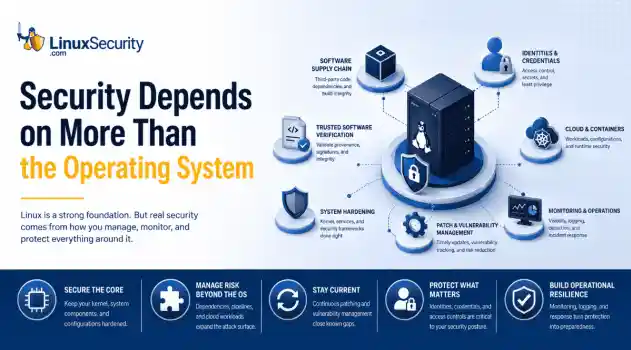
 If more than 12 million enterprise systems can be exposed by flaws in a security control designed to harden Linux, it's probably worth asking whether Linux gives people a false sense of security. That's a question that has come up repeatedly throughout 2026. . This year alone, researchers have disclosed privilege-escalation vulnerabilities, root-level kernel flaws, and multiple supply-chain compromises affecting Linux environments. That doesn't mean Linux suddenly became insecure. It means...
 Jun 15, 2026
  security advisory attack
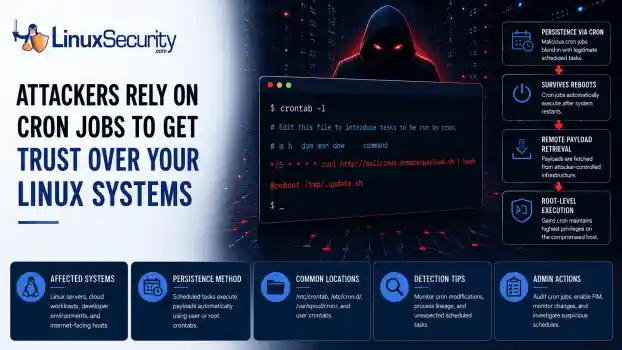
 A Linux server gets cleaned up after an intrusion. The suspicious process is terminated, credentials are rotated, and the system is rebooted during maintenance. Everything seems secure. A few hours later, the same outbound connection appears again. . Situations like that point to persistence . The attacker no longer needs the original exploit because something on the host continues restoring access behind the scenes. Finding that mechanism is often more important than understanding how the...
Jun 08, 2026 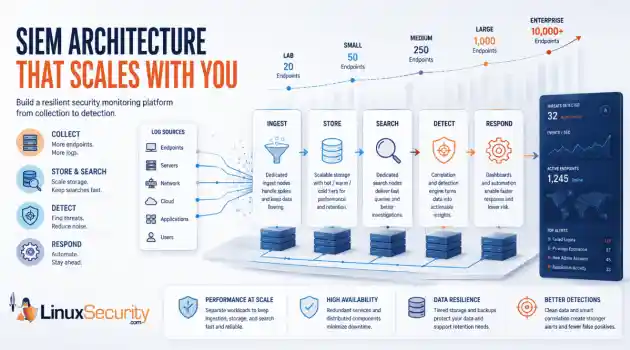 threat detection scalability
 Building a SIEM is easier than scaling one. Most open-source deployments start as a simple "all-in-one" server. It is easy to set up, but that design rarely survives the transition from a lab to a production workload. . A SIEM watching 20 endpoints is not doing the same job as one watching 500. More endpoints mean more logs; more logs require more storage; more storage makes search heavier. Eventually, the very architecture that made your lab easy to deploy becomes the reason your production...
Jun 04, 2026 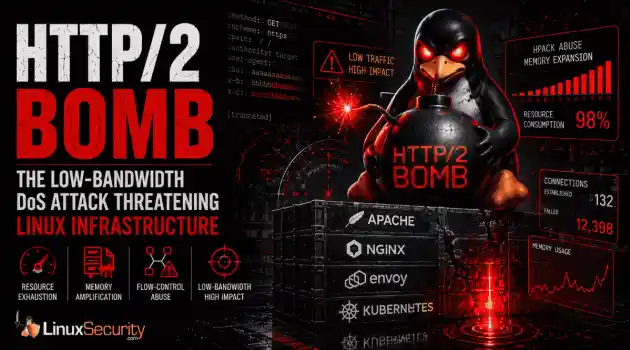 security advisory apache
 A newly disclosed attack technique called HTTP/2 Bomb is drawing attention because it targets the software that sits at the front of much of the Linux internet. Apache HTTP Server, NGINX, Envoy, and the ingress layers that many Kubernetes environments depend on can be forced into consuming disproportionate amounts of memory using relatively small amounts of attacker traffic. . For Linux administrators, the concern is not the HTTP/2 protocol itself. It is the possibility that a single...
Jun 04, 2026  security advisory important
 The compromise of Nx Console shows how much infrastructure now sits behind a single developer account. GitHub repositories, CI/CD pipelines, container build systems, Terraform projects, Kubernetes deployments. None of those systems was the initial target. The workstation was. . Attackers did not need a Linux privilege escalation bug or a remote code execution chain. They needed developers to trust a tool they were already using. For many organizations, that was enough. What Happened? Federal...
Jun 03, 2026  Refine features
X Clear Filters Get the latest News and Insights
Get the latest Linux and open source security news straight to your inbox.
Community Poll
What got you started with Linux?
Loading...
Explore Latest Linux Security features
We found -2 articles for you...
102
 security advisorydependency managementsoftware integrity
Why Linux Supply Chain Attacks Are Becoming a Nightmare for DevOps Teams
Linux has long carried a reputation for resilience, bolstered by open-source reviews, hardened kernels, and transparent development pipelines. While that trust is well-founded, attackers have shifted their focus to a more vulnerable target: the surrounding software supply chain. . Instead of breaking Linux directly, malicious actors are poisoning the delivery pipeline. The shift is obvious when you look at the last few years of incidents. Compromised maintainers, malicious packages, dependency confusion, and poisoned updates frequently land on systems long before defenders realize the code has changed. While security teams are busy patching traditional vulnerabilities, attackers are quietly slipping through package managers and CI/CD workflows we assumed were trustworthy. The XZ Utils backdoor fundamentally changed the tone of this conversation. The XZ Backdoor: The Scenario Everyone Feared In early 2024, attackers inserted a backdoor into XZ Utils , a compression library embedded across Linux distributions and SSH-related workflows. The malicious code targeted liblzma (a data compression library) and created a path to intercept SSH authentication under specific conditions. It was subtle, heavily obfuscated, and positioned deep enough in the stack that most environments would never notice it during routine reviews. But the most dangerous part wasn’t the payload itself—it was how access was gained. A contributor operating under the alias "Jia Tan" slowly built trust inside the project over months. The pattern started with normal, helpful commits, routine maintenance, and participation, before the poisoned update eventually landed. This long-game approach mirrors what’s happening across open-source ecosystems today: attackers are playing the long game rather than relying on smash-and-grab compromises. The backdoor was ultimately caught by Microsoft engineer Andres Freund after he noticed strange CPU behavior in Debian test environments. If that anomaly had gone unnoticed for a fewmore release cycles, the blast radius would have been catastrophic. The Pattern Didn't Stop with XZ In March 2026, a supply chain attack hit Axios , one of the most widely used HTTP client libraries in the JavaScript ecosystem. Attackers got access to a maintainer’s npm account and quietly published two compromised versions, 1.14.1 and 0.30.4, before anyone caught it. The Axios source code itself wasn’t altered. That part mattered. Instead, the attackers slipped a malicious dependency called plain-crypto-js into the release chain, which is a much easier place to hide when everyone’s focused on the main project diff and not the packages underneath it. Once installed, npm automatically ran post-install scripts tied to the dependency. The code was heavily obfuscated and built to stay unnoticed long enough to deploy a remote access trojan across Linux, macOS, and Windows systems. Researchers later connected the infrastructure and forensic overlap to North Korean operators. What unsettled a lot of security teams wasn’t the sophistication. It was the timing. The poisoned packages were live for only a few hours, but Axios pushes tens of millions of downloads every week, so developer workstations, CI runners, and production pipelines started pulling the update almost immediately without anyone stopping to inspect a routine dependency refresh. That’s the part that supply chain attacks keep exposing now. Attackers do not always need to compromise the primary codebase anymore. A transitive dependency buried deep enough in the update path can move through trusted channels quietly, especially in environments where automated installs happen faster than meaningful review ever does. Takeaway : Open-source trust models are incredibly vulnerable to patient attackers. To learn more about how organizations are improving software transparency, you can review the CISA Software Bill of Materials Guidance Linux Repositories as Active Attack Surfaces The problem extends far beyond Linuxdistributions themselves. Language ecosystems are hit constantly because developers install dependencies—third-party code modules used to speed up development—at scale with almost zero scrutiny. Go Modules: In 2025, researchers uncovered malicious Go modules (such as prototransform, go-mcp, and tlsproxy) that deployed destructive shell scripts to wipe Linux disks through /dev/sda. The payload didn't even attempt to extort the user via ransomware; it destroyed the systems outright. PyPI Packages: Packages frequently serve as delivery mechanisms for credential theft and remote access tooling. Some have abused Gmail SMTP infrastructure and WebSockets to blend exfiltration traffic into normal outbound communications, easily bypassing monitoring in smaller environments. Node.js Ecosystem: The event-stream compromise remains one of the clearest examples of this evolution. A maintainer handed project ownership to a new contributor who gradually introduced malicious code through a nested dependency targeting cryptocurrency wallets. npm audit failed to flag it because it wasn't tied to a known vulnerability at the time. You can read the original breakdown of the event-stream GitHub discussion to understand how social trust becomes an attack vector. Why Traditional Dependency Scanning Falls Short Many organizations treat tools like npm audit, Dependabot, or standard vulnerability scanners as a complete supply chain defense. They aren't. These tools are great for identifying known vulnerable versions tied to published advisories and helping with patch management. However, they fail to reliably catch: Compromised maintainer accounts Typosquatted or malicious packages Obfuscated payloads Malicious post-install scripts Dependency confusion attacks Insider sabotage Runtime exfiltration behavior The ua-parser-js compromise demonstrated this gap. Attackers hijacked the maintainer’s account and pushed malicious package versions that deployed cryptominers andcredential-stealing malware. The window lasted only a few hours, but thousands of developer systems and CI pipelines pulled the update automatically before any advisory was published. Ecosystems are trying to improve trust validation, and you can see how in the npm Registry Signatures and Provenance documentation . The Trap of Trust at Scale Modern applications routinely pull hundreds or thousands of dependencies through transitive package chains (where one dependency relies on another). Most teams cannot realistically audit all of them manually, leading to the dangerous assumption that "popular" equals "safe." Attackers know developers trust download counts, GitHub stars, and familiar names: Typosquatting: Campaigns exploit simple human errors. Packages like crossenv successfully harvested environment variables simply because someone missed a hyphen while trying to install cross-env. Dependency Confusion: In research by Alex Birsan, public packages using internal company names tricked package managers into pulling malicious versions from public registries rather than private ones. Giants like Apple, Microsoft, PayPal, and Tesla were impacted during testing. This attack chain works because the package resolution behavior itself is exploited. You can review the original Dependency Confusion Research to see how this vulnerability operates. How to Reduce Supply Chain Risk There is no single silver bullet. Because attackers target multiple parts of the pipeline simultaneously, teams need layered verification: Lockfiles and Integrity Validation Lockfiles (like package-lock.json or yarn.lock) pin exact dependency versions and verify integrity hashes. In production pipelines, use npm ci instead of npm install to enforce deterministic installs rather than recalculating dependency trees dynamically. It's a small change with a big security difference. SBOMs and Dependency Visibility Software Bills of Materials (SBOMs) provide much-needed visibility into what is running insideapplications. Tools like CycloneDX and Syft generate SBOMs for Linux systems and container images, helping teams quickly check whether suspicious components exist in their environments. To learn more about reproducible builds and software integrity frameworks, check out the SLSA Framework . Provenance and Signed Builds Projects like Sigstore modernize software provenance verification using cryptographic signing tied to CI/CD workflows, rather than relying on developer machines. This ensures we know where a package was built, which pipeline produced it, and if it was altered afterward. You can read the Sigstore project overview to learn more. Restrict Install-Time Execution Many attacks abuse post-install scripts that inherit broad execution privileges. Using flags like npm install --ignore-scripts stops an entire category of malicious behavior. High-trust production pipelines should strictly limit unnecessary execution paths and isolate build runners to prevent lateral movement. 5 Things Linux Teams Should Do This Week Require MFA for package maintainers Pin dependency versions in production Disable unnecessary install scripts Generate SBOMs during builds Monitor dependency changes in CI pipelines Open Source Security Relies on Human Processes Some of the hardest problems in supply chain security aren't technical: maintainer burnout, poor account security, weak review pipelines, and underfunded projects maintaining critical infrastructure. The colors.js and faker.js sabotage incident showed what happens when maintainers themselves become unpredictable risk factors. This wasn't an external intrusion; the maintainer intentionally broke downstream systems. The industry is slowly responding by requiring MFA, improving provenance tooling, and adopting reproducible builds. But adoption is uneven outside of large enterprises, and that gap is where attackers continue to operate. Treat Supply Chain Monitoring Like Endpoint Security The old assumption thatLinux repositories are inherently trustworthy no longer holds up under modern attack patterns. Defenders need visibility into dependency changes, unusual network behavior, build pipeline anomalies, and maintainer activity—not just CVEs. Because most supply chain compromises don’t arrive as traditional exploits. They arrive as routine updates: quietly, usually signed, and almost always trusted. If you’re tracking issues like this, Linux security newsletters are a great way to keep them on your radar. . Explore how supply chain attacks threaten Linux ecosystems and discover proactive measures for better security.. Linux Supply Chain Attack, Open Source Security, Software Integrity, Dependency Management. . MaK Ulac
 May 06, 2026 •
102
 remote accessLinux securitydata exfiltration
New Supply Chain Attack: Protect Linux Systems from Typosquatting Threats
In a sneaky new supply-chain attack , threat actors have been discovered exploiting package naming conventions to trick unsuspecting developers into installing malicious packages that appear legitimate at first glance. You are likely fastidious about checking package names. Still, in today's fast-paced environment, I could see myself overlooking a small error and putting my systems and data at risk of persistent compromise. Falling for this stealthy scam impacting npm users could enable bad actors to remotely control your servers, siphon sensitive information, and retain continuous access through injected SSH keys. . This emerging threat is a much-needed reminder of the critical importance of robust dependency auditing and network monitoring to protect against silent compromises in your environment. In this article, I'll help you better understand and prepare for this new threat, equipping you to safeguard your Linux systems from this attack and similar vulnerabilities introduced in the modern software supply chain. The Mechanics of Typosquatting Attacks Source: Socket Typosquatting attacks exploit software package managers and dependency resolution processes, such as npm or pip, to take advantage of software dependency resolution mechanisms and ease library integration for developers. However, they depend on exact naming conventions when pulling library content into projects. By publishing malicious packages with names similar to trusted libraries, such as those offered through these package managers, attackers hope to fool users into silently installing their code. Once installed, it may take advantage of system permissions to perform unauthorized actions. The Telegram bot-related packages recently discovered by Socket contained scripts designed to inject SSH keys directly into their victims' server, opening hidden backdoors that allowed for persistent access even after the malicious package had been uninstalled. Furthermore, these packages included capabilities forexfiltrating private keys or configuration data, further expanding an attack's reach into connected machines — making what initially may seem like an isolated attack into an event with far-reaching effects. Why Linux Environments are at Risk Linux systems are particularly susceptible to these attacks for several reasons. First, these servers often host essential applications, databases and services - making them high-value targets for attackers. With developer ecosystems like Node.js frequently running on Linux systems and extensively using Node Package Manager (npm) packages as part of their development workflows, there is an increased potential for exposure to typosquatting threats if left unmonitored. Linux's open nature encourages flexibility and customization, which can have unintended security ramifications. While administrators and developers take advantage of the extensive freedom to configure environments, malicious actors can exploit overlooked details, such as dependency management or package installations, that go undetected by admins and developers alike. Its portability and accessibility make Linux popular among enterprises — but those same qualities require a strong defense against potential supply chain compromises. Proactive Defenses: Auditing Dependencies and Infrastructure Preventing typosquatting attacks begins with better dependency hygiene. Security-conscious Linux admins should enforce strict practices to audit and validate packages before they are installed. While many developers rely on npm’s default settings for fetching libraries, tools like dependency checker scripts like OWASP dependency-check or supply chain security platforms like IBM's Software Composition Analysis can take it a step further by identifying packages that exhibit suspicious behavior. Socket’s detection algorithms are an example of how automated analysis can catch anomalies in package behaviors—such as hidden payloads or excessive permission requests—before they reach yourenvironment. Beyond package auditing, frequent reviews of infrastructure-specific indicators, such as SSH keys, are equally critical. Attackers who exploit typosquatting often aim to inject unauthorized keys to create persistent access. By maintaining a clean and well-documented list of SSH credentials and rotating keys periodically, Linux admins can reduce the likelihood of unauthorized use. Furthermore, network traffic monitoring , especially related to outgoing connections, can reveal signs of an ongoing compromise. Malicious npm packages often generate unusual outbound traffic, such as data exfiltration attempts or callbacks to command-and-control servers, which can serve as a warning sign for administrators. Detecting and Mitigating Silent Compromises Typsquatting attacks have one of the more dangerous features: their insidious ability to go undetected for extended periods. Developers might resolve broken dependencies or uninstall suspicious packages without realizing malicious code has already embedded itself within the system. We admins need layered defense mechanisms, including intrusion detection systems (IDSs) or file integrity monitoring (FIM), in place to detect silent compromises, such as unauthorized changes to system files or configuration settings. Administrators should also carefully assess their servers' behavior. Any indications of slowdown, unusual disk usage or unexpected access patterns might signal attackers have gained entry through typosquatting. Regular security scans, designed to detect abnormal traffic or suspicious command executions, could help uncover their covert attacks. It is critical to remember that conventional antivirus tools might miss malicious npm packages. Modern Linux frameworks, designed with supply chain risks in mind, will often detect deeper implications more promptly than antivirals alone. The Bigger Picture: Reinforcing the Software Supply Chain At its core, protecting Linux systems against typosquatting attacks is part of a moresignificant challenge: safeguarding the entire software supply chain . With open-source ecosystems experiencing exponential growth and more and more third-party packages entering production every day, administrators and organizations alike must implement proactive measures to minimize supply chain vulnerabilities such as adding automated scanning solutions into CI/CD pipelines to detect malicious artifacts before production. At the same time, security awareness training can reduce incidents that result from accidental typosquatting installations. Securing the supply chain doesn't stop with packages; it also involves vetting repositories and registries developers use. While npm regularly removes malicious packages when reported, administrators must encourage developers to carefully verify dependencies before installing them. Developers should pin specific versions of libraries to avoid unexpected updates that introduce vulnerabilities into their infrastructure. Our Final Thoughts: Staying Ahead of Tomorrow’s Threats As attackers continue to refine their techniques, Linux admins must remain vigilant and adaptable. Typosquatting attacks on npm packages targeting Linux environments are proof of how clever adversaries can exploit minor attention lapses. The consequence of such compromises often goes beyond the initial infection, with attackers leveraging access to infiltrate connected systems and extract valuable data. By combining dependency auditing, infrastructure monitoring, proactive detection strategies, and supply chain resilience, Linux admins can disrupt attackers' pathways and fortify their systems against future threats. This battle is ongoing, but with the right tools and practices, it’s one that security teams can confidently face without sacrificing the flexibility and power that Linux so uniquely provides. Every system hardened and every attack prevented adds to the collective effort to protect open-source environments—and the critical services they enable—from becoming unwittingvictims of supply chain exploits. . This emerging threat highlights the necessity of robust dependency audits and proactive defenses for Linux systems.. in a sneaky, supply-chain, attack, threat, actors, exploiting, package. . Brittany Day
Apr 21, 2025 • 
102
 open source toolscontainer securitysupply chain attack
Comprehensive Overview Of Emerging Tools In Container Security
Containers are among the many recent inventions of modern computing. They have emerged as the cornerstone of software development and deployment. They isolate applications and their dependencies into a closed environment, enabling efficient and consistent deployment across different infrastructures. . There are plenty of reasons behind the shift to containerization, the key being the widespread adoption of DevOps practices and cloud-native innovations. However, despite the unmatched convenience and efficiency, containers bring various security challenges that traditional security measures can’t fully address. As this new technology proliferates across production environments, securing them should be a priority for all organizations. Unlike traditional devices, containers share the hosts’ OS kernel, which is beneficial but exposes it to potential vulnerabilities. This means businesses should re-evaluate their security strategies throughout the container’s lifecycle. Similarly, the future of container security depends on several emerging innovations. The increasing shift towards Zero Trust models is especially relevant to containerized environments. This model assumes no inherent trust within the network and enforces stringent authentication measures for access. The shift-left security option, which integrates security practices from the development lifecycle, is also beneficial. This strategy helps developers detect and mitigate vulnerabilities before production, significantly reducing attack surfaces. Various open-source tools, including Trivy, lead the pack in ensuring these developments. Below is a detailed guide on container security and its future. Read on! The Current State of Container Security With the rise of the adoption of containers, there’s a need to understand the current state of container security. While containers offer significant benefits, they introduce significant security challenges. It is prudent for organizations and businesses to know some of theexisting threats and common attack vendors before adopting them. They Include: Vulnerable code is the most important security risk of containerized applications. As mentioned, containers package applications alongside their dependence. This often includes insecure or outdated libraries that attackers can exploit. Compromised images: Containers rely on images containing apps and their dependencies. Unfortunately, some may have insecure components that expose the entire network to security risks. A compromised container image serves as a perfect entry points for attackers. Insecure working: Containers communicate through internal networks. Poorly secured networks become excellent vectors for attacks. Lack of encryption and insufficient segmentation often lead to data breaches. Container escape: This severe threat occurs when attackers break out of container isolation and access the host system, compromising the host and other containers running on it. While these risks are dire, container environments have various built-in security measures that mitigate these vulnerabilities. These features are built on Docker and Kubernetes but have some limitations. For instance, Docker uses namespaces to isolate containers and host systems. This significantly prevents unauthorized access and denial-of-service attacks and reduces the attack surface. However, Docker’s default features are slightly insufficient. Simple issues like using untrusted images can bypass its security setup. Kubernetes also provides perfect built-in security features for container environments. It enhances container security by implementing RBAC, which controls access and empowers network segmentation. Unfortunately, configuring Kubernetes securely often proves challenging. Wrong settings expose containers to vulnerabilities. However, this doesn’t mean containers are entirely insecure. Organizations can leverage various open-source container security tools to address these issues that exceed the capability of built-insecurity measures. These tools include: Trivy and Clair for image vulnerability scanning Kube-bench and Kubescape for configuration and compliance issues. Falco and Sysdig for enhanced runtime security Cilium and Calico will address network security issues. Open Policy Agent and Kyverno to sort policy enforcement issues. Dex and Keycloak for identity verification and access management. Sealed Secrets and HashiCorp Valut for secrets management. They enhance the security of stored sensitive information. Grafana Loki and Prometheus for better incident responses. Collectively, these tools provide targeted solutions that enhance container security in different aspects of the container lifecycle. Emerging Trends in Container Security With the expanding use of containerization, the security realm surrounding these environments keeps evolving in response to emerging threats. Below is a breakdown of top trends shaping the future of container security: Exploitation patterns and attacks targeting containerized environments Attackers now use sophisticated techniques to exploit vulnerabilities present in these systems. Some of the recent trends in exploitation patterns include: Supply chain attacks : Malicious persons compromise container images and dependencies, ultimately affecting the supply chain. They can inject malware into private or public repositories. Lateral movement: Attackers attempt to move laterally to access other containers after successfully accessing a container. Resource hijacking – malicious individuals hijack resources for malicious activities. Containers with misconfigured resources are often very vulnerable. Integrating security into the CI/CD pipeline This practice is a perfect response to the dynamic nature of container deployments. Also called shift-left security, it focuses on identifying and mitigating vulnerabilities earlier in the container development lifecycle. Various tools, including automated vulnerability scanning andsecurity testing, are integrated into CI/CD workflows before containers reach final production. Automated checks are also conducted to ensure containers have the necessary security structure before deployment. The use of software bills of materials Containers heavily rely on third-party components and dependencies. Using SBOM has become crucial for tracking and managing all components. It provides a detailed inventory of all components in the container image, including frameworks, libraries, and dependencies. Doing this is beneficial in many ways. For starters, it helps in vulnerability management. Organizations can easily identify and address threats in third-party components. SBOMs also provide vital information during incident response. Knowing the components makes it easy to identify the origin of the compromise. Adoption of policy as code practices Policy as Code is a practice of defining security policies enforceable through code. This approach aligns perfectly with shift-left practices, embedding security policies directly into the container development lifecycle. Adoption of these practices helps organizations achieve consistency and automation. Administrators define and automate policies, significantly reducing the risk of misconfiguration and human error. These policies also enhance collaboration between development and security teams. Adoption of AI and ML  Artificial intelligence and machine learning have transformed container security in the following ways: Threat prediction: ML models analyze patterns and historical data to predict potential threats. This proactive approach helps anticipate and mitigate vulnerabilities before they materialize. Behavior analysis: Al-powered tools analyze container patterns to identify anomalies that indicate security threats like resource usage or unexpected connections. Automated responses: Automatedtools provide faster and accurate responses to arising incidents. Integrating AI with incident response workflow allows organizations to streamline threat mitigation and minimize the impact of breaches. Adoption of service mesh architectures Organizations have increasingly adopted service mesh architectures to secure communication between containerized environments. This practice enhances traffic control and policy enforcement. Service meshes like Istio provide more control over network traffic, enhancing confidentiality and data integrity. Service meshes also allow organizations to monitor traffic patterns and detect anomalies. Such visibility is crucial for identifying and responding to threats in real time. However, meshes introduce some complexities. Organizations should carefully balance these security advantages with resource demands. Spotlight on Open Source Security Tools Securing these environments becomes important as containerization becomes the cornerstone of modern app deployment. Open-source tools can help organizations address various challenges. Some of the top open-source tools to consider include: Trivy Trivy is an open-source tool from Aqua Security that offers excellent vulnerability scanning for container images and file systems. This tool stands out for its comprehensive vulnerability scanning ability, which makes it a must-have tool in business container security sets. Key features of Trivy include: Wide vulnerability coverage: The tool scans various vulnerabilities in container images. It also supports various languages and package managers, broadly covering potential threats. Ease of use: The command-line interface is straightforward and requires minimal setup. Community and support: As an open-source project, Trivy benefits from contributions from a vibrant community of developers. This collaborative environment ensures that it remains up-to-date. Hadolint This is another open-source linter that helps developers write secure Dockerimages. Hadolint evaluates Docker files, ensuring they adhere to best practices like minimal image size, reduced number of layers, and more. These practices enhance the performance and security of container images. Hadolint also provides security recommendations for improving Docker Files' security. For instance, it can suggest using the “latest” tag, which has potential security vulnerabilities. The tool allows users to define custom configurations and rules to suit their requirements. Organizations can also benefit from Clair, Grype, Syft, and Kube-Bench. These tools play a crucial role in improving the container security landscape. Future of Open Source Container Security Tools
  The container security landscape continues evolving, with applications becoming more complex and new threats emerging. Open-source tools like Trivy will also likely undergo significant advancements to meet emerging challenges. As containerized environments become sophisticated, Trivy will expand its detection abilities. Its threat detection abilities will include supply chain attacks and new exploitation techniques. Trivy will also evolve to adapt to the needs of modern architectures, especially hybrid and multi-cloud environments. On the other hand, Hadolint will feature advanced limiting rules and a deeper integration with the container ecosystem. Hadolint will feature sophisticated features that address emerging performance and security issues in Docker Files. However, the fast-paced culture of this environment will necessitate a community-driven approach to open-source tool development. Open-source communities allow for rapid response to emerging threats, leveraging collective expertise and resources. Similarly, integrating open-source security tools into comprehensive security platforms is very possible. Integration ofthese tools will focus on enhancing interoperability and automation. This will require standardization of APIs and data formats to allow smooth data exchange and communication of these tools. Lastly, new tools will emerge tailored to address specific vulnerabilities associated with evolving container technologies. These tools will likely focus on specific areas, like serverless security. New tools will also help organizations navigate complex compliance requirements. For instance, they will automate compliance checks and provide detailed reports to ensure containerized apps adhere to legal provisions. Challenges and Considerations for the Future Maintaining robust security becomes challenging as containerization becomes more disrupted and dynamic. The main issues are: Securing dynamic and distributed environments: This requires tools that adapt to diverse deployment environments, including on-premise data centers, edge devices, and multiple clouds. Balancing agility and usability: Focusing overly on agility leads to misconfiguration, while stringent security practices hinder usability. Finding the perfect balance is key. Legal and regulatory issues: Open-source tool development should adhere to a complex legal landscape. Compliance with data protection laws, software licensing and other legal issues becomes challenging. Addressing these challenges requires collaboration and continuous innovation. Keep Learning About Container Security Container technologies offer great flexibility and scalability. However, they come with unique security challenges that necessitate innovative solutions. Fortunately, open-source tools play a crucial role in enhancing security. Their capabilities, ranging from vulnerability scanning to runtime monitoring, help secure container environments. However, developers and professionals still need to contribute to enhancing the security of these projects. Participating in open-source communities helps shape the future of container security and ensuresthese tools meet the demands of modern applications. Learn about Container Security basics Secure Docker Containers with These Data Management Software Options Open Source Vulnerability Assessment Tools & Scanners . Investigating developments, technologies, and threats influencing the next phase of container protection and its transformation.. Container Security, Open Source Tools, Shift Left Security, CI/CD Pipeline, Runtime Monitoring. . Dave Wreski
Jul 13, 2024 • 
Get the latest News and Insights
Get the latest Linux and open source security news straight to your inbox.
Community Poll
What got you started with Linux?
Search Topics
Powered By

Linux Security - Your source for Top Linux News, Advisories, HOWTOs and Feature Releases
QUICK LINKS
subscribe to newsletters!
Like staying secure? So do we.
Sign up for updates, tips, and alerts!
Discover faster search, smarter navigation, and deeper Linux security insights. Read More