Audit Linux privileges now to limit compromise, escalation, and system-wide damage. Review Linux Privileges×


Stay Ahead With Linux Security Features
 identity management security tactics
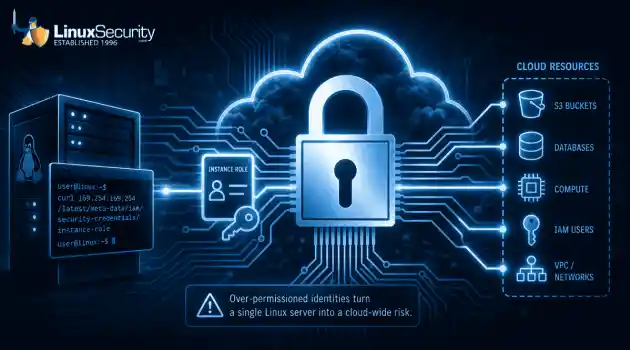
 For years, we secured our Linux infrastructure by building walls: VPCs, security groups, and hardened SSH configurations. We treated the cloud like a virtual data center, assuming that if we kept the "bad guys" out of the network, our workloads were safe. . That model is no longer sufficient. Today, one of the most common paths from an initial compromise to a major cloud breach is the identity assigned to your Linux workload. When an attacker gains code execution on a Linux instance—through a...
 Jul 17, 2026
 security practices patch management
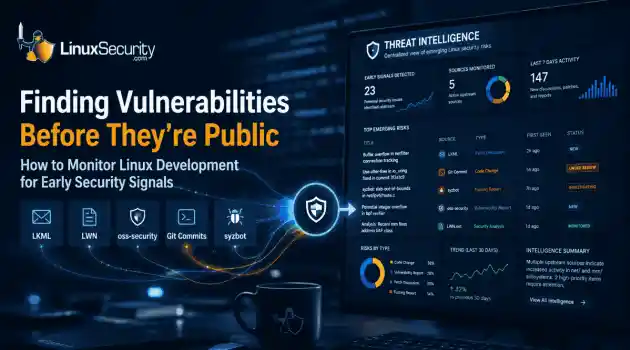
 Most of us don't hear about a kernel vulnerability until a CVE lands in our inbox or the vulnerability scanner starts complaining. By then, the patch isn't new anymore. Kernel developers may have been passing it around for review, arguing over the implementation, or revising it for days before anyone outside that community noticed it. None of those discussions are secret. They're sitting in mailing list archives, Git commits, and patch reviews where they've been the whole time. The strange...
Jul 14, 2026
 Linux security cyber attacks
 Every Linux server in your fleet produces thousands of events every minute. From journald logs and auditd records to kernel-level eBPF hooks, your systems are constantly talking. Most of that noise is just the mundane churn of system services, CI/CD runners, or routine administrative automation. But among that noise, an attacker might be establishing a foothold, moving laterally, or setting up persistence. The challenge for any security team is: how do you separate the routine from the...
Jul 13, 2026
 open-source infrastructure risk
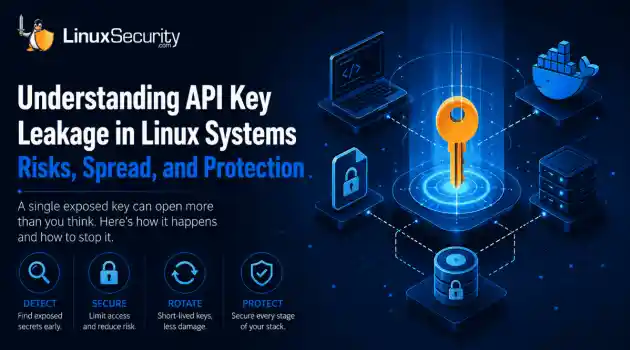
 Security scanners flag exposed API keys in public repositories every day. The initial response is usually predictable: delete the commit, revoke the credential, and move on. That’s a mistake. . In a real Linux environment, an API key never stays in one place. By the time it hits a public repo, it’s already everywhere. It’s in the CI/CD pipeline. It’s in your container registry. It’s in the build logs. It’s in the backups. Git makes this worse because the history never dies. Deleting a file in...
Jul 11, 2026
 open-source rootkit
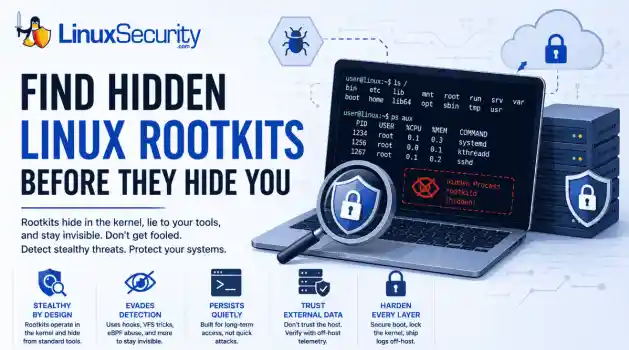
 Most of us think of Linux rootkits as ancient history—the stuff of 90s hacking forums and clunky malware that would crash your system if you looked at it the wrong way. But if you think they’ve gone away, you’re mistaken. They’ve just gotten smarter. . Modern attackers aren't using the noisy tools of the past. Today’s threats are surgical. Many of today’s most advanced Linux rootkits operate at the kernel level or abuse legitimate system features to blend in with normal traffic. They’re...
Jul 09, 2026
 Refine features
X Clear Filters
Get the latest News and Insights
Get the latest Linux and open source security news straight to your inbox.
Community Poll
Should Linux servers automatically install security updates?
Loading...
Explore Latest Linux Security features
We found -1 articles for you...
102
 security advisoryhigh severitylocal privilege escalation
Ubuntu Copy Fail High Local Privilege Escalation Threat Advisory 2026-31431
Most Linux hardening focuses on access. This vulnerability bypasses that entirely. . Think about Linux security like the structural integrity of a building. We spend a lot of time on the front door—locks, cameras, and ID badges. Those are just policy layers. They’re great for keeping people out, but they don't tell you what happens to the foundation if a core system component is bypassed in plain sight. The reality is that upstream kernel security moves a lot faster than enterprise adoption. Defenses are being built quietly through patch discussions and mailing lists, not through big announcements. By the time a vulnerability like this becomes a standard operational concern, the risk has already been sitting in the gap between what is "available" and what is actually "active" in your environment. Copy Fail (CVE-2026-31431 ) sits right in that gap. It’s a high-severity local privilege escalation flaw in the Linux kernel’s cryptographic subsystem ( authencesn ), and it’s easy to miss if you’re only tracking what’s been announced instead of what’s actually running. This isn't about just listing what exists; it’s about verifying what is actually working on your systems and knowing where the risk actually lives. Why This Matters in Production Environments If you're trying to figure out how to secure a server, the structural boundaries are where things usually break down. Copy Fail is not remotely exploitable on its own, but chained with a web Remote Code Execution (RCE), a compromised CI runner, or an SSH breach, it gives an external attacker an immediate express lane to host-level root. The real danger of this local privilege escalation Linux flaw isn't on a single, isolated desktop. The risk lies in the shared infrastructure that powers modern enterprise tech: Container Escape Vulnerabilities: The vulnerability represents a dangerous container escape primitive . Because the page cache is shared at the host level, an attacker doesn’t stay contained. Frominside a compromised container, this turns into a path straight to the underlying Kubernetes node. Shared Kernels: Containers aren’t isolated in the way most people assume; they all rely on the same kernel and memory. Once that boundary breaks, it doesn’t stop at one workload. How 4 Bytes Can Give You Root To understand what’s happening, you don't need to be a kernel developer. Most server security conversations stay at the surface—firewalls, access controls, patching. But this vulnerability stems from an in-place processing optimization introduced to the Linux kernel back in August 2017 (commit 72548b093ee3). The kernel uses a mechanism called the page cache to keep frequently accessed files in RAM, so the system doesn't have to keep reading the slower disk drive. When you make an AEAD (Authenticated Encryption with Associated Data) request through an AF_ALG socket to the authencesn cryptographic template, the kernel processes the data. Due to this optimization, a page from the page cache ends up in the writable destination scatterlist: The Overwrite: If an attacker binds a socket to authencesn and sends a recvmsg call with the exact offset, the kernel treats the request as an in-place operation. It writes four controlled bytes into the page cache of a target setuid binary (such as /usr/bin/su ). The Hijack: The exploit doesn't alter the file on disk. File integrity monitoring tools will see nothing. Instead, it alters the binary as it is executed . When that setuid binary is run by the system or another user, it reads the modified cache, executes the corrupted memory instead of the original code, and hands over root privileges to the unprivileged user. The Simplicity: Unlike older, complex LPEs like Dirty Pipe, there are no race conditions or tricky timing windows to worry about. With a 732-byte Python script, it works reliably on the first try across almost all enterprise Linux builds (Ubuntu, Debian, RHEL, SUSE) released since 2017. The AI Factor: Why This Problem Is About to Get Worse This isn't an isolated discovery pattern, nor is it just a theoretical milestone. Copy Fail wasn't found by a researcher spending months hunting through assembly code by hand. It was identified by Theori researcher Taeyang Lee using their Xint Code AI scanning software in about an hour. Think about the economics of vulnerability research: for years, finding a reliable, high-severity local privilege escalation flaw in the Linux kernel required deep domain expertise, patience, and manual fuzzing with tools like syzbot . The barrier to entry was high, and the turnaround time was measured in weeks or months. That barrier has completely collapsed. When an AI-driven tool can scan, identify, and trace a deep logic flaw in the kernel's cryptographic subsystem in sixty minutes, the friction of discovery drops to zero. We are looking at an exponential increase in automated vulnerability discovery. The industry is already feeling the downstream pressure of this shift—security programs and maintainers are being inundated with automated bug reports, struggling to triage deep logic vulnerabilities at scale. What does this mean for your infrastructure? It forces a change in your fundamental threat model. You can no longer treat kernel-level LPEs as rare anomalies that only affect high-value targets. If vulnerabilities are found in minutes, threat actors and automated agents can weaponize and chain them into container escapes much faster than enterprise release cycles can accommodate. When the foundation can be breached this quickly, infrastructure security stops being about patching known bugs one by one. It becomes a requirement to harden the environment against entire classes of vulnerabilities and validate those protections at the host layer before an attacker even gets a foot in the door. The System Looked Clean, but Wasn’t In internal testing, this exploit worked on fully patched enterprise Linux builds from the last several years,with no alerts triggered and no file changes on disk. What to Check and Where Mitigations Fail The gap between what’s possible and what’s deployed is where risk lives. Standard patching doesn't always validate these internal controls, and many teams assume a patch was applied without auditing the running state of the host. For instance, simply updating the base image of a container does nothing if the underlying host kernel remains vulnerable. Furthermore, disabling modules requires active host reboots or unloads that often get delayed in production. Here is a quick check for your endpoint security: Patch Your Kernels: Major Linux distributions have already rolled out updates. Debian, Ubuntu, and SUSE are pushing patches. Red Hat shifted its guidance to issue patches promptly. Check your distribution's security repository and apply the latest kernel packages. On production Kubernetes clusters, plan a rolling drain-and-reinstate procedure. Apply Temporary Mitigations: If you can't reboot or patch your kernels immediately, you can disable the vulnerable algif_aead module. Harden Container Pipelines: Restrict the creation of AF_ALG sockets using seccomp profiles to stop the exploit from being executed within containers. # Disable the vulnerable algif_aead module echo "install algif_aead /bin/false" > /etc/modprobe.d/disable-algif.conf rmmod algif_aead 2> /dev/null || true (Note: This mitigation doesn't affect standard encryption like IPsec or OpenSSL, but you should always test it in a non-production environment first). True infrastructure security is about the foundation. Validation matters more than assumptions. The best defenses aren't the ones you read about in a memo—they’re the ones you’ve actually turned on and validated within your container workloads. Where Security Assumptions Break Nothing here throws obvious signals. The system runs, policies stay loaded, logs look routine, and the control still doesn’t behave the wayanyone expects once it’s actually exercised. The problem shows up at the boundary. A container reaches past its limits, a syscall path resolves when it shouldn’t, a restriction exists but doesn’t apply in the exact context an attacker lands in, and that’s enough. It doesn’t take much. One weak spot in a shared layer, one enforcement gap that never got tested under real conditions, and isolation starts to blur in ways that don’t show up in configs or dashboards. This isn’t about adding more controls. It’s about knowing which ones you’ve pushed hard enough to trust, and which ones are still sitting there unverified. Subscribe to the newsletter if you want direct insight into where these breaks actually happen, especially around kernel behavior and container boundaries. . Think about Linux security like the structural integrity of a building. We spend a lot of time on th. linux, hardening, focuses, vulnerability, bypasses, entirely, think, about. . MaK Ulac
 May 01, 2026
•
May 01, 2026
•
102
 security advisorycriticallocal privilege escalation
Ubuntu PackageKit Critical Local Privilege Escalation CVE-2026-41651
Most information security best practices are built on a single, comfortable assumption: that the "root" gate is locked and only the administrator holds the key. We assume that unless we explicitly hand over credentials, the core of the system is off-limits. . But the recent discovery of Pack2TheRoot (CVE-2026-41651) just blew that theory apart. For over 12 years, a local privilege escalation flaw has lived in the default install of almost every major Linux distribution. It didn't require a complex network exploit or a social engineering scheme. It sat in PackageKit—a background service designed for "convenience", and it allowed any unprivileged user to walk through the front door and claim root privileges in seconds. This isn't just a bug write-up. It’s a case study in how trust is enforced (and how it fails) in modern system security. The Hidden Layer of Server Security Everyone Ignores When we talk about how to secure a server, we usually focus on the perimeter: hardening SSH, configuring firewalls, and managing user identities. But there is an invisible layer of "helper" services running in the background that most admins never touch. PackageKit is the poster child for this hidden attack surface. It’s a D-Bus abstraction layer designed to make software updates "seamless" for desktop users and web-based management tools like Cockpit. Because it’s meant to be user-friendly, it’s often installed and activated by default. The problem? You can harden your network security all day, but if PackageKit is sitting there waiting to be triggered by a local D-Bus call, you’ve left a root-level power tool sitting on the counter for anyone to pick up. True server security isn't just about who can get into the box; it's about what the box is allowed to do once they're there. How the PackageKit Trust Model Breaks System Security The technical failure here is a classic Time-of-Check to Time-of-Use (TOCTOU) race condition , but the design failure is much deeper In a healthysystem security model, trust should be "atomic, it either exists or it doesn't. PackageKit breaks this by splitting trust across layers. It checks if a user is authorized to start an update (via polkit), but then it relies on "transaction flags" to decide how that update happens. Attackers found they could initiate a legitimate request and then, in the millisecond before the system executed the command, overwrite those flags. By the time the system actually acts, it’s no longer running the authorized update; it’s running the attacker’s malicious code with full root authority. This is what happens when trust is split: the gap between the "check" and the "action" becomes a playground for exploits. Why Endpoint Security Doesn’t Catch This This is where the reality of endpoint security gets uncomfortable. Most security tools are designed to look for "bad" things: known malware signatures, suspicious network traffic, or unauthorized binary execution. The process is a legitimate system daemon ( packagekitd ). The action is a legitimate system function (installing a package). The authorization was technically "passed" at the start. Security tools trust the same system components that attackers abuse. If your endpoint security strategy is purely reactive, it will stay silent while the system's own "trusted" tools are used to dismantle it from the inside. The Cross-Distro Problem: An Infrastructure Security Failure When a vulnerability is this widespread, it stops being a 'Linux bug' and becomes a massive failure in infrastructure security, as detailed on the OSS-Security mailing list . This wasn't a misconfiguration or an edge case; it was the default behavior shipped to millions of users. Distribution Default Status Risk Profile Ubuntu Enabled by default Critical (Widely used in Cloud/Desktop) Fedora Enabled by default High (bleeding-edge defaults) Debian Standard Install High (The backbone of many servers) Rocky/RHEL Active if using Cockpit Medium-High (Enterprise standard) When the "standard" image is vulnerable out of the box, scale becomes your biggest risk. If you are managing a fleet of a thousand servers based on these defaults, you aren't just managing servers—you're managing a thousand open windows. Breaking the Data and Information Security Models We need to be clear about the stakes: Root access is total access. All your information security best practices assume that you have control over what software is running on your hardware. Once an attacker can install arbitrary packages via PackageKit, that control is gone. They can install kernel modules, sniff network traffic, or bypass every data security best practice you’ve implemented. If they have root, they don't need to crack your database encryption; they can just pull the keys directly from memory. Your entire policy model is built on the assumption that software installation is a privileged, controlled act. Pack2TheRoot turns that act into a free-for-all. How to Secure a Server Right Now (Without Waiting) Most environments should not be running PackageKit at all. If you are running a server, you likely use apt , dnf , or an automation tool like Ansible to manage packages. You don't need a middleman. Here is how to secure a server against this class of "default" vulnerabilities: Check: See if the service is lurking on your system. systemctl status packagekit Disable: If you don't need a GUI or Cockpit-based updates, kill the service and mask it so it can't be "woken up" by other processes. sudo systemctl stop packagekit sudo systemctl mask packagekit Patch: If you absolutely must use it, verify you are on PackageKit version 1.3.5 or higher Investigate: Look for the "crash" signal in your logs. The exploit often causes the daemon tocrash immediately after it grants root access. journalctl -u packagekit | grep "status=6/ABRT" The Real Lesson: Stop Trusting Default System Behavior If there is one thing that cybersecurity best practices consistently get wrong, it’s the idea that "default" equals "safe." Defaults prioritize usability. They want the system to "just work" for the broadest number of people. But security assumes correct behavior, and reality breaks both. If a 12-year-old flaw can sit in default installs across every major distro, the problem isn’t a lack of patching—it’s a lack of skepticism. The most dangerous systems are the ones that look normal. Security isn't about the tools you've installed; it's about the trust you've refused to give. Stop trusting that the "standard" install has your back. Start validating the foundation. . A critical flaw in PackageKit exposes root access on various Linux distros. Discover how to protect your systems now.. PackageKit security, linux privilege escalation, Ubuntu critical risk, system security best practices. . MaK Ulac
Apr 27, 2026
•

102
 security advisorynetwork securityVPN
What Is Wireguard? A Practical Breakdown for Linux Admins
You’ve probably heard that Wireguard is simpler and more secure. That sounds good, but it doesn’t answer the question you actually have to deal with, which is whether it changes your risk profile or just rearranges it.. Most of us grew up on IPsec or OpenVPN. They work. They’re flexible, feature-heavy, and full of negotiation layers, cipher options, and compatibility switches that have accumulated over years of patching and edge cases. A typical Linux VPN deployment with OpenVPN can mean thousands of lines of configuration across servers, clients, and PKI infrastructure. You end up managing certificates, CRLs, TLS parameters, and firewall rules, sometimes across multiple teams. Wireguard takes a very different position. It strips away negotiation logic, reduces the cryptographic surface area, and lives directly inside the Linux kernel. That simplicity is real, but it moves responsibility. You’re no longer managing certificate chains and TLS handshakes. You’re managing static key trust, allowed IP scoping, kernel patch cadence, and interface-level monitoring. If you’re evaluating Wireguard, the real question is not whether it is modern. It is. The question is what changes for you operationally. How you monitor. How you revoke access. How you explain the design to compliance when they ask where identity enforcement happens. In this breakdown, we’ll look at what Wireguard actually is under the hood, how it fits into Linux kernel security, what it looks like in production on real systems, and what you need to verify before you trust it in front of anything important. The goal is simple. By the end, you should know whether it fits your environment, and what you’re agreeing to own if you deploy it. What Wireguard Actually Is Under the Hood At a technical level, Wireguard is a Layer 3 Linux VPN implemented inside the kernel. Not a user-space daemon negotiating TLS sessions. Not a feature-heavy appliance model. It creates a network interface, usually something like wg0, and from thesystem’s perspective it behaves like any other interface you can see with ip link. That detail matters more than it sounds. Wireguard uses a fixed, opinionated cryptographic suite. There’s no cipher negotiation, no fallback logic, no compatibility matrix to maintain. Compare that to a traditional virtual private network built on IPsec or OpenVPN, where cipher suites and handshake parameters are negotiated dynamically. In those systems, flexibility is a feature. In practice, it also becomes configuration debt. Peers in Wireguard are identified strictly by public keys. There are no certificates, no certificate authorities, no TLS handshake validating a chain of trust. A peer’s public key is mapped to a set of allowed IP ranges in the configuration. If a packet comes in from a peer and the source IP matches what you’ve declared, it’s accepted and routed. If it doesn’t, it’s dropped. There’s no built-in concept of users, roles, or centralized policy enforcement. Wireguard does not know who a person is. It knows keys and IP ranges. That’s it. If you’re thinking of this as just another Linux VPN, pause for a second. It’s closer to attaching a cryptographic network cable between hosts than deploying a full VPN stack with identity, policy engines, and session tracking. Here’s what you need to do. Treat every peer definition like both a firewall rule and a trust contract. The AllowedIPs line is not just routing. It’s authorization. In real environments, what breaks first is over-permissive configuration. Someone sets AllowedIPs = 0.0.0.0/0 for convenience during testing, then it makes its way into production. Now that peer effectively has full tunnel access. Wireguard will not warn you. It will do exactly what you told it to do. Before I trust a deployment, I run wg show and verify the peer list matches what we expect. Then I cross-check the AllowedIPs against actual network segmentation design. Good looks like tight subnets, scoped to specific services or zones. Brokenlooks like broad ranges that do not match any documented requirement. This is the shift. You’re no longer managing VPN sessions and certificate chains. You’re managing static key trust tied directly to routing decisions. The simplicity is real. So is the responsibility. Where Does Wireguard Fit in Linux Kernel Security? Wireguard runs inside the Linux kernel. Not beside it. Not as a user-space process you can restart independently when something behaves oddly. That architectural choice is a big part of its appeal, and it is also where your risk conversation changes. From a code perspective, Wireguard is relatively small compared to traditional IPsec stacks or OpenVPN. Fewer lines of code means fewer places for logic bugs to hide. That reduction in protocol complexity is one reason many people trust it. But kernel space is not forgiving. If something goes wrong at that level, the impact is broader than a crashed daemon. Start with this question. How disciplined is your kernel patch cycle? If your environment regularly lags on kernel updates, then deploying a security-critical component inside the kernel directly ties your Linux kernel security posture to your VPN exposure. A remotely exploitable flaw in kernel networking or cryptographic handling is no longer theoretical. It sits directly on your encrypted transport layer. In practice, I watch kernel CVEs that touch networking subsystems, crypto APIs, or memory handling. I verify the running version with uname -r, check whether Wireguard is built-in or a module with modinfo wireguard, and track distribution advisories. Good looks like consistent patch windows and documented rollback plans. Broken looks like production systems running kernels that are months behind because “nothing seemed urgent.” There’s also the integration angle. Wireguard plugs into routing tables, works with netfilter and nftables, and relies on standard Linux capabilities for configuration. That’s good because it behaves predictably within the existingnetworking stack. It also means misconfigurations at the firewall or routing layer apply just as cleanly to encrypted traffic. This is not a reason to avoid Wireguard. It’s a reason to be honest about operational maturity. When your VPN lives in kernel space, patch management and change control stop being background hygiene and become part of your perimeter strategy. What Changes in Your Threat Model Once you deploy Wireguard, the shape of trust inside your network shifts. Not dramatically at first glance, but enough that you start to notice it when you review access paths. Wireguard authenticates devices by public key. It does not authenticate users. There is no built-in MFA, no identity provider integration, no per-session authorization check. If a system possesses the correct private key and sends traffic that matches its configured AllowedIPs, the tunnel accepts it. That design is clean. It is also blunt. Here’s the part you need to slow down on. A compromised private key is not just a failed login attempt. It is network-level access within whatever scope you defined. If a laptop is breached and its key is exfiltrated, the attacker does not need to guess credentials or bypass MFA. They present the key and become that peer. In practical terms, your exposure is defined by configuration choices: Each peer is trusted for the IP ranges listed in AllowedIPs There is no dynamic revocation protocol, removal is manual Roaming is automatic, a peer can change public IPs and remain trusted There is no visibility into user intent, only encrypted packet flow Overbroad routes such as 0.0.0.0/0 effectively grant full tunnel access This is where lateral movement risk shows up. If you give a peer access to an internal subnet that contains database servers, jump hosts, and management interfaces, that peer can reach all of them unless you layer additional firewall controls. Wireguard will not enforce segmentation beyond the IP ranges you define. It assumes you meant what youconfigured. I have seen environments where a test peer was given full-tunnel access for troubleshooting. It stayed that way for months. Nothing malicious happened, but the exposure was real. You only notice these patterns when you periodically diff configs against intended architecture. Here’s what you should do before trusting a deployment. Review every AllowedIPs entry and map it to a documented requirement. If you cannot explain why a peer needs a subnet, remove it. Then simulate key compromise in your head. If that key leaked today, how far could someone move? This is the shift. With a traditional virtual private network solution, you often lean on centralized policy engines and user-level controls. With Wireguard, your containment boundary is static IP scoping and external firewall policy . If those are tight, the model is predictable. If they are loose, you will not get a second warning from the protocol itself. Monitoring and Logging Realities This is where expectations usually collide with reality. If you are coming from a traditional Linux VPN deployment , you may be used to session logs, user authentication records, detailed handshake traces, maybe even built-in accounting. Wireguard does not give you that. It is intentionally quiet. There is no rich per-session log stream. No built-in record of which internal resource a peer accessed. No authentication transcript beyond the fact that a cryptographic handshake succeeded. Don’t waste time hunting for logs that are not there. Here is where you actually look. Start with wg show all. That gives you peer public keys, endpoint IPs, latest handshake timestamps, and byte counters. Good looks like recent handshakes for active peers and transfer counts that align with expected traffic patterns. Broken looks like stale handshakes on systems that claim to be connected, or steadily increasing byte counts from peers that should be idle. That is just the surface. Real visibility comes from what you log around the interface.Wireguard creates wg0 or a similar device, and from the kernel’s perspective it is just another interface. Netfilter or nftables rules apply to it. Connection tracking applies to it. Your IDS only sees decrypted traffic if it is positioned after the tunnel endpoint. If this feels too clean, you are probably missing a log source. In production, I want three things in place before I consider monitoring adequate. Firewall logs on the Wireguard interface so I can see allowed and denied flows. Flow data or connection tracking records at the gateway for broader pattern analysis. Host-level audit logs on critical systems so I can correlate activity back to a specific peer’s IP range. One thing to verify before you trust the setup is placement. If your IDS sensor sits outside the tunnel endpoint, it will only see encrypted packets. That may satisfy perimeter logging requirements, but it tells you nothing about lateral movement inside the tunnel. The shift here is subtle but important. With Wireguard, monitoring moves away from the VPN layer and into standard Linux networking telemetry. If your logging strategy is already interface-centric and host-centric, this feels natural. If you depended on your VPN appliance to be your primary audit source, you will need to redesign that assumption. Key Management and Operational Discipline Once Wireguard is in place, key management becomes your control plane. Not identity integration. Not session policy. Keys. Private keys are typically stored in flat configuration files under /etc/wireguard. That simplicity is part of the appeal. It is also where mistakes become permanent until someone notices. There is no automatic rotation built into Wireguard. No expiration timestamps. No CRL equivalent. If you want rotation, you design it. If you want revocation, you remove the peer’s public key from configuration and reload the interface. That is the entire mechanism. Here’s what you need to do. Treat Wireguard private keys with the same sensitivity as SSHhost keys combined with firewall rules. They grant access and define scope at the same time. In one environment I reviewed, configuration management was backing up /etc/wireguard into a central repository. Access to that repository was broader than it should have been. That meant every private key was effectively readable by a wider internal group. Nothing malicious happened, but from a compliance standpoint it was hard to defend. Start with the basics. Run ls -l /etc/wireguard and confirm permissions are restricted to root. Verify your backup tooling either encrypts those files or excludes private keys entirely. Then test revocation. Remove a peer’s key in staging, reload the interface with wg-quick down wg0 && wg-quick up wg0 or an equivalent systemd reload, and confirm traffic is immediately denied. Rotation requires coordination. Both sides must update keys, and any automation you introduce becomes part of your risk surface. Automation helps at scale, but it also means you need clear ownership and audit trails. Before you trust the deployment, answer this plainly. If a private key leaks today, how quickly can you detect it, remove it, and prove that access is gone? This is where policy catches up to architecture. Wireguard reduces protocol complexity, but it increases the importance of disciplined key storage, documented rotation intervals, and clearly defined revocation workflows. If those are informal, the simplicity of the protocol will not save you. When Wireguard Makes Sense and When It Doesn’t By the time you get here, the question is not whether Wireguard works. It does. The question is whether it fits the shape of your environment and the kind of control you need to enforce. Wireguard is strongest when you treat it as a secure transport primitive. It creates encrypted links between known systems with minimal overhead and very little ambiguity. That makes it predictable, and predictability is valuable in infrastructure. In practice, it fits cleanly into scenarios like: Site-to-site tunnels between fixed locations Server-to-server backhaul inside cloud or hybrid environments Admin access paths to infrastructure where device trust is tightly controlled Small, well-defined peer meshes with stable membership You start to feel friction when requirements shift toward user identity, dynamic policy, and granular access control. Wireguard does not provide per-user authentication, short-lived credentials, posture checks, or built-in MFA. If your compliance model requires user-level attribution at the VPN layer, you will need an external identity and access control system layered on top. This is where expectations matter. If you are replacing a traditional enterprise virtual private network appliance that handled identity integration, logging, and centralized policy decisions, you are not just swapping protocols. You are redesigning responsibility boundaries. Wireguard can be the encrypted transport, but something else must answer the questions about who the user is and whether they should have access right now. Here’s what you should do before deciding. Map your requirements line by line. If you need device-level trust with static peers, Wireguard is often cleaner and easier to reason about than many Linux VPN alternatives. If you need dynamic user onboarding, role-based policy, and detailed session accounting, plan for additional components or consider whether a different model fits better. The simplicity reduces configuration sprawl. It does not eliminate architectural decisions. That part still belongs to you. Our Final Take for Linux Admins Considering Wireguard At this point, the pattern should be clear. Wireguard reduces protocol complexity, but it increases the importance of everything around it. Key control. Patch cadence. Interface-level monitoring. Tight routing boundaries. That trade is not good or bad on its own. It depends on how you operate. Because Wireguard runs inside the Linux kernel, your kernel update disciplinebecomes part of your perimeter story. Because it authenticates peers by key, your key storage and rotation process becomes your access control system. Because it does not generate rich session logs, your firewall and host telemetry have to carry more weight. If you are trying to decide whether to deploy Wireguard, start with your operational maturity, not the feature list. If your team patches kernels on a predictable schedule, reviews configuration changes, and already monitors traffic at the interface and host level, Wireguard will likely feel straightforward. It behaves consistently. It does what you configure and nothing more. If you rely heavily on VPN-layer logs for compliance reporting, or if key management today is informal and loosely tracked, you will feel the gaps quickly. Not because Wireguard is weak, but because it assumes you are handling those responsibilities elsewhere. Here is a practical way to approach it. Pilot Wireguard in a narrow scope, such as site-to-site connectivity or a controlled admin backhaul. Define rotation and revocation steps before production rollout. Use wg show to confirm handshake behavior and monitor byte counters under normal and test conditions. Correlate that with firewall logs on the Wireguard interface and validate that you can detect and contain an intentionally revoked peer. Only expand once you are confident you can answer a simple question during an audit. If a key is compromised, how fast can we detect it, remove it, and prove that access ended? At that point, the conversation shifts. You are no longer debating VPN brands. You are deciding how much key management and kernel-level exposure you are prepared to own, and whether the simplicity Wireguard offers aligns with the way you actually run Linux systems. . Explore how Wireguard transforms Linux VPN management and discusses key management, threat models, and operational maturity.. Wireguard management, VPN simplicity, kernel security, Linux networking, key management best practices. .Brittany Day
Feb 22, 2026
•
102
 system managementLinux securityopen-source
Exploring AI Agents' Influence on Linux Security Threats and Administration
AI didn’t invent hacking, and it didn’t make attackers smarter. It removed friction. Tasks that once required patience, focus, and a fair amount of context now run unattended, looping quietly until something gives or someone notices. . Most AI agents run on Linux. Most of the infrastructure they interact with runs on Linux, too. CI runners, container platforms, build systems, cloud control planes. You start to see the pattern once you trace where agent frameworks live and what they need to touch to be useful. The same agent models show up in red team automation, blue team hygiene checks, and criminal tradecraft. The mechanics don’t change much between those uses. The intent does, and intent is rarely obvious in logs or telemetry when everything looks like normal administrative activity. In this article, we’ll look into what AI agents have changed for hacking, where they still fall short, and why Linux and open source sit at the center of both the opportunity and the risk. This isn’t a prediction about some distant future. It’s an attempt to make sense of the tools already in use, and what they mean for admins responsible for securing Linux systems today. Why Do AI Agents Change the Threat Model? AI agents don’t replace attackers. They remove delay and fatigue. Once you hand an agent a goal, it doesn’t wait for coffee, context switching, or a free afternoon. It keeps going, even when nothing works the first time. That changes the shape of attacks. Instead of a scan here and an exploit attempt there, you get continuous recon, execution, and retry loops that run until they’re stopped or succeed. In Linux environments, where misconfigurations tend to be small and layered, persistence matters more than cleverness. Linux admins tend to feel this shift first. Most agent infrastructure runs on Linux, and most of the services agents probe or control do as well. Containers, SSH access , internal APIs, build systems. The result is activity that looks familiar at a glance, butbehaves differently over time, steady, repetitive, and unconcerned with how long it takes. What Is an AI Agent? An AI agent isn’t just a script with better syntax. It’s a task-driven system that can plan a sequence of actions, execute them, look at the output, and adjust before moving on. That feedback loop is the important part, not the language model behind it. Most agents lean heavily on existing Linux and open-source tooling. Shell commands, API clients, scanners, cloud CLIs. There’s usually nothing novel in the tools themselves, which is why their activity blends so easily into normal administrative workflows. The difference shows up mid-run. A script follows a path until it fails and then stops. An AI agent notices the failure, tries another option, changes parameters, or pivots to a related target. Over time, that adaptability turns routine automation into something closer to an operator that doesn’t need to log off. ARTEMIS: A Neutral Example of AI Hacking ARTEMIS wasn’t built as an attack framework. It’s a general-purpose AI agent designed to break down objectives, call tools, and iterate based on what comes back. In normal use, that means automating complex workflows that would otherwise take a human hours to coordinate. A simple example makes this clearer. Given an objective to assess a Linux service, ARTEMIS might start by enumerating exposed endpoints, then pivot to pulling related configuration files or repository metadata when something looks misaligned. If a scan returns limited results, it adjusts. Different ports, different credentials, a related host. Each result feeds the next action, without a human deciding every step. From a security perspective, it’s useful precisely because nothing about it is malicious by default. Change the objective, point it at exposed Linux services, public repositories, or loosely protected APIs, and the behavior shifts without any change to the core system. Recon becomes just another task. So does persistence. That’swhat makes intent hard to reason about. The same ARTEMIS run can look like legitimate administration, testing, or maintenance in logs and telemetry. Code doesn’t carry motive, and AI agents don’t announce why they were told to act. By the time behavior stands out, the work is often already done. What Do AI Agents Give Hackers? The biggest advantage AI agents bring to hacking is speed, but not the obvious kind. It’s not about one exploit running faster. It’s about many small actions running at the same time, without pauses, across systems that were never meant to be examined in parallel. Where that speed shows up first: Recon across services, repositories, containers, and configuration files happening simultaneously Correlating small signals that would normally be ignored or reviewed later Revisiting the same targets repeatedly without fatigue or loss of focus In Linux environments, exposure often lives in the gaps between tools and teams. That consistency matters. An AI agent doesn’t get distracted or decide something is probably fine and move on. Agents also execute long attack chains reliably. They don’t skip steps or lose patience halfway through a process. For less experienced attackers, that reliability is the real shift. Syntax, sequencing, and tool choice get abstracted away, leaving the human to define an outcome rather than understand every command that leads there. Where Do AI Agents Still Struggle? For all their persistence, AI agents are bad at understanding history. They see what’s there now, not why it exists. In Linux environments shaped by years of migrations, quick fixes, and half-finished projects, that gap shows up quickly. They struggle most with things that only make sense to the people who lived through them: Bespoke workflows and hand-rolled scripts with no documentation Systems whose behavior reflects past incidents or temporary workarounds Inconsistent configurations that were never meant to be permanent Agents assume a level of consistency that rarely exists. They also trust tool output more than they should, especially when permissions or ownership don’t tell the full story. That overreliance on current state leads to quiet mistakes. Misread permissions. Incorrect assumptions about control. False confidence that a path is closed when it’s merely hidden. Humans still catch those faster, mostly because they remember breaking them before. Linux and Open Source as the Amplifier of AI Hacking AI hacking scales because Linux and open source make it easy to build on existing work. Most AI agent frameworks are open. So are the scanners, API clients, and orchestration tools they rely on. An attacker doesn’t need to invent new techniques when the building blocks are already there. The same tools Linux admins use to manage systems show up in agent workflows. SSH libraries, container runtimes, package managers, cloud CLIs. Used one way, they keep infrastructure running. They enumerate, pivot, and persist. From the outside, the commands often look identical. That transparency cuts both ways. Defenders can read the same code, understand the same execution paths, and anticipate how agents behave. In practice, many don’t. Linux and open source don’t create the risk, but they do make it easier for AI agents to move quickly once someone points them in the wrong direction. Ethical vs Malicious Use in Practice In practice, AI agents don’t announce whether they’re being helpful or harmful. The same mechanics show up on both sides, which is why this line keeps getting blurred in real environments rather than in theory. Red teams use AI agents to increase coverage. They let an agent enumerate systems, test configurations, and follow up on weak signals without burning human time. Blue teams are starting to do the same thing for drift detection, exposed secrets, and forgotten services, especially in large Linux estates where manual review never really scales. Criminal use lookssimilar on the surface, which is the problem. When everything runs through standard tooling, intent doesn’t show up cleanly in logs. Common patterns across all three uses include: Automated discovery of hosts, services, and trust relationships Repeated low-impact actions that test assumptions over time Use of standard Linux administration tools rather than custom malware From an operational view, logs and telemetry rarely separate these cases on their own. Context matters, and context usually lives outside the system doing the logging. AI Hacking Trends Emerging Right Now The most noticeable trend is where AI agents spend their time. Instead of hammering production systems first, many start by pulling at public and semi-public artifacts. Git repositories, CI output, container registries, and documentation pages tend to leak just enough detail to make the next step easier. Post-access automation is growing as well. Once an AI agent gets a foothold, it doesn’t rush. It enumerates. It maps permissions. It tests escalation paths slowly and repeatedly, blending into normal Linux activity in a way that’s hard to flag without baseline behavior. Another shift is away from single, critical exploits. AI hacking favors chaining small weaknesses together. A permissive repo here, a stale credential there, a misconfigured service that was never meant to be public. None of these matters much alone. Together, they’re often enough. What the Next Phase of AI Hacking Likely Looks Like The next change isn’t about smarter exploits. It’s about memory. AI agents are starting to persist context across runs, learning how an environment behaves instead of treating every scan like a fresh start. That’s when activity gets quieter. Cost plays into this as well. As agent frameworks get cheaper to run, volume goes up first. More attempts. More noise. Over time, that noise drops as operators tune objectives and filters, leaving behind fewer actions that look increasinglyintentional. The hardest part to spot will be familiarity. Future AI hacking activity is likely to resemble normal Linux administration, using the same tools, the same access paths, and the same schedules. The difference won’t be what runs, but why it runs and how often it comes back. The Broader Takeaway: What Linux Security Admins Should Keep in Mind About AI Hacking AI agents don’t require a new security model as much as they expose weak ones. Most of what they exploit already exists. Forgotten services, permissive defaults, scripts no one owns anymore. Automation just reaches those gaps faster and more consistently. Chasing AI-specific indicators tends to miss the point. What matters is behavior over time. Repetition, timing, and actions that don’t quite line up with human workflows. Linux environments generate enough noise that these patterns are easy to ignore until you start looking for them deliberately. The practical takeaway is simple and uncomfortable. Any task you can automate, someone else already has. That doesn’t mean locking everything down to the point of paralysis. It means tightening fundamentals, understanding your own automation, and assuming that persistence, not sophistication, is what most AI hacking relies on today. . Explore how AI agents impact hacking in Linux environments and what it means for system security.. AI agents, Linux security, automation, threat model, open source. . Brittany Day
Dec 29, 2025
•

Get the latest News and Insights
Get the latest Linux and open source security news straight to your inbox.
Community Poll
Should Linux servers automatically install security updates?
Search Topics
Powered By

Linux Security - Your source for Top Linux News, Advisories, HOWTOs and Feature Releases
QUICK LINKS
subscribe to newsletters!
Like staying secure? So do we.
Sign up for updates, tips, and alerts!