Audit Linux privileges now to limit compromise, escalation, and system-wide damage. Review Linux Privileges×


Stay Ahead With Linux Security Features
 identity management security tactics
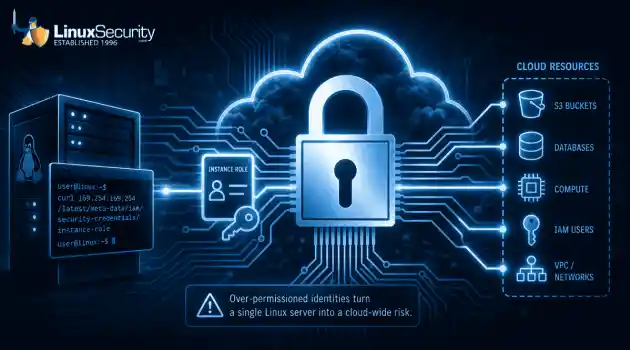
 For years, we secured our Linux infrastructure by building walls: VPCs, security groups, and hardened SSH configurations. We treated the cloud like a virtual data center, assuming that if we kept the "bad guys" out of the network, our workloads were safe. . That model is no longer sufficient. Today, one of the most common paths from an initial compromise to a major cloud breach is the identity assigned to your Linux workload. When an attacker gains code execution on a Linux instance—through a...
 Jul 17, 2026
 security practices patch management
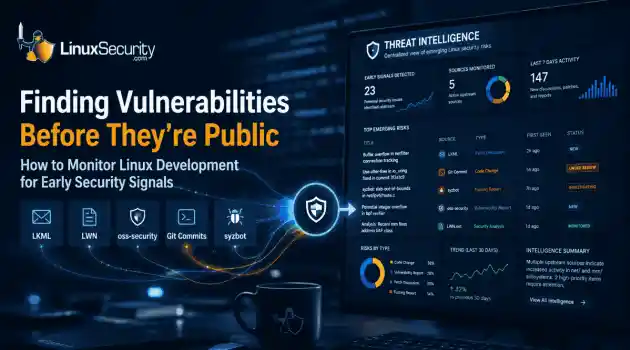
 Most of us don't hear about a kernel vulnerability until a CVE lands in our inbox or the vulnerability scanner starts complaining. By then, the patch isn't new anymore. Kernel developers may have been passing it around for review, arguing over the implementation, or revising it for days before anyone outside that community noticed it. None of those discussions are secret. They're sitting in mailing list archives, Git commits, and patch reviews where they've been the whole time. The strange...
Jul 14, 2026
 Linux security cyber attacks
 Every Linux server in your fleet produces thousands of events every minute. From journald logs and auditd records to kernel-level eBPF hooks, your systems are constantly talking. Most of that noise is just the mundane churn of system services, CI/CD runners, or routine administrative automation. But among that noise, an attacker might be establishing a foothold, moving laterally, or setting up persistence. The challenge for any security team is: how do you separate the routine from the...
Jul 13, 2026
 open-source infrastructure risk
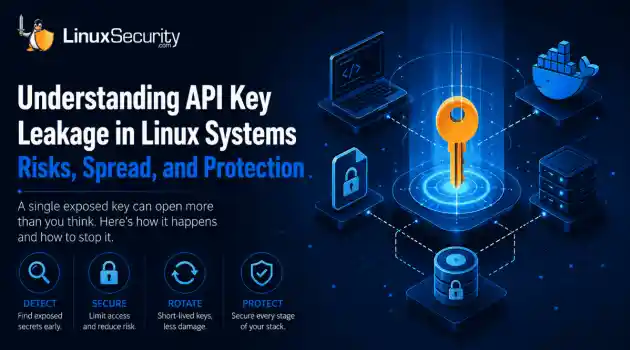
 Security scanners flag exposed API keys in public repositories every day. The initial response is usually predictable: delete the commit, revoke the credential, and move on. That’s a mistake. . In a real Linux environment, an API key never stays in one place. By the time it hits a public repo, it’s already everywhere. It’s in the CI/CD pipeline. It’s in your container registry. It’s in the build logs. It’s in the backups. Git makes this worse because the history never dies. Deleting a file in...
Jul 11, 2026
 open-source rootkit
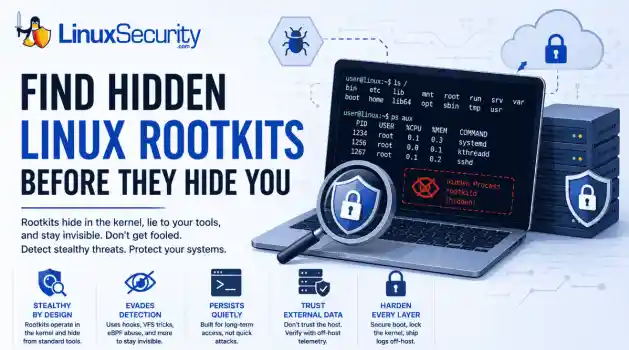
 Most of us think of Linux rootkits as ancient history—the stuff of 90s hacking forums and clunky malware that would crash your system if you looked at it the wrong way. But if you think they’ve gone away, you’re mistaken. They’ve just gotten smarter. . Modern attackers aren't using the noisy tools of the past. Today’s threats are surgical. Many of today’s most advanced Linux rootkits operate at the kernel level or abuse legitimate system features to blend in with normal traffic. They’re...
Jul 09, 2026
 Refine features
X Clear Filters
Get the latest News and Insights
Get the latest Linux and open source security news straight to your inbox.
Community Poll
Should Linux servers automatically install security updates?
Loading...
Explore Latest Linux Security features
We found -3 articles for you...
102
 security risksopen sourcelegacy systems
Navigating Linux Modernization to Secure Legacy Systems Effectively
Most businesses understand the need for cybersecurity. However, many of those same companies still rely on outdated systems, making it hard to ensure the security they know they need. . Technology moves quickly, so it’s easy to fall behind the latest innovations, especially when facing budgetary constraints. As understandable a problem as it might be, legacy IT poses a host of security issues. Thankfully, modernization through Linux security is possible. We’ll examine how modernization through Linux security can help close the security gap and offer practical advice to help you navigate modern technology and outdated systems and ensure security in your Linux environment. What Are The Security Risks of Outdated Technology? Before you learn how to bridge the legacy security gap with Linux, you must understand why it’s essential. Outdated technology — hardware and software — is a severe threat for three reasons. Unpatched Vulnerabilities The most obvious risk of outdated systems is that they don’t have the latest security patches. Once developers stop supporting an app or operating system (OS), any unpatched vulnerabilities will remain that way. As mundane as software patches may seem, ignoring them can cause much damage. The infamous WannaCry ransomware grew by 53% between 2020 and 2021 despite the necessary patch being around since 2017. In fact, that patch was available before WannaCry hit its peak. All the losses stemming from this ransomware worm are due to outdated software. Of course, new technology can still have vulnerabilities. However, supported versions can eventually get a fix for these issues, whereas legacy software can’t. Cybercriminals know this, so they often target organizations they know will likely use outdated, vulnerable systems. Lack of Modern Protection Similarly, older systems won’t have the same built-in protections as newer alternatives. The more cybercrime has grown, the more seriously businesses have taken it. As a result,cybersecurity best practices have come a long way over time, so outdated IT may lack the defenses you’d expect today. Things like multifactor authentication (MFA) , firewalls, and intrusion detection come standard in many modern hardware. You can’t say the same about older systems; without these protections, you can’t employ the best practices you know you need. More worryingly, it may not be evident that these features aren’t there. Some built-in protections are common enough with new devices you don’t think about anymore. You’d naturally expect them to be there. Consequently, you may not double-check this on an older device or use it the same way out of habit, overlooking the lack of needed protections. Incompatibility With New Resources Sometimes you can install modern protections on an old system when not built in. However, that’s not always possible. As systems age, you’ll find fewer resources supporting them. This incompatibility can cause efficiency problems and create security vulnerabilities at worst. The cloud — which 70% of businesses plan to run some office systems in within two years — isn’t a perfect solution, either. While cloud-based systems largely work around OS limitations, older devices may lack the necessary memory or processing speed to run them efficiently. Cloud platforms won’t reach their full potential if you assess them on outdated systems. Any latency can create openings for cyberattacks. Not all your resources are on the cloud, so even if migration offsets some aging infrastructure, you’d still encounter compatibility issues elsewhere. What Are the Security Advantages of Linux for Older Systems? Given these dangers, it’s easy to see how outdated technology is a considerable risk. Still, upgrading hardware — especially on a companywide scale — can be expensive and complicated. One promising alternative is to remove the outdated OS and install Linux instead. Here’s why. Compatibility When you switch to Linux, you nolonger have to worry about a lack of support for an outdated OS. Many distros are free or low-cost, so it’s cheaper than buying a new proprietary OS but has the same modernization effect. You can install Linux quickly and efficiently to give your old hardware support for new software. Not every application offers Linux support, but many do. Linux fuels over 90% of web servers and internet-connected devices, and enterprise developers are particularly fond of open-source software. That’s all to say you won’t have much trouble finding modern tools you need that can run on Linux. Gaining this compatibility opens the door to newer security systems and interoperability with new hardware. You can use more robust defenses without a lengthy, expensive upgrade process. Open Source Support When you modernize with Linux, you also gain support from the open-source community. This has two main benefits in terms of cybersecurity . First, you have a much wider group contributing to vulnerability patching. Secondly, you don’t have to worry about your software eventually becoming outdated because you have ongoing support. A whopping 89% of IT leaders agree that open-source software is as or more secure than proprietary alternatives. Most say this security stems from confidence that the software is well-tested, thanks to the large community of contributors. With more people analyzing and updating the code, bug fixes are faster, and audibility is easier. Similarly, Linux resembles the as-a-service model in terms of lifetime support. Instead of replacing old versions with new ones, the community keeps improving existing resources. As a result, you can always have the latest Linux version, ensuring you don’t lose compatibility with newer systems. Performance Improvements While Linux won’t change your hardware, it does help you make the most of it. Linux distros are often lightweight and don’t run as many background applications as proprietary systems like Windows or MacOS. As a result, theycan give your old IT a needed performance boost. Independent testing shows that Linux is up to twice as fast as Windows in many processes. That speed means you can use newer cloud or local resources efficiently despite having outdated hardware. Using more modern systems means you can benefit from their security improvements over older versions. These performance boosts also mean your IT systems can respond to security threats faster. Response time is a huge factor in how much damage an attack does, as it lets you stop it before it spreads. That’s particularly important for anyone dealing with highly sensitive data. How Can I Modernize and Protect My Linux Systems? Now that you know why you should modernize your security with Linux, it’s time to learn how. Securing and updating outdated systems looks slightly different in each instance, but there are a few general guidelines to follow. Choose Your Distro Carefully The first step in bridging the legacy security gap with Linux is to choose the right distro. You can choose from hundreds of distros; the best choice for one company may not be the best for you. Start by determining your needs and obstacles, including your budget, hardware constraints, tech skill level, and modernization goals. Ubuntu is the most popular Linux distro and has a reputation for user-friendliness, making it a good choice if your team doesn’t have much tech experience. RHEL is another popular choice for businesses for its security features and scalability. Before choosing a distro, ensure any software or hardware you want to use supports it. It’s also a good idea to read community reviews to learn common problems people have with it and what they like. You should also keep long-term expansion in mind, so look for something with enough update frequency to support your scaling rate. Transition Slowly Compared to other security modernization methods, switching to Linux is relatively easy. Still, it’s best to take a slower, methodical approach than totransition everything simultaneously. Moving to any new system involves a learning curve, so a slower shift will let you work out the kinks without disrupting your entire business. Start with your systems in most dire need of an upgrade. These may be your oldest resources, but they could also be ones that have more significant security issues due to their age. Be sure to back everything up before moving it to Linux. Remember that switching to Linux may look different for various parts of your IT system. You may even want to use different distros for separate functions. Many businesses do. This variation can help you make the most of each part of your operation, but it necessitates doing things one at a time to prevent mix-ups and disruption. Remove Unnecessary Features and Settings Next, you’ll want to look for features or apps you won’t use in your work. While Linux has comparatively little bloatware compared to other operating systems, your distro may still have apps you don’t need. Your tech stack may also include features you don’t require anymore. Removing these unnecessary features serves two critical functions. First, it minimizes the number of ports and potential openings attackers can target. Secondly, it frees resources to ensure better performance, which is especially important for older hardware. Pay special attention to internet-connected apps, as most Linux attacks are web-based. Similarly, you should turn off any unneeded settings. Some distros or apps may have unsafe features like automatic connections to other devices on the network that increase your attack surface. Deactivate anything your team won’t take advantage of to be as safe as possible. Monitor Your Systems Closely Once you have your systems up and running on Linux, remember to monitor them . Ongoing monitoring is a good idea in any context, but it’s more pressing when using older equipment or after switching to a new system. Linux aids these audits by maintaining detailed system logs. Don’toverlook that resource. Review your file and system access history regularly to ensure you catch potential breaches as early as possible. While monitoring your Linux system manually is possible, automated approaches are more efficient. Look for an automatic detection and response platform compatible with your distro to free your IT team’s time and contain potential issues faster. Update Often Finally, as with any software, you should update your systems regularly. Linux’s extensive community support is only advantageous if you take advantage of it. Download and install updates as soon as they’re available to maximize your performance and patch all bugs. Known vulnerabilities as old as 2017 are still more prominent than zero days. It’s far more cost-effective for attackers to target known weaknesses in hopes businesses haven’t patched them than to discover new ways around defenses. Many people also overlook updates, adding more fuel to this fire. Enable automatic updates to stay as safe as possible. Remember, the goal is to modernize your security everywhere you can. You can’t do that if you don’t install the latest software versions when they become available. Final Thoughts on Bridging the Legacy Security Gap Today Legacy systems pose a huge threat to cybersecurity today, but it may be easier to overcome them than you initially think. Linux’s open-source nature, accessibility, security by design, and ongoing support make it an ideal platform to bridge that gap. These steps will help you modernize and protect your outdated systems with minimal disruption but maximum results. . Legacy systems pose significant security threats; discover how adopting Linux can refresh and protect your infrastructure efficiently.. Legacy System Risks, Linux Modernization, Open Source Solutions, Security Practices. . Dave Wreski
 Feb 09, 2024
•
Feb 09, 2024
•
102
 secure connectionsencryption algorithmsopen source solution
Exploring WireGuard: The Future of VPN Technology and Security
VPN technology has become a critical part of our digital lives, serving a variety of purposes including securing wireless connections, resolving geographical limitations, reaching prohibited websites and protecting the privacy of sensitive data. However, the unfortunate reality is that many of the VPN protocols on the market today are comlex, slow, unstable and insecure. Luckily, the new, innovative Wireguard protocol has demonstrated significant promise in all of these areas - and has earned a place in the mainline Linux kernel as a result. This article will briefly explore VPN protocols and potential concerns when implementing a VPN, and will dive deeper into the unique benefits that Wireguard offers users. . What is a VPN and Why Should I Use One? VPN (Virtual Private Network) is a method of encryption that aims to protect privacy online and serves to safeguard users from cyberattacks and other malicious behavior through the use of a layered tunneling protocol. VPNs function as a third party and can be used to access untrusted networks, to remotely communicate to a local area network or to conceal and secure information traveling through an otherwise insecure network.. VPNs can be used to hide your IP address and restrict your ISP or third-party platforms from monitoring your online behavior. Trustworthy VPN providers secure confidential data during connectivity issues and ensure that malicious parties are unable to identify you online by changing your IP address. Currently VPN Protocol Concerns: How Wireguard Compares to OpenVPN and IPsec OpenVPN and IPsec are two widely-used VPN protocols with some serious drawbacks that should be considered. OpenVPN is more common than IPsec due to its simple settings; however, complexity is still a significant issue for both protocols. Standard VPN protocols like OpenVPN or IPSec have a mechanism of negotiation that is slow and complicated. This can be attributed to the fact that several settings need to be negotiated by both the server and theclient. WireGuard, on the other hand, is a new, innovative open-source protocol that eliminates these issues. Wireguard’s use of versioning of cryptography packages enables the VPN protocol to focus on ciphers believed to be among the most secure current methods of encryption. It delivers a VPN that is clearer, faster, more efficient, and easier to use compared to other solutions on the market. Let’s take a closer look at some of the key benefits that Wireguard offers users. Key Benefits of the WireGuard VPN Protocol 1. Simplicity If there is one characteristic that truly sets Wireguard apart from other VPN protocols, it is indeed its simplicity. WireGuard is engineered with convenience-of-implementation and ease-of-use as top priorities. Since it is leaner than OpenVPN in terms of code base, Wireguard is inherently much simpler and more secure. In a simple code base, the attack surface is much smaller and errors and bugs affecting features are generally much less common than in a more complex code base. 2. Easy User Interface and Application Because Wireguard is a revised protocol, the VPN tunnel offers faster installation than its competitors. In other words, updates are published in the form of modified versions, each of which includes a unique requirement for encryption from other versions. In comparison, OpenVPN will change its encryption algorithm and credentials at the demand of the admin. 3. Better Performance Wireguard is the most efficient VPN tunnel on the market, offering unmatched performance and speed. Wireguard utilizes SSSE3, AVX, AVX2, AVX512, and NEON speed upgrades in its protocol for encryption. As it also employs the latest algorithm of ChaCha20 encryption, the VPN operates remarkably fast on almost any piece of equipment. Concerning bandwidth and ping time, Wireguard outclasses its rivals. WireGuard’s ability to deliver substantially improved results and speed is the product of the fact that it operates with a high-speed CPU utilization rate in the kernel. 4. Secure Encryption Through the use of advanced encryption principles and algorithms, WireGuard also refuses outdated tech. In comparison, to protect the VPN tunnel, most other protocols use stable but old encryption algorithms. WireGuard employs encryption algorithms that are not supported by any other protocol such as: ChaCha20 (Poly13045 verified) BLAKE2s (hybrid and switched hybrid) Curve 25519 (ECDH) HKDF SipHash24 Potential Drawbacks of WireGuard VPN Technology WireGuard is an open-source project that is actively being worked on for free, so it is still changing and evolving, and there has been no official stable version published yet. Certain VPN providers have cited WireGuard 's failure to operate without logging user data, which contradicts the fundamental promise of any VPN provider – not to involve, track, or log user information. While some providers have continually advised that using Wireguard is unsafe and could lead users to experience security risks in their VPN products, many vendors including Mullvad, IVPN, AzireVPN, Algo VPN and Astrill VPN do use WireGuard protocols. Wireguard is also included in most current Linux distributions, and can be installed install . Ubuntu users can learn how to set up Wireguard VPN on Ubuntu 18.04 in this Linode tutorial . The Bottom Line With VPN technology becoming an increasingly important part of our online lives, selecting a VPN that uses a simple, efficient and secure tunneling protocol like Wireguard is highly beneficial. Because of its impressive performance and efficiency, Wireguard is run as a Linux kernel module (LKM) and is used by a wide array of VPN providers as a simpler, more secure alternative to OpenVPN and IPsec. We expect to see the use of Wireguard increase over the coming years as the Wireguard project continues to progress toward releasing a stable version of its innovative open-source VPN tunneling protocol. . Uncover the advantages of WireGuard VPN technology, highlighting swift performance,user-friendliness, and strong encryption for secure communications.. WireGuard VPN, Open Source Protocol, Secure Connections, Performance Improvements. . Brittany Day
Nov 04, 2020
•


Get the latest News and Insights
Get the latest Linux and open source security news straight to your inbox.
Community Poll
Should Linux servers automatically install security updates?
Search Topics
Powered By

Linux Security - Your source for Top Linux News, Advisories, HOWTOs and Feature Releases
QUICK LINKS
subscribe to newsletters!
Like staying secure? So do we.
Sign up for updates, tips, and alerts!