Overly broad permissions can turn one compromised account into a much larger security problem. Learn how to reduce unnecessary access, review privileges, and apply least privilege across modern Linux systems. Review Linux Privileges×


Stay Ahead With Linux Security Features
 identity management security tactics
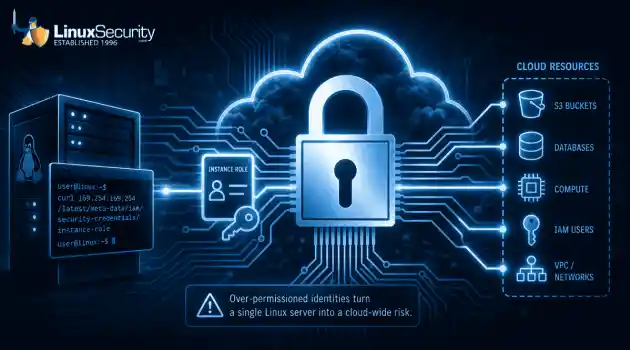
 For years, we secured our Linux infrastructure by building walls: VPCs, security groups, and hardened SSH configurations. We treated the cloud like a virtual data center, assuming that if we kept the "bad guys" out of the network, our workloads were safe. . That model is no longer sufficient. Today, one of the most common paths from an initial compromise to a major cloud breach is the identity assigned to your Linux workload. When an attacker gains code execution on a Linux instance—through a...
 Jul 17, 2026
 security practices patch management
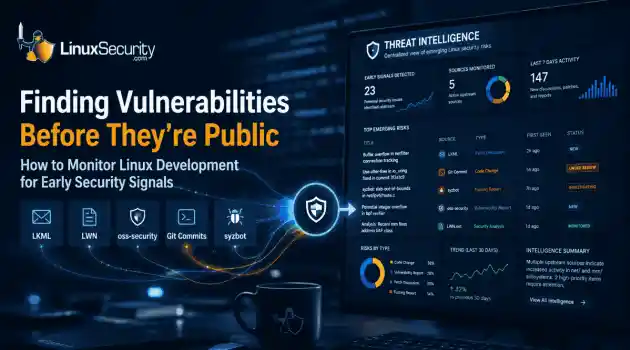
 Most of us don't hear about a kernel vulnerability until a CVE lands in our inbox or the vulnerability scanner starts complaining. By then, the patch isn't new anymore. Kernel developers may have been passing it around for review, arguing over the implementation, or revising it for days before anyone outside that community noticed it. None of those discussions are secret. They're sitting in mailing list archives, Git commits, and patch reviews where they've been the whole time. The strange...
Jul 14, 2026
 Linux security cyber attacks
 Every Linux server in your fleet produces thousands of events every minute. From journald logs and auditd records to kernel-level eBPF hooks, your systems are constantly talking. Most of that noise is just the mundane churn of system services, CI/CD runners, or routine administrative automation. But among that noise, an attacker might be establishing a foothold, moving laterally, or setting up persistence. The challenge for any security team is: how do you separate the routine from the...
Jul 13, 2026
 open-source infrastructure risk
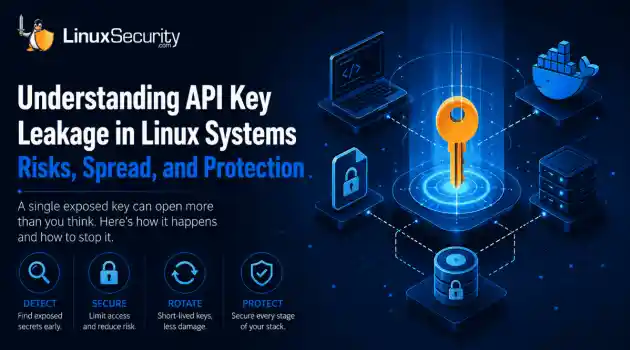
 Security scanners flag exposed API keys in public repositories every day. The initial response is usually predictable: delete the commit, revoke the credential, and move on. That’s a mistake. . In a real Linux environment, an API key never stays in one place. By the time it hits a public repo, it’s already everywhere. It’s in the CI/CD pipeline. It’s in your container registry. It’s in the build logs. It’s in the backups. Git makes this worse because the history never dies. Deleting a file in...
Jul 11, 2026
 open-source rootkit
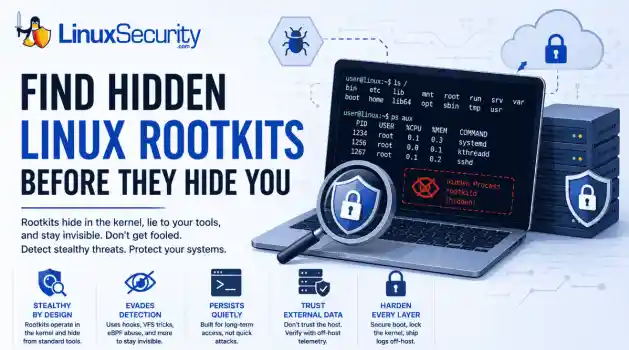
 Most of us think of Linux rootkits as ancient history—the stuff of 90s hacking forums and clunky malware that would crash your system if you looked at it the wrong way. But if you think they’ve gone away, you’re mistaken. They’ve just gotten smarter. . Modern attackers aren't using the noisy tools of the past. Today’s threats are surgical. Many of today’s most advanced Linux rootkits operate at the kernel level or abuse legitimate system features to blend in with normal traffic. They’re...
Jul 09, 2026
 Refine features
X Clear Filters
Get the latest News and Insights
Get the latest Linux and open source security news straight to your inbox.
Community Poll
Should Linux servers automatically install security updates?
Loading...
Explore Latest Linux Security features
We found -3 articles for you...
102
 security toolscryptographyfile encryption
Best Tools for Securing Files and Disks on Linux Operating Systems
Most of us are familiar with Microsoft Windows or macOS - these OSes dominate the personal computing space. But the OS that is taking over the world isn’t owned by Microsoft, Apple, or any tech company for that matter. . In fact, the most popular OS in the world today isn’t owned by anyone. It’s the completely open-source Linux operating system. While Linux-based systems are generally considered to be more resistant to cyberattacks and cybercrime , they are not completely invulnerable to a determined intruder. Encryption is one of the most effective and widely used methods of securing senstive information from unauthorized parties. This article will introduce five of our favorite file and disk encryption tools to keep your important enterprise information safe from prying cybercriminals. Why Is Linux A Great OS for the Enterprise? What makes Linux such an appealing OS for enterprise purposes is its open-source nature. Unlike proprietary software such as Microsoft’s server solutions which have high licensing fees, Linux is freely available to anyone. More importantly, Linux’s core components can be easily edited, swapped out, or totally replaced by a user with the appropriate skills. This makes Linux amazingly customizable and adaptable to different businesses' needs and requirements. The benefits of employing a Linux-based distribution include: Free Open-source Widespread and accessible availability of support resources Cloud computing & storage standard Easy scalability A high degree of reliability Supports multitasking and cooperative work Not hardware intensive Highly secure Linux & Cybersecurity Many IT and cybersecurity experts consider Linux to be the safest, most secure operating system available to the world today. Because Linux is open-source, anyone can review it and ensure that there are no bugs or exploitable backdoors built into the OS. The same cannot be said of proprietary operating systems such as Microsoft’s Windowsor Apple’s macOS platforms. While both Microsoft and Apple may have a large team of well-resourced, professional developers working on security issues, no team of coders can compare to the sheer number of Linux user-developers around the world. Linux-based systems also benefit from a more secure user privileges hierarchy that discourages social engineering attacks, such as malicious email attachments. Its incredible distribution diversity also makes Linux a relatively unattractive target for cyber thieves in comparison to proprietary OSes. Linux comes in various forms and packages from Ubuntu to Debian to Gentoo just to name a few. Because Linux comes in so many different flavors and segmented audiences, it is much more difficult for a cybercriminal to develop a single, effective virus or piece of malware that can affect many users. Proprietary competitors, on the other hand, come in just one or two flavors. Windows, for example, is a prime example of this “monoculture effect”. It is much more profitable, and therefore attractive, for hackers or criminal organizations to develop an attack against Windows, which has a comparably much, much larger user base running identical OSes. Top 5 Linux File & Disk Encryption Tools 7-Zip 7-Zip offers strong command line encryption on Linux. Many people are familiar with 7-Zip as an archiving and zipping utility. However, for Linux user-developers, 7-Zip also offers a suite of robust encryption tools intended to keep your data safe and secure. Find out more about how to encrypt files and data with 7-Zip on your Linux distribution . Tomb Tomb is an excellent, easy-to-use, and minimalist command line encryption tool popular among Linux user-developers. Like Linux itself, Tomb is also totally free and open-source. One of the primary features of Tomb is its ability to generate encrypted storage vaults to be opened and closed using a password chosen by the user. These so-called “tombs” are like a locked folder that can be safelytransported and hidden in a filesystem away from malicious users. Unfortunately, Tomb does not have a graphical user interface (GUI) and relies on command line input in order to function. Learn more about Tomb file encryption on Linux . Cryptmount Cryptmount allows users to not only protect important file systems information but also swap system space. Multiple encrypted file systems can be “mounted”, or made active, or “unmounted”, or deactivated, depending on the users’ immediate needs. This is particularly useful when you want to work in an encrypted environment without having to mess around with your system’s inbuilt partitions. Like the other disk encryption tools above, Cryptmount relies on passphrases to maintain operational security. A strong passphrase will go a long way towards rebuffing cyberattacks and hacking attempts. Learn more about how to protect filesystems with Cryptmount . Gnu Privacy Guard (GnuPG or GPG) GnuPG , also known as GPG, is a unique hybrid encryption tool that not only employs conventional symmetric-key cryptography but also uses public-key cryptography. This two-prong approach to encryption helps speed up the encryption process without compromising OS security. GnuPG is popular among journalists who use the tool to encrypt important documents and protect the identities of their sources. GnuPG operates under the GNU General Public License (GPL) . Download GnuPG - the GNU Privacy Guard - to encrypt and sign your data. Dm-crypt Dm-crypt is great for encrypting entire disks of information, including removable media such as USB sticks, internal OS partitions, as well as individual files. In fact, some Linux distributions even allow Dm-crypt to encrypt and secure root system files. Because Dm-crypt only deals with transparent encryption of block devices, it is much more flexible than other encryption tools. Dm-crypt operates under the GNU General Public License (GPL) . Learn more about how to encrypt a Linux file system with Dm-crypt. The Bottom Line While Linux users enjoy built-in security and privacy as a result of the OS’s open-source nature, architectural diversity and strict user privilege model, this doesn’t mean that your files are safe in the event that your Linux system gets hacked! If you want to keep your sensitive data private, try out one of the awesome file and disk encryption tools for Linux covered in this article and let us know what you think on Twitter . About the Author Stephen Wright Stephen Wright is the founder and CEO of Wright Business Technologies . He is responsible for the overall success of the company, clients, employees, and vendor partners who support the business. Stephen graduated from Texas Tech University with a degree in business management and established Wright Business Technologies in 1992. He later earned his MBA, also from Texas Tech University. . Secure your Linux data with top encryption tools like LUKS, GnuPG, and VeraCrypt, enhancing protection against unauthorized access and data breaches. Linux Encryption Tools, Disk Security Solutions, Open Source Encryption, File Protection Software. . Brittany Day
 Sep 04, 2021
•
Sep 04, 2021
•
102
 open source softwareLinux securitycybersecurity
Enhancing Remote Work Security With Linux Customization And Tools
Operational security at least seemed so much easier back when traditional 9-to-5 office life was still dominant. Talk of professionals taking their work home with them was largely metaphorical, with only occasional instances of C-suite types dragging their laptops everywhere they went. Business hardware and systems would be shielded through physical security and isolated networks. One office (or office complex), one place to guard: entirely straightforward. . Now, after a year that’s seen countless businesses (some eagerly and others reluctantly) adopt the working-from-home model, there are different challenges to overcome. Teams are scattered and must share sensitive data across the internet — data to which other companies and fraudsters would love to gain access. When information gets out, reputations are destroyed and businesses (particularly those working entirely online) struggle to survive. So what can be done about this? Well, there are various steps you can take to improve cybersecurity, and in this post we’re going to consider whether the use of Linux is one of them. Can companies bolster their remote-working operations — even offline — through swapping their current operating systems for Linux? Let’s see what conclusions we can reach. What are the strengths of Linux for securing online activities? While this certainly isn’t a comprehensive account of what makes Linux great for online security, there are three long-standing benefits of Linux distributions that we should focus on here: They’re entirely customizable, removing the need to rely on third parties. Windows is updated by Microsoft, and iOS is updated by Apple. It’s possible to find unofficial and unsigned patches, but they’re always going to cause issues with support services (and that’s if they work at all). This means that those using these systems must rely on those companies to react appropriately to security threats. Because Linux is open-source software, it doesn’t rely on securityupdates from any single provider, and its ever-improving compatibility options make it a stable like-for-like replacement. If you want to run a VPN service, you’ll find that all the leading contenders support Linux — and if you want to do something like implement a system-level proxy server, you can easily load up a caching proxy like Squid through the terminal. Additionally, the fundamental transparency of Linux makes it relatively simple to review for potential security issues. If you’re willing to put in the effort to steer the ship, you can achieve far more impressive levels of security through Linux systems. They’re updated by people who care about privacy and security. Leading software companies do care about security, but largely in the sense that their profits and reputations are affected by system vulnerabilities. Linux, on the other hand, is heavily driven by passionate enthusiasts who actually care about user privacy. If you’re looking to resolve a certain issue, you can inevitably find free community support to point you in the right direction. And if you want to run a cut-down OS with none of the default telemetry services that plague all the mainstream alternatives, Linux isn’t just your best option: it’s your only practical option. Throw in superior support for things like using SSH and saving and reviewing comprehensive log files, and you have a fantastic out-of-the-box option (so to speak) that will only get better the more you work on it. They’re not high-priority targets for hackers due to their niche appeal. While it’s true that Linux servers have become very popular ( and thus attracted attention ), the same can’t yet be said of Linux desktop operating systems. Almost all attention goes towards Windows and iOS, all because it’s far more economical to target them. On top of that, you need to factor in the presence of different Linux distros. Where Windows installations will differ only marginally, systems running on Debian,Red Hat and Linux Mint can have far more substantial differences. There isn’t much motivation for a hacker to specifically target Linux Mint systems, making them much safer. How can Linux secure remote-working hardware? We’ve looked at how Linux helps to secure online operations, but what about offline activity? Remote-working hardware still poses a threat, after all, and needs to be kept in line. Well, just as it supports plenty of online security services, Linux also offers a tremendous array of at-home security solutions that allow extensive configuration. For businesses that still want to use office spaces (or those determined to monitor their remote-working employees extremely closely, however much that seems like a bad idea), there’s open-source monitoring software like Zoneminder . For network user authentication (key for all remote-working companies, and often managed through cloud systems like Azure Active Directory), there’s the free Kerberos protocol. And for those who need to keep their business hardware secure on the go (despite lockdowns, there are still workers who need to travel), it’s easy enough to take advantage of tools like the Yubico Pluggable Authentication Module (PAM). The PAM makes it convenient to use hardware dongles for user authentication, ensuring that lost laptops don’t present major weaknesses. Linux can shield smart technology from threats by offering a robust and customizable security framework capable of combating a wide array of cyber vulnerabilities. What is the value of tech comprehension in cybersecurity? User error is the one thing that even the most tightly-secured systems can’t fully move past. This is why social engineering is such a popular endeavor for fraudsters. Hacking an up-to-date system is complicated and risky, while convincing a poorly-trained employee to volunteer their login details under false pretences can provide quick success. Due to this, ensuring that your employees have strong awareness of security basics willdo much to make your operation stronger — and though Linux still has an intimidating learning curve, it’s sufficiently approachable that you could make it your main operating system without asking more of your workers than they can reasonably provide. It certainly helps that so much is done through browsers at this point. If someone can use a Chromebook, they can get to grips with a Linux distribution, and learning more about how Linux works (and how it treats something like admin authentication) will slowly but surely leave them less likely to make basic security mistakes. Wrapping up, the answer to the titular question is a strong yes. Less likely to be attacked than other systems, built with security and flexibility in mind, and equipped with rich compatibility features that make it easier than ever to swap from Windows or iOS, Linux is a mature solution that every modern business should consider using. About the Author Elliot Mark is a senior writer at Ecommerce Platforms with a deep curiosity for all things digital and the changing world of ecommerce. He’s helped create a number of unique online stores, providing content and marketing support to help people grow their own ecommerce biz. Connect with him on Twitter @EcomPlatformsio. . In today's remote work environment, Linux emerges as a strong OS that enhances organizational security with its built-in features and community support. Remote Work Security, Linux Customization, Cyber Tools, Open Source Solutions, Cybersecurity Best Practices. . Brittany Day
Apr 19, 2021
•


Get the latest News and Insights
Get the latest Linux and open source security news straight to your inbox.
Community Poll
Should Linux servers automatically install security updates?
Search Topics
Powered By

Linux Security - Your source for Top Linux News, Advisories, HOWTOs and Feature Releases
QUICK LINKS
subscribe to newsletters!
Like staying secure? So do we.
Sign up for updates, tips, and alerts!