Audit Linux privileges now to limit compromise, escalation, and system-wide damage. Review Linux Privileges×


Stay Ahead With Linux Security Features

 identity management security tactics
 For years, we secured our Linux infrastructure by building walls: VPCs, security groups, and hardened SSH configurations. We treated the cloud like a virtual data center, assuming that if we kept the "bad guys" out of the network, our workloads were safe. . That model is no longer sufficient. Today, one of the most common paths from an initial compromise to a major cloud breach is the identity assigned to your Linux workload. When an attacker gains code execution on a Linux instance—through a...
 Jul 17, 2026
 security practices patch management
 Most of us don't hear about a kernel vulnerability until a CVE lands in our inbox or the vulnerability scanner starts complaining. By then, the patch isn't new anymore. Kernel developers may have been passing it around for review, arguing over the implementation, or revising it for days before anyone outside that community noticed it. None of those discussions are secret. They're sitting in mailing list archives, Git commits, and patch reviews where they've been the whole time. The strange...
Jul 14, 2026
 Linux security cyber attacks
 Every Linux server in your fleet produces thousands of events every minute. From journald logs and auditd records to kernel-level eBPF hooks, your systems are constantly talking. Most of that noise is just the mundane churn of system services, CI/CD runners, or routine administrative automation. But among that noise, an attacker might be establishing a foothold, moving laterally, or setting up persistence. The challenge for any security team is: how do you separate the routine from the...
Jul 13, 2026
 open-source infrastructure risk
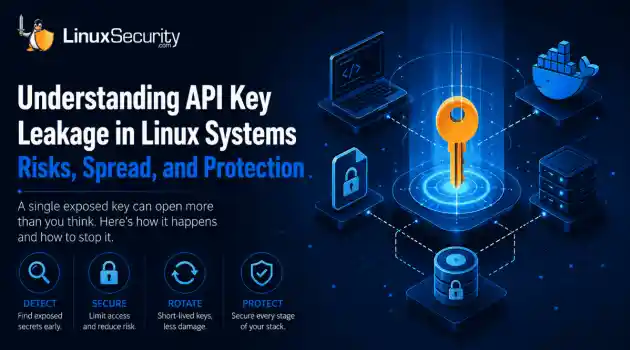
 Security scanners flag exposed API keys in public repositories every day. The initial response is usually predictable: delete the commit, revoke the credential, and move on. That’s a mistake. . In a real Linux environment, an API key never stays in one place. By the time it hits a public repo, it’s already everywhere. It’s in the CI/CD pipeline. It’s in your container registry. It’s in the build logs. It’s in the backups. Git makes this worse because the history never dies. Deleting a file in...
Jul 11, 2026
 open-source rootkit
 Most of us think of Linux rootkits as ancient history—the stuff of 90s hacking forums and clunky malware that would crash your system if you looked at it the wrong way. But if you think they’ve gone away, you’re mistaken. They’ve just gotten smarter. . Modern attackers aren't using the noisy tools of the past. Today’s threats are surgical. Many of today’s most advanced Linux rootkits operate at the kernel level or abuse legitimate system features to blend in with normal traffic. They’re...
Jul 09, 2026
 Refine features
X Clear Filters
Get the latest News and Insights
Get the latest Linux and open source security news straight to your inbox.
Community Poll
Should Linux servers automatically install security updates?
Loading...
Explore Latest Linux Security features
We found -3 articles for you...
102
 security advisoryimportantsystem updates
Parrot OS 6.4 Release Overview: Key Updates and Features for Admins
For those of us who’ve been following Parrot OS through its gradual evolution, the launch of version 6.4 feels less like a routine update and more like a defining moment. It’s not just a refresh of the security-oriented Linux distro ; it’s a glimpse into the next phase of its maturity, with tools, optimizations, and system-level refinements that elevate its place in the arsenal of infosec professionals and Linux enthusiasts alike. . This release doesn’t try to reinvent the wheel, but it does turn that wheel with serious intention, integrating what admins and cybersecurity pros need today while laying the groundwork for what’s coming tomorrow. Let’s break it down methodically. Tool Enhancements: The Lifeblood of Any Security Distro The first thing that catches the eye in Parrot OS 6.4 is its expanded suite of security tools. Metasploit, Sliver, Caido, and Empire—all staples for penetration testers —have been significantly tuned up, giving attackers-turned-defenders one less reason to manually update these tools post-install. On top of that, newer versions of utilities like airgeddon (for wireless auditing) and beef-xss (browser exploitation) are now built-in. But what’s really exciting for admins who routinely bounce between audits and scans is the inclusion of fresh pre-installed tools. Netcat-openbsd and WPScan are now part of the default lineup, saving you a few tedious installation steps for remote connections and WordPress vulnerability checks. John the Ripper, Subfinder, and Katana—tools that are as familiar as a terminal prompt—are available immediately after installation. This isn’t window dressing either; these additions allow administrators to dive into assessments straight out of the box. If you’ve worked long enough hours in your role (read: troubleshooting broken dependencies at 2 AM), you’ll know how much of a difference these pre-installed refinements make. You’re not spending precious cycles resolving tool installation issues when you shouldbe focusing on the task at hand. Kernel Update: Where Performance and Compatibility Meet Linux Kernel 6.12.32 doesn’t sound impressive on paper—until you deploy it. The performance gains are tangible for hardware compatibility, whether you’re working with esoteric setups or simply running a standard issue workstation. For those integrating Parrot OS into edge use cases, the new kernel also delivers better support for modern peripherals while minimizing legacy hang-ups that compromise stability. On Raspberry Pi devices, the updated kernel (6.12.34) has been fine-tuned for improved compatibility. This matters not just for enthusiasts playing around with ARM but for admins testing security exploits or deploying lightweight sensor networks on Pi hardware. If hardware support has ever bottlenecked your workflows, Parrot OS 6.4 takes a noticeable stab at remedying that. Privacy: Keeping Firefox in Check Privacy has always been a cornerstone for Parrot, and that philosophy continues here. The patched Firefox ESR release now includes mechanisms that block telemetry data, effectively stopping Firefox from "calling home." If you’ve ever hammered down privacy settings only to watch your browser reset to default after a version upgrade, this one’s for you: custom configurations persist across updates. This is likely a response to admins who’ve grown frustrated with mainstream browsers slipping invasive telemetry settings past their defenses. It's not groundbreaking in concept, but it’s reassuringly proactive, and something many other Linux distros could take a page from. System Security: Subtle, but Needed Parrot OS 6.4 doesn’t shout its system-level tweaks, but they deserve mention. For instance, the /root directory is no longer world-readable, meaning admins and users no longer have to worry about exposure in multi-user environments. Similarly, smaller bugs like home path autocompletion issues have been smoothed out—it might seem trivial, but quality-of-life improvements likethese accumulate over time. What stands out more strategically, though, is automation. The developers have streamlined the distro’s build scripts, which gives this release the feel of a polished transition. As Parrot edges closer to version 7, which will be based on Debian 13, these refinements feel like preparatory groundwork to make the jump smoother. The Unexpected Twist: Microsoft Tool Support It’s hard not to raise an eyebrow at the inclusion of official support for Debian-compatible Microsoft tools like Powershell 7.5 and .NET SDKs. To be blunt, this addition won’t matter to many users who’ve leaned hard into Parrot’s reputation as an open-source, privacy-first platform. But for those who need cross-compatibility in enterprise or hybrid environments, this new flexibility could save countless headaches (and arguments over dual-OS architectures). Does this make Parrot OS more attractive to admins working in Windows-heavy spaces? Absolutely. Does it detract from the OS’s staunch open-source ethos? Slightly, though it’s more a matter of purists versus pragmatic sysadmins. How Can I Get or Upgrade to Parrot OS 6.4? If you’re installing fresh, getting the latest ISO from the Parrot Security website is your safest bet—stick to official links , always. Torrent downloaders have backup webseed options too, especially useful if you’re navigating corporate firewall restrictions. Upgrading from earlier versions is straightforward; just run: sudo parrot-upgrade Or, if you prefer something less abstract: sudo apt update && sudo apt full-upgrade Be cautious during the upgrade process, especially if you've been running legacy configurations on prior iterations. Backup critical files beforehand and double-check compatibility if you’re jumping multiple versions. If you encounter GPG keyring issues, updating those manually remains the go-to solution—don’t skip this step. What’s Ahead in Parrot OS 7? This release is almost certainly the last hurrahfor the 6.x branch. With Parrot OS 7 looming on the horizon, admins can expect exciting changes: full RISC-V architecture support, new desktop environment variants, and deeper integration into Debian 13's ecosystem. Based on the foundation being laid here, the next version promises significant scalability and flexibility for diverse workloads. Whether you’re intrigued by evolving architectures or just want usability refinements, Parrot OS is headed somewhere interesting—and version 6.4 feels like a strong finish for this chapter. Our Final Thoughts on the Significance of the Parrot OS 6.4 Release Parrot OS 6.4 has landed with intentionality. It’s not flashy, but it’s thoughtful, pragmatic, and equipped to handle the demands placed on it by admins in real-world environments. From hardened system directories to pre-installed tools and privacy-focused browser patches, every change feels practical. Whether you’re an infosec professional handling network assessments or a Linux admin trying to harden hybrid environments, this release won’t disappoint. It’s worth taking a moment to appreciate how far Parrot has come, not just as a penetration testing distro but as a mature platform capable of serving administrators across a broader spectrum of roles. If you’re on the fence about upgrading, there’s little reason to wait, especially with Debian 13 compatibility around the corner. . This release doesn’t try to reinvent the wheel, but it does turn that wheel with serious intention for strong security.. those, who’ve, parrot, through, gradual, evolution, launch, versi. . Brittany Day
 Jul 08, 2025
•
Jul 08, 2025
•
102
 security advisoryfirewallSELinux
EnGarde Community V3.0 Offers Major Security Enhancements
Guardian Digital is pleased to announce the release of EnGarde Community v3.0. This release represents the most significant number of improvements since the first version released more than four years ago. If you haven't tried EnGarde recently, then I'm certain you'll be equally as excited about this release as we are. Completely redesigned web interface, firewall functionality, integrated Security-Enhanced Linux protection, and completely free updates are just a few of the outstanding new benefits. . With EnGarde, you can build a complete and secure Internet presence featuring all standard Internet functions (web, DNS, email, etc) within minutes using one of the available Wizards.Interested in taking it for a spin? Download the ISO and use the "LiveCD" mode to test it alongside your current operating system to compare. No other Linux platform provides the security and ease-of-management available with EnGarde. Engineered from the ground up with security as a primary focus, EnGarde is protected from unauthorized access using multiple open source techniques. Here's a shortlist of features: Linux 2.6 kernel featuring SELinux Mandatory Access Control Guardian Digital Secure Network features free access to all system and security updates Support for new hardware, including 64-bit AMD architecture Web-based management of all functions, including the ability to build a complete web presence with FTP, DNS, HTTP, SMTP and more Apache v2.0, BIND v9.3, MySQL v5.0(beta) Completely new WebTool, featuring easier navigation and greater ability to manage the complete system Integrated firewall with ability to manage individual firewall rules, control port forwarding, and creation of IP blacklists Built-in UPS configuration provides ability to manage an entire network of battery-backup devices RSS feed provides ability to display current news and immediate access to system and security updates Real-time access to system and service loginformation For information on downloading EnGarde, please visit the community site: Guardian Digital Makes Email Safe For Business - Microsoft 365, Goo.... . With EnGarde, you can build a complete and secure Internet presence featuring all standard Internet . release, guardian, digital, pleased, announce, engarde, community, represen. . Benjamin D. Thomas
Sep 28, 2005
•


Get the latest News and Insights
Get the latest Linux and open source security news straight to your inbox.
Community Poll
Should Linux servers automatically install security updates?
Search Topics
Powered By

Linux Security - Your source for Top Linux News, Advisories, HOWTOs and Feature Releases
QUICK LINKS
subscribe to newsletters!
Like staying secure? So do we.
Sign up for updates, tips, and alerts!