Overly broad permissions can turn one compromised account into a much larger security problem. Learn how to reduce unnecessary access, review privileges, and apply least privilege across modern Linux systems. Review Linux Privileges×


Stay Ahead With Linux Security Features

 identity management security tactics
 For years, we secured our Linux infrastructure by building walls: VPCs, security groups, and hardened SSH configurations. We treated the cloud like a virtual data center, assuming that if we kept the "bad guys" out of the network, our workloads were safe. . That model is no longer sufficient. Today, one of the most common paths from an initial compromise to a major cloud breach is the identity assigned to your Linux workload. When an attacker gains code execution on a Linux instance—through a...
 Jul 17, 2026
 security practices patch management
 Most of us don't hear about a kernel vulnerability until a CVE lands in our inbox or the vulnerability scanner starts complaining. By then, the patch isn't new anymore. Kernel developers may have been passing it around for review, arguing over the implementation, or revising it for days before anyone outside that community noticed it. None of those discussions are secret. They're sitting in mailing list archives, Git commits, and patch reviews where they've been the whole time. The strange...
Jul 14, 2026
 Linux security cyber attacks
 Every Linux server in your fleet produces thousands of events every minute. From journald logs and auditd records to kernel-level eBPF hooks, your systems are constantly talking. Most of that noise is just the mundane churn of system services, CI/CD runners, or routine administrative automation. But among that noise, an attacker might be establishing a foothold, moving laterally, or setting up persistence. The challenge for any security team is: how do you separate the routine from the...
Jul 13, 2026
 open-source infrastructure risk
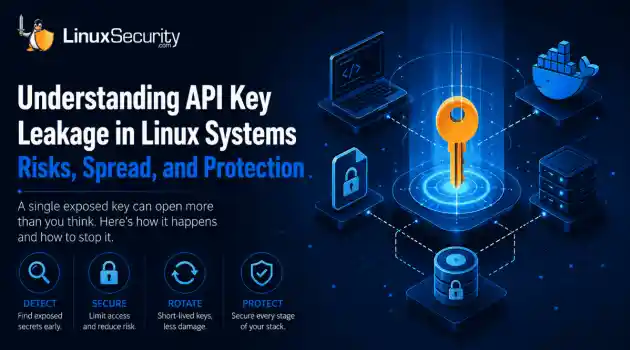
 Security scanners flag exposed API keys in public repositories every day. The initial response is usually predictable: delete the commit, revoke the credential, and move on. That’s a mistake. . In a real Linux environment, an API key never stays in one place. By the time it hits a public repo, it’s already everywhere. It’s in the CI/CD pipeline. It’s in your container registry. It’s in the build logs. It’s in the backups. Git makes this worse because the history never dies. Deleting a file in...
Jul 11, 2026
 open-source rootkit
 Most of us think of Linux rootkits as ancient history—the stuff of 90s hacking forums and clunky malware that would crash your system if you looked at it the wrong way. But if you think they’ve gone away, you’re mistaken. They’ve just gotten smarter. . Modern attackers aren't using the noisy tools of the past. Today’s threats are surgical. Many of today’s most advanced Linux rootkits operate at the kernel level or abuse legitimate system features to blend in with normal traffic. They’re...
Jul 09, 2026
 Refine features
X Clear Filters
Get the latest News and Insights
Get the latest Linux and open source security news straight to your inbox.
Community Poll
Should Linux servers automatically install security updates?
Loading...
Explore Latest Linux Security features
We found -1 articles for you...
102
 security measuresdos attacktcp syn flood
TCP SYN Flood Attacks: Understanding Protocol Exploits In VoIP Networks
There are several general categories of DoS attacks . Some groups divide attacks into three classes: bandwidth attacks, protocol attacks, and logic attacks. Following are brief descriptions of some common types of DoS attacks. . Bandwidth Attacks Bandwidth attacks are relatively straightforward attempts to consume resources, such as network bandwidth or equipment throughput. High-data-volume attacks can consume all available bandwidth between an ISP and your site. The link fills up, and legitimate traffic slows down. Timeouts may occur, causing retransmission and generating even more traffic. An attacker can consume bandwidth by transmitting any traffic at all on your network connection. A basic flood attack might use UDP or ICMP packets to consume all available bandwidth simply. For that matter, an attack could consist of TCP or raw IP packets as long as the traffic is routed to your network. A simple bandwidth-consumption attack can exploit the throughput limits of servers or network equipment by focusing on high packet rates—sending large numbers of small packets. High-packet-rate attacks typically overwhelm network equipment before the traffic reaches the available bandwidth limit. Routers, servers, and firewalls all have constraints on input-output processing, interrupt processing, CPU, and memory resources. Network equipment that reads packet headers to route properly traffic becomes stressed handling the high packet rate (PPS), not the volume of the data (Mbps). In practice, denial of service is often accomplished by high packet rates, not by sheer traffic volume. Protocol Attacks The basic flood attack can be further refined to take advantage of the inherent design of common network protocols. These attacks do not directly exploit weaknesses in TCP/IP stacks or network applications but, instead, use the expected behavior of protocols such as TCP, UDP, and ICMP to the attacker's advantage. Examples of protocol attacks include the following: SYN flood is an asymmetric resourcestarvation attack in which the attacker floods the victim with TCP SYN packets, and the victim allocates resources to accept perceived incoming connections. As mentioned above, the proposed Host Identity Payload and Protocol (HIP) are designed to mitigate the effects of a SYN flood attack. Another technique, SYN Cookies, is implemented in some TCP/IP stacks. Smurf is an asymmetric reflector attack that targets a vulnerable network broadcast address with ICMP ECHO REQUEST packets and spoofs the source of the victim. Fraggle is a variant of Smurf that sends UDP packets to echo or charging ports on broadcast addresses and spoofs the source of the victim. Software Vulnerability Attacks Unlike flooding and protocol attacks, which seek to consume network or state resources, logic attacks exploit vulnerabilities in network software, such as a web server, or the underlying TCP/IP stack. Some vulnerabilities by crafting even a single malformed packet. Teardrop (bonk, boink) exploits TCP/IP IP stacks that do not properly handle overlapping IP fragments. Land crafts IP packets with the source address and port set to be the same as the destination address and port. Ping of death sends a single large ICMP ECHO REQUEST packet to the target. Naptha is a resource-starvation attack that exploits vulnerable TCP/IP stacks using crafted TCP packets. There are many variations on these common types of attacks and many varieties of attack tools to implement them. . Investigating TCP SYN Flood threats in VoIP systems and the diverse range of Denial-of-Service incidents affecting network infrastructure.. TCP SYN Flood, VoIP Security, Network Attacks, Bandwidth Attack, Protocol Exploits. . Benjamin D. Thomas
 Jan 11, 2024
•
Jan 11, 2024
•
102
 network securitydos attackvoip
IPv6 SYN Flood Analysis: DoS Threats and Protection Strategies
In this paper, we describe and analyze a network-based DoS attack for IP-based networks. It is known as SYN flooding. It works by an attacker sending many TCP connection re¬quests with spoofed source addresses to a victim's machine. Each request causes the targeted host to instantiate data structures out of a limited pool of resources to deny further legitimate access. Part I Part II Part III Part IV . Result Analysis Most powerful and flexible L4-7 security and content networking test solution proven for: Firewalls, edge routers, session controllers, proxies, IDS/IPS, and VPN concentrators. Servers, content switches/caches, load balancers, SSL accelerators Mix real VoIP calls (H.323 & SIP) over integrated DHCP, IPSec, PPPoE, and 802.1 xs Realistic testing, faster set-up, no need for scripting I ntegrated IPv6, IPsecv6, VLAN, and SNMP support -Rapidly test next-generation dual-stack devices and Stress the management plane at the same time. Create a realistic mix of application traffic with H.323, SIP, RTSP, SNMP, messaging on each test interface, and DoS. /spam /virus attacks with over 150 measurements. Final Thoughts on IPv6 approach for TCP SYN Flood attack over VoIP This paper has described and analyzed a network-based denial of service attack called SYN flooding. It has contributed a detailed analysis of a practical approach to application Performance validation for VoIP applications with IPv6/IPv4 configurations and TCP SYN Flooding attacks over connection-oriented networks. To protect from DoS attacks for secure, scalable, high-availability IPV6 services over VoIP performance, the above methods have proven to have better results. It has also proved to work for spam and virus attacks over TCP connections with network tester methods of MoonV6. Acknowledgment We would like to thank Zlata Trhulj for the design documentation of IPv6 services and network tester methods presented at the North American IPv6 Coalition Meeting, Reston, VA, 25 May 2005. About theAuthor: Suhas A Desai Undergraduate Computer Engineering Student, Walchand CE, Sangli, INDIA. Previous Publications in the area of "Linux Based Biometrics Security with Smart Card" include ISA EXPO 2004, InTech Journal, TX, USA, IEEE Real-Time and Embedded System Symposium 2005, CA, USA.,e-Smart 2005, France. Writes security newsletters and features for many security sites. . Explore the challenges of network-centered Denial of Service attacks in IPv6 VoIP environments. Investigate strategies to strengthen defenses and enhance communication integrity. tcp syn flood, ipv6 security, voip testing, dos solutions, network analysis. . Benjamin D. Thomas
Jan 11, 2024
•

102
 network securitydos attacktcp syn flooding
SYN Flooding Analysis: IPv6 Solutions for VoIP Challenges
In this paper, we describe and analyze a network-based DoS attack for IP-based networks. It is known as SYN flooding. It works by an attacker sending many TCP connection requests with spoofed source addresses to a victim's machine. Each request causes the targeted host to instantiate data structures out of a limited pool of resources to deny further legitimate access. . The paper contributes a detailed analysis of the SYN flooding attack and existing and proposed countermeasures. SYN flooding attacks in application Performance Validation with VoIP gives improper results. To overwhelm it, IPv6 approaches have been proposed here with successful implementation with Network Tester using Moonerv6 Phases algorithms. Agilent Network Tester practices on the same principles to make availability of IPv6 service in Networks or sensor networks. Introduction The attack exploits weaknesses in the TCP/IP (Transmission Control Protocol/Internet Protocol) protocol suite. This cannot be corrected without significant modifications to its protocols. This denial of service attacks can be launched with little effort. Presently, it is difficult to trace an attack back to its originator. Others have proposed several possible solutions to this attack, and some implemented. We have proposed and developed a monitoring tool in IPv6 that classifies IP source addresses with a high probability of being falsified or genuine. Our approach finds connection establishment protocol messages that are coming from forged IP addresses and takes actions to ensure that the resulting illegitimate half-open connections are reset immediately to work over VoIP applications. Background We will provide a brief description of the features of the TCP/IP protocol suite that facilitate this attack. Internet Protocol The Internet Protocol (IP) is the standard network layer protocol of the Internet that provides an unreliable, connection-less, best-effort packet delivery service. IP defines the basic unit of data transfer usedthroughout an IP network, called a datagram. The service is unreliable because the delivery of datagrams is not guaranteed. Datagrams may be lost, duplicated, delayed, or delivered out of order. IP is connection-less because each packet is treated independently of others — each may travel over different paths, and some may be lost while others are delivered. IP provides best-effort delivery because packets are not discarded unless resources are exhausted or underlying networks fail. Datagrams are routed towards their destination. A set of rules characterizes how hosts and gateways should process packets, how and when error messages should be generated, and when packets should be discarded. . Examining SYN flood assaults and recommended IPv6 defenses for Voice over IP systems.. SYN Flood, IPv6, VoIP, DoS Attacks, Network Security. . Benjamin D. Thomas
Jan 11, 2024
•
102
 buffer overflowremote code executionsql injection
Essential Cybersecurity Knowledge: Buffer Overflows, DoS, And More
The popularity of web applications is constantly growing as businesses and corporations host several services through them. However, as companies utilize web applications, they still face the threat of cybersecurity vulnerabilities. . Web application security vulnerabilities refer to any flaws in your system that hackers may exploit to obtain unauthorized access, run malicious code, install malware, and perhaps steal sensitive information. Remediating these attacks on network security could be near impossible, especially since most small businesses, corporations, and even daily users lack the resources to fix several network security issues at a time. As network security threats become a critical risk for every company, it is valuable to have an expansive range of security knowledge to prevent carelessness from being the cause of application layer web application security issues. In general, a vulnerability scanner will scan your environment and compare it to a vulnerability database or a list of known flaws. However, in order to grasp what cybersecurity threats and vulnerabilities you may be facing, it is best to start with the basics. Throughout this article, we will go through the fundamentals of web application security vulnerabilities and how they may or may not be affecting your system. What Are the Vulnerability Basics I Should Know? Buffer Overflow To correctly manage Linux buffer overflow vulnerabilities to prevent buffer overflow attacks, you should first understand what they are, the threats they pose to your applications, and the exploits that cybersecurity attackers utilize in their tactics. A buffer overflow attack occurs when a program attempts to put more data in a buffer than it can store or a program tries to place data in a memory region past a buffer. In doing so, this can destroy the application and possibly trigger the execution of malicious code, allowing cybercriminals to gain unauthorized access to systems and networks. Although buffer overflow is a well-knownnetwork security threat, it continues to pose a risk to both companies and small organizations. Attackers use a buffer overflow to corrupt a web application’s execution stack, execute arbitrary code, and take over a machine. Flaws in buffer overflows can exist in both application servers and web servers, especially web applications that use libraries like graphics libraries. Buffer overflows can also exist in custom web application codes. Types of Buffer Overflow Cybersecurity Vulnerabilities According to OWASP, there are two types of Linux buffer overflow vulnerabilities: A Stack-based buffer overflow attack occurs when an attacker sends data containing malicious code to an application, which stores the data in a stack buffer. This overwrites the data on the stack to give the attacker transfer control. A Heap-based buffer overflow attack specifically targets the heap. It involves flooding a program’s memory space beyond the memory it uses so the data in the heap can be overwritten to exploit aspects of the programming. Once this is completed, an attacker can grant themselves access to edit the software. DoS Basics A DoS attack, or Denial of Service attack, is a cloud security breach meant to shut down a machine or network so it and its services are inaccessible to intended users. DoS attacks flood the target with traffic or send the target information that triggers a crash. In both instances, the DoS attack deprives legitimate users, such as employees or account holders, of the service. Thankfully, when it comes to DoS attacks, the remediation process is quicker since they are easier to block and trace, as only a single device is in play. Types of DoS Attacks There are a variety of DoS attack types to keep in mind: Buffer Overflow : Buffer Overflow attacks, as listed above, are a common type of DoS attack that relies on sending an amount of traffic to a network resource that exceeds the default processing capacity of the system. Ping of Death : Also knownas ICMP Flood and Smurf Attack, the Ping of Death involves attackers sending spoofed, enlarged, or malicious packets that ping every computer on the targeted network. The target responds and becomes flooded with responses from the malicious packet. When an attacker sends a packet larger than that size, the target system will break it down into smaller-sized packets, allow the packets through, and when it gets pieced back together, it causes a buffer overflow, which can cause the machine to freeze or crash. SYN Flood : A SYN Flood attack exploits the TCP handshake. The attacker sends a SYN message, and the handshake is left incomplete either because the server does not acknowledge the SYN message or because it sent back a SYN/ACK message and the attacker never answered. Doing this leaves the connected host in an occupied status and unavailable to take further requests. Attackers will increase the number of requests, populating all open ports and preventing anyone from connecting to the network. Teardrop : In a Teardrop attack, IP data packet fragments are sent to the target network, which then reassembles the fragments into the original packet. The process of reassembling these fragments exhausts the system and it ends up crashing. In some cases, attackers might even try to find a TCP/IP vulnerability to do the same thing. Ultimately, the server is unable to reassemble these packets, causing an overload. SQLi Attacks SQL Injection is a type of injection attack that makes it possible to execute malicious SQL statements that can control a database server behind web applications. Attackers can use SQL Injection on cybersecurity vulnerabilities to bypass security measures in a system. SQLi interferes with the queries that get sent to the database, such as modifying or deleting data, and can cause persistent changes to an application's behavior. Scanning for SQLi vulnerabilities is a must to make sure that important information is not accessed and to be able to reinforce your server and mitigateSQLi attacks in network security. There are many different situational SQLi attacks, and threat actors can: Retrieve hidden data to modify an SQL query and return additional results and data that would not be normally available otherwise Change application logic by changing a query to interfere with the app Perform a UNION attack where it is possible to retrieve data from different database tables using the UNION SQL selector Execute a Blind SQL injection, one of the most well-known SQLi attacks, where the results of a query you control are not returned Cross-Site Scripting (XSS) Cross-site scripting (XSS) targets application users by inserting code, typically client-side like JavaScript, into the output of an online application. The principle of XSS is to change client-side scripts of a web application so that they run in the way that the attacker wishes. XSS enables attackers to run scripts in the victim's browser, allowing them to hijack user sessions or possibly cause redirects, sending users to malicious sites. Since XSS allows unauthenticated users to execute code in trusted users' browsers and access certain types of data, XSS web application security vulnerabilities also allow attackers to intercept and control data from users. This can lead to an attacker taking control of a site or an application if an administrative or elevated user is targeted. Ultimately, when it comes to XSS, there are two things to remember: The web application is not the target - the user is Attackers plan to manipulate these users by injecting malicious code Cross-Site Request Forgery (CSRF) Cross-Site Request Forgery is in the OWASP Top 10 Web Application Security Vulnerabilities list. CSRF is a malicious attack that tricks a user into executing an act they did not plan to do. The attacker then can gain access through the victim's already established browser. Web applications like email clients, Facebook, Instagram, and online banking applications can be targets. Attacks trickusers by having them log in or change their email addresses in order to gain information on their credentials. If you have input a login and have the information saved for the future, the attacker can take those credentials and redirect your browser to input money into other websites without your knowledge. Remote Code Execution Remote Code Execution (RCE) cybersecurity vulnerabilities allow an attacker to execute arbitrary code from a remote device and place it onto a computer. RCE network security issues can lead to attacks that range from malware executions to threat actors obtaining full control over a compromised machine. A Remote Code Execution Attack can lead to a full-scale network security threat that could harm an entire web application and web server. RCE could also lead to privilege escalation, network pivoting, and establishing persistence. Why Are the Basics Important? It is valuable to understand any web application security vulnerabilities you may encounter because they form the backbone for attacks in network security, whether well-known or not. Having this knowledge gives you a larger understanding of the threats you face. You must be educated on what these web application security vulnerabilities are, how they can be used in attacks, and different scenarios in which an attacker might use these exploits in cybersecurity so that you can fight attacks and better prepare your company for any risks. Our Final Thoughts on Vulnerability Basics Educating yourself and your team on basic cybersecurity vulnerabilities is essential to being able to mitigate these attacks in network security. To better understand network security threats, it might be helpful to implement a daily vulnerability scanner to minimize the amount of security flaws your applications might have. Make sure to read our Complete Guide to Using Wapiti Web Vulnerability Scanner to get an idea of how we can assist you with your data and network security. . Web application security vulns involve flaws hackersexploit for unauthorized access, risk management, and mitigation.. popularity, applications, constantly, growing, businesses, corporations. . Brian Gomez
Mar 27, 2023
•

Get the latest News and Insights
Get the latest Linux and open source security news straight to your inbox.
Community Poll
Should Linux servers automatically install security updates?
Search Topics
Powered By

Linux Security - Your source for Top Linux News, Advisories, HOWTOs and Feature Releases
QUICK LINKS
subscribe to newsletters!
Like staying secure? So do we.
Sign up for updates, tips, and alerts!